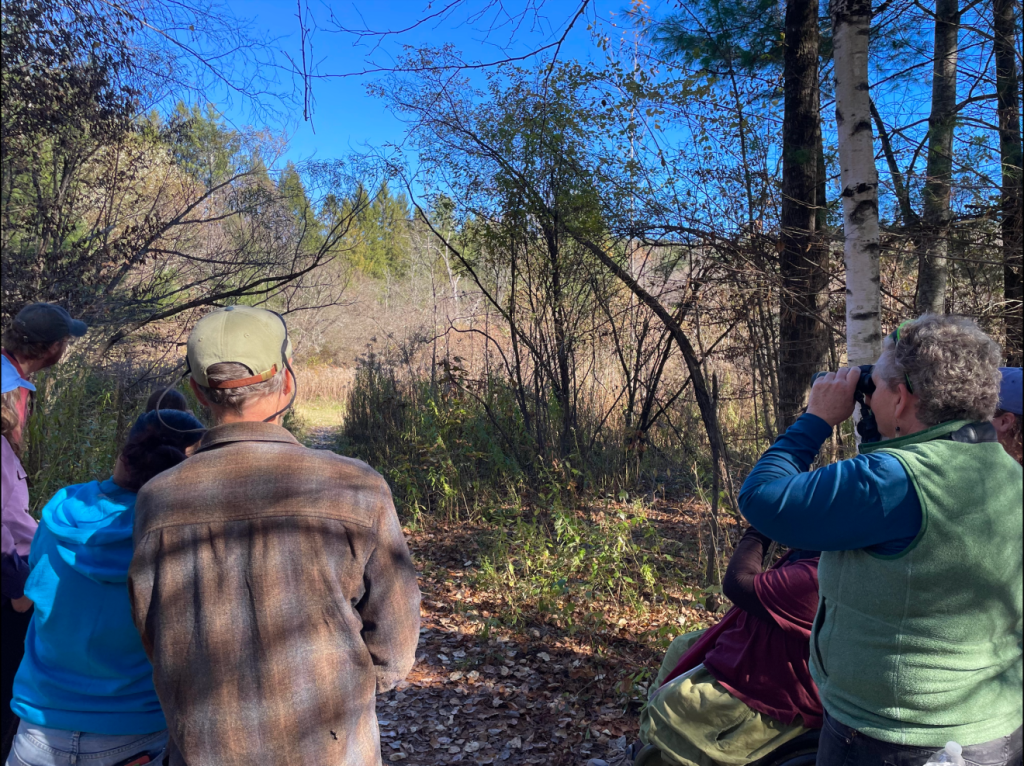
On a recent Saturday afternoon at the North Branch Nature Center in Montpelier, the sounds of the woods were punctuated by a different kind of communication.
Luis Gonzalez, the center’s community engagement coordinator, paused along the Universal Access Trail to ask a group of a dozen birders to identify a call. As the group scanned the trees with binoculars, an American Sign Language interpreter stood nearby, ensuring the exchange was fully accessible to everyone present.
This gathering, held on October 24, was the first event of its kind in Vermont, organized by local birder Nick Parker in partnership with the national nonprofit Birdability.
The push for inclusive birding is about more than just widening paths; it is about dismantling the barriers—both physical and sensory—that have historically kept people with disabilities from engaging with the outdoors. Birdability, the organization behind the effort, works to make nature more welcoming, safe, and accessible for everyone.
For participants like Nick Parker, who is hard of hearing, the event was a personal mission. “I would love to see more hard-of-hearing and deaf people out in birding,” Parker told the Vermont Daily Chronicle.
The Shift Toward Sensory Accessibility
Birding has traditionally been an auditory-heavy hobby, often centered on identifying species by their songs and calls. For the deaf and hard-of-hearing community, this has frequently created an invisible wall. Parker, who started his own life list last year and has already identified 211 species in Vermont, found that his entry into the hobby required a shift in strategy.
He relies on field marks—the visual characteristics of birds—to catalog his sightings. However, the presence of an ASL interpreter during group walks has fundamentally changed his experience, allowing him to catch the nuances and shared observations he previously missed.
Mary Essex, another participant who is deaf, echoed this sentiment. She said that while interpreters do not sign bird calls, they provide the essential bridge that allows her to participate in the social and educational aspects of the walk.
“When the facilitators are talking and giving some education, I learn something myself, and sometimes I even have something to add,” she explained to the Vermont Daily Chronicle. “I don’t want to keep that information to myself, so if there’s an interpreter present, then I can share the knowledge I have as well.”
Physical Infrastructure Remains Critical for Outdoor Inclusion
Beyond sensory access, the event highlighted the critical need for physical infrastructure. Jude Hawthorne, a participant who uses a wheelchair, pointed out that many natural spaces are designed without considering the needs of disabled visitors. “Disabled people are left out of so many spaces because we’re not thought of,” Hawthorne said. “The outdoors is, like, right here, and we’re still left out of it.”
The Universal Access Trail at the North Branch Nature Center—a wide, flat, packed-gravel path—serves as a model for what is possible when design prioritizes inclusion. Similar projects, such as the new trail at the Pratt Refuge in Duxbury that opened this past summer, are beginning to appear across Vermont.
For many, these are not just minor improvements; they are essential gateways to the natural world. As Hawthorne put it, “The extra steps that people do to make it accessible is so massively appreciated. Every little bit can make a big difference for folks.”
Building Community Beyond the Bird List
For Parker, the advocacy goes beyond birding. As an older trans person, he finds that the birding community offers a rare space where he can be entirely himself.
“As an older trans person, this is not a very friendly world to live in right now,” Parker said. “But when I’m birding, I feel more myself. I don’t feel like I’m having to put on a face or a mask for anybody.”
This sense of belonging is perhaps the most important outcome of these inclusive events. While the excitement of spotting a rare species is a thrill, Parker finds more joy in the collective enthusiasm of the group. He is now looking to collaborate with other organizations across the state to expand the reach of these accessible bird walks.
“I try to be the change you want to see in the world,” Parker said. “People are doing fantastic stuff all over the U.S. and the world, so I think I would just love to do more of that.”
Keep reading

North Alabama Conference Celebrates Eighth Summer of QuadW Missional Internship
The North Alabama Conference of The United Methodist Church has wrapped its eighth consecutive summer of the QuadW...

Rent, Buy or Raffle: Ireland’s Housing Lotteries in 2026 – RTÉ.ie
For a generation priced out of the traditional housing market, the dream of homeownership in Ireland is increasingly...

Pine, Fir, Spruce, Even Cottonwood? What’s The Best Firewood To Burn In Wyoming?
In Wyoming, the best firewood is rarely about choosing a specific species for prestige, but rather about sourcing...

Wisconsin Basketball: Braeden Carrington Hospitalized Following Injury in Win Over Coastal Carolina
Wisconsin defeated Coastal Carolina 89-81 at the Kohl Center. The Badgers struggled for much of the first half...