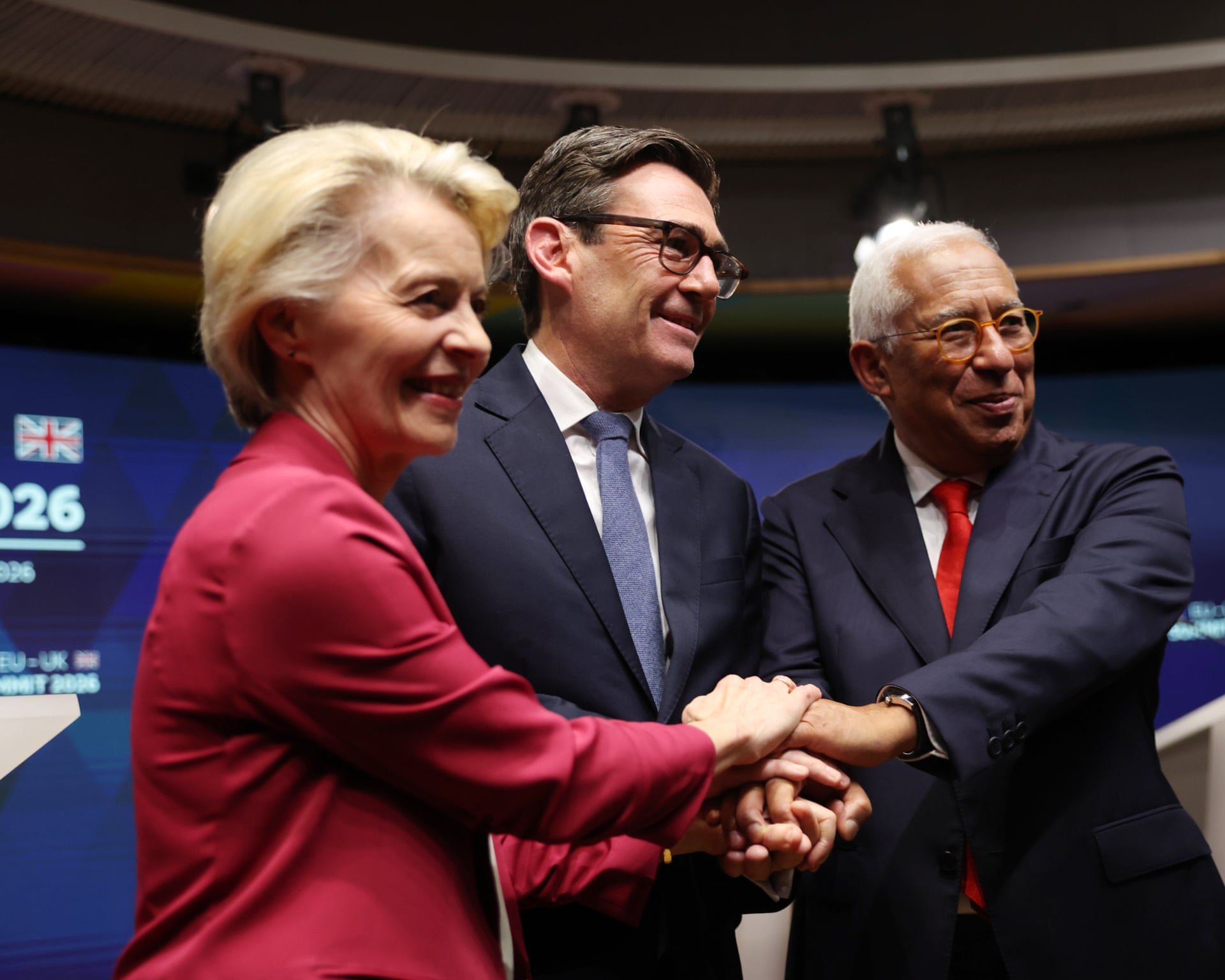
UK Prime Minister Andy Burnham signed a package of agreements with the European Union in Brussels on Friday, calling it a “landmark agreement” that could add up to 0.5% to UK GDP — a £17 billion boost the Treasury says is the largest growth measure available this Parliament.
That is a £17 billion boost to the British economy. The deals cover veterinary checks on food and animal products, a youth mobility scheme, carbon market linkage and a structured dialogue on migration.
European Commission President Ursula von der Leyen described the summit as a “turning point” in relations, while European Council President Antonio Costa said the bloc respects Britain’s decision to leave and its choice to strengthen ties now, DW.com reported.
Youth mobility cap doubled
Britain has provisionally agreed to raise the cap on the youth mobility scheme from the current 50,000–80,000 participants a year to 100,000, allowing more young EU citizens to live and work in the UK, The Independent reported. “Brexit took opportunities from young people,” he said.
Von der Leyen said the project would “open horizons and create friendships that will last a lifetime,” according to DW.com. “That generation can feel finally that people in our positions are directly doing something to recognise that they need more help and that they need more opportunity in their lives,” Burnham said.
The EU and the UK are closest neighbours, reliable allies and natural partners – bound by deep historical ties and shared values. And in an increasingly challenging world, we have both a responsibility and a duty to work together. https://t.co/aq5meSSTGe
Tuition fees dispute delays food deal
Implementation of the veterinary agreement — which would scrap certificates and border checks on food and animal products — is tied to a separate negotiation on university tuition fees for EU students. The EU wants European students to pay the same fees as British students.
Burnham acknowledged the link, saying “there will be further discussions coming out of it on issues including on tuition fees,” DW.com reported. Von der Leyen said negotiators would work on a solution over the next month. RTÉ reported the EU aims to strike a fees deal within six months, which would enable the food agreement to take effect by 1 March 2028.
Domestic politics and the electoral calculus
RTÉ described Burnham as betting that demographic shifts — a shrinking over‑65 cohort that backed Brexit and a younger electorate more open to EU ties — will let Labour win the argument before the next election.
The Guardian’s editorial warned that the reset cannot be the final destination, citing the Swiss precedent where more than 120 bilateral deals eventually forced a new framework negotiation. The Irish Times noted Burnham focused his public remarks on economic gains — lower prices at Marks & Spencer and Morrisons — rather than on partnership rhetoric.

Defence and economic security talks launched
Leaders agreed to open formal talks on economic security, including export controls and supply chains, and to pursue closer cooperation on electric vehicle supply chains, DW.com reported. A structured dialogue on migration was also established, covering engagement with third countries and returns. Leaders said they will establish a “structured dialogue on migration.”
Their joint summit statement said this would include “engagement with third countries” and “returns to third countries,” among other issues. Von der Leyen said the trade agreement is a “two way street” and it means “more choice for the customers.” Burnham told reporters the government would bring forward legislation to Parliament next week if the deal is secured.
More on Andy Burnham
SECURED ✔️Cutting costs ✔️Restoring opportunities for young people ✔️Easing pressure on food prices in the shops A £17 billion boost for the British economy. That’s what we’ve secured at today’s UK EU Summit. Find out more: https://t.co/8A6CvgP3wu pic.twitter.com/296ybmZEwU
The EU-UK agreement reached today is good news for people and businesses on both sides. More young people will be able to work and study across the Channel. They must have the same tuition fees as domestic students. This is just a beginning. The UK and the EU should work closer…
Welcome to Brussels, dear @andyburnham – it is our pleasure to host the second EU-UK Summit. Our progress since the last summit is already helping people and businesses, and today we’ll build on this momentum: ✔️ Making it easier for our young people to live, work and study in… pic.twitter.com/vxOirvKTIp

Six Zodiac Signs Find Relief as Astrological Transits Promise
Two astrological transits promise relief for three zodiac signs on Monday, November 23, 2026, with Jupiter turning direct...
How ASEAN Uses a ‘G-Minus’ Model to Deepen China Ties While Keeping U.S. Market Access”’
Southeast Asia’s trade bloc is deepening ties with China while keeping U.S. market access, defying pressure to choose...

China, Russia, US Hold First Trilateral Summit, Issue Peace Declaration
Leaders of China, Russia and the United States held their first trilateral summit Thursday in Shenzhen, issuing a...

The Associated Press Called the Race for Hubbard on Sunday
Hubbard beat Foxx by 330 votes after a recount, cwibc.co.id reported. The 258-seat total matches Democrats' 1992 high...