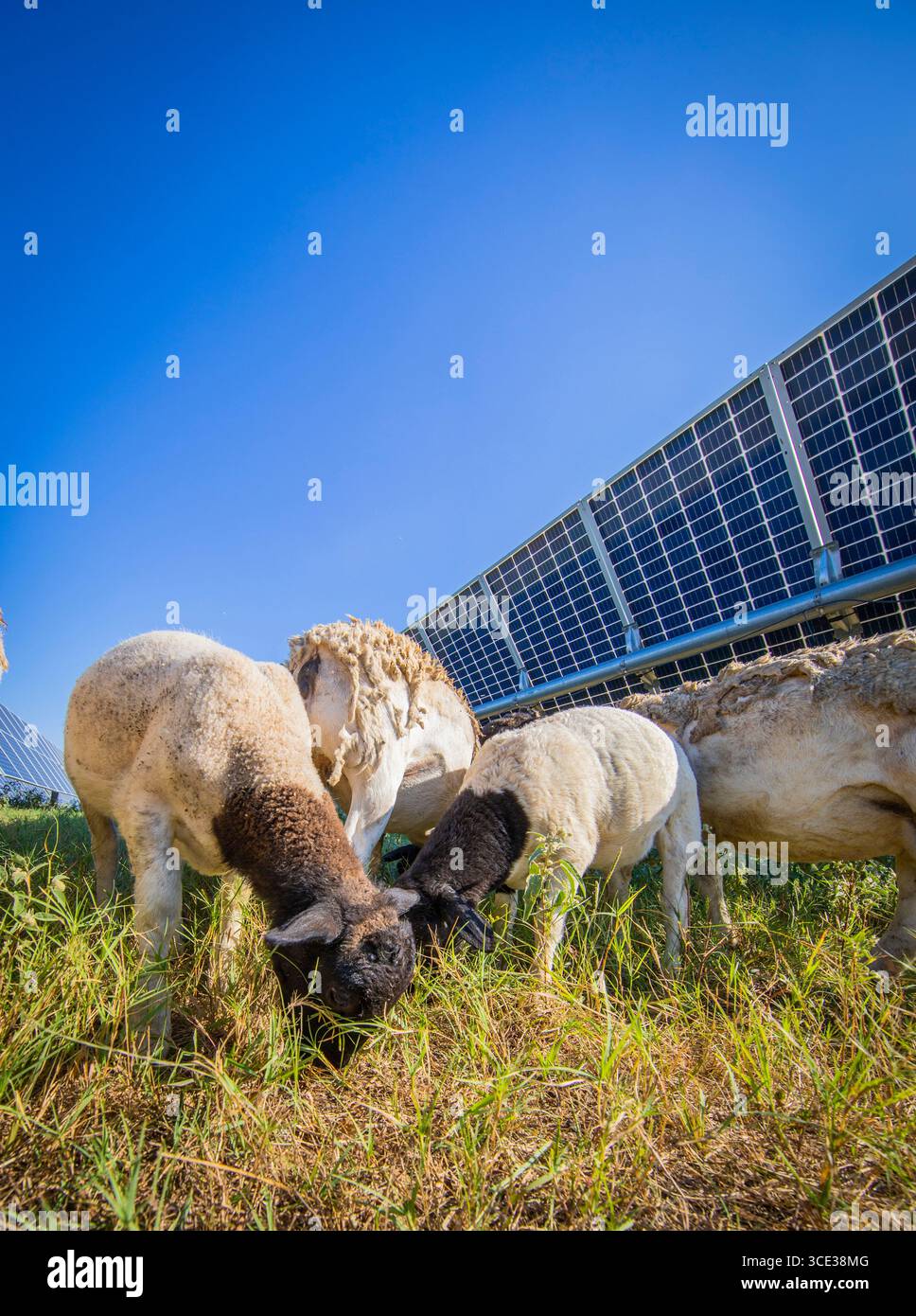
Lansing’s newest utility workers don’t punch a clock — they graze, and they arrived at the Lake Lansing solar site this fall to clear the grass beneath 13,000 panels.
The flock of 125 sheep, subcontracted through Dragonfly Downs Farm in Grand Ledge, began mowing the 6-megawatt array on Lake Lansing Road in Lansing Township recently. It is the first time the Lansing Board of Water and Light has used livestock to manage vegetation at a solar installation.
“It would take a lot of time and fossil fuel to mow this site and now we’ve got mowers here,” BWL CEO Dick Peffley said, speaking over the bleating of Snips, a ram who wandered into the press conference. The utility sees the pilot as a way to cut maintenance costs and curb emissions from gas-powered equipment.
Sheep beat the alternatives on temperament. Goats climb and chew wiring; cows treat racking as scratching posts. Sheep are docile, portable, and — crucially — uninterested in eating electrical infrastructure. “They don’t have a habit of eating wires, which is handy at a utility site,” said Egypt Krohn, owner of Dragonfly Downs Farm.
Krohn’s operation is designed for mobility. A portable electric fence, powered by its own small solar array, contains the flock. Water demand is modest: 20 to 30 gallons a day on the hottest afternoons, hauled in a tank on her truck. “The fence and watering flexibility means her sheep can go just about anywhere, no infrastructure required,” Krohn said.
The site itself carries a redemption arc. Once a gravel pit and disposal ground, the parcel at Lake Lansing Road and Wood Road now hosts the panels, which throw enough shade to shelter the animals until winter forces their return to the farm.
Peffley framed the project as a direct answer to critics who argue solar displaces agriculture. “We came up with this idea to do the exact opposite here,” he said. “This has always been light industrial, now we’re going to use it for agricultural use.”
Context matters for BWL’s broader portfolio. Solar supplies roughly 10 percent of the utility’s generation; natural gas still provides about half.
The Lake Lansing array is small beside the 115-megawatt Whitetail Solar project in Washtenaw County and three other installations in Eaton, Clinton and Shiawassee counties that together deliver between 10 and 80 megawatts each. But its visibility on a busy township border road makes it a daily billboard for the utility’s green transition.
Lake Lansing, a 461-acre lake in Haslett a few miles northeast of the capital, was originally called Pine Lake and drew crowds as a recreation destination in the early 1900s.
The name changed in 1930, but popularity faded until a 1978 dredging restored the lake’s health. A small dam on the northwest side, rebuilt in 1976, regulates outflow to the Pine Lake Outlet Drain under a 2003 court order that sets summer and winter water levels.
The sheep will truck out before the ground freezes. Whether they return next spring depends on the numbers — fuel saved, labor hours avoided, and how neatly the grass stays trimmed. For now, Snips and the flock are the most visible proof that BWL is willing to try something old to make something new work better.
Worth a look
Fifth Circuit Lifts Injunction Blocking Mississippi Age-Verification Law for Nine Major Platforms
A federal appeals court on Thursday refused to keep Mississippi's age-verification law on ice, meaning nine major platforms...

NYC, LA, Chicago Weigh Breaking Up With Google Search Over AI
New York City, Los Angeles and Chicago are weighing a breakup with Google Search after the company told...

Conservation Law Foundation Notifies EPA of Lawsuit Over Great Bay Estuary Pollution
Eelgrass coverage in New Hampshire's Great Bay Estuary has dropped roughly 80% since 2024, a collapse researchers at...

FTX’s $500M Anthropic Stake Now Worth $48B After Direct Listing, Enriching 37 Buyers
Anthropic shares opened Thursday at $111.50, handing a $48 billion paper gain to 37 investor groups that bought...