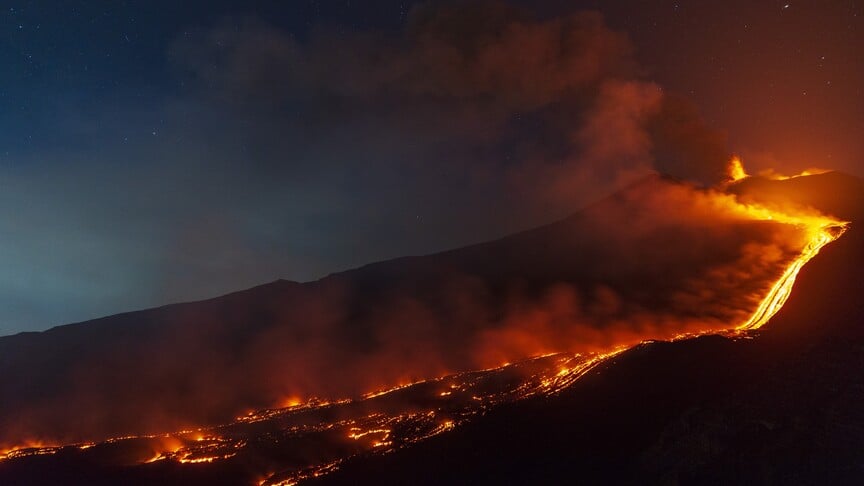
Catania Airport suspended all inbound and outbound flights after Mount Etna erupted, sending a four-kilometer volcanic ash plume into the atmosphere. The eruption prompted a red aviation warning and airspace closures across sector C1, leaving thousands of travelers facing cancellations and diversions.
Volcanic activity from Sicily’s tallest active volcano once again brought regional air traffic to a standstill on Saturday, September 26, 2026. The latest eruption originated from Mount Etna’s northeast crater, propelling an ash cloud approximately 4 kilometers high into the atmosphere, according to measurements cited from Italy’s National Institute of Geophysics and Volcanology (INGV).
Airspace Closures and Flight Suspensions at Fontanarossa Airport
Operations at Catania-Fontanarossa International Airport ground to a halt as the Operational Coordination Unit ordered the closure of airspace sector C1. The restriction enforced a strict zero-landing and zero-takeoff policy across the affected zone.
Before the full suspension took effect, airport authorities had already scaled back traffic capacity to just four landings per hour, down from the normal operating rate of 12. SAC, the company managing the facility, urged travelers to verify their flight statuses directly with airlines before heading to the terminal. According to the airport management company, flight operations were initially halted into the afternoon before being extended further.
Following volcanic activity and weather conditions, inbound and outbound flight operations at Fontanarossa Airport have been suspended until 12:00 PM tomorrow, Sunday, September 27. Passengers are requested to check the status of their flight with their airline before heading to the airport. Updates will follow.
Catania Airport, Official Statement
Widespread Diversions Across Sicilian Airports
Airlines scrambled to reroute incoming aircraft as the ash cloud dispersed southward. At least 10 flights operated by carriers such as ITA Airways were diverted to alternative airports across the island before the airspace was fully locked down. Five flights were redirected to Palermo, three were sent to Trapani, and two landed in Comiso. Additionally, a Volotea service scheduled between Catania and Verona managed to depart from Comiso instead.

The disruption marks another chapter in a turbulent season for Sicily’s aviation sector. Etna’s frequent eruptions have repeatedly forced closures in recent months, most notably during August when peak summer travel was disrupted by multi-day shutdowns. The volcano, which rises 3,324 meters (10,906 feet) and sits roughly 40 kilometers from the airport, remains under constant observation by scientific monitors.
Red Aviation Alerts and Regional Volcanic Monitoring
The Etna Observatory issued a red Volcano Observatory Notice for Aviation (VONA), representing the highest level on the four-point alert scale. Volcanic ash poses severe hazards to aircraft engines and electronic onboard systems, making immediate airspace restrictions necessary whenever winds carry particulate matter across active flight paths.

Related reading

Diplomats Walk Out as Benjamin Netanyahu Addresses UN General Assembly
More than 100 diplomats streamed out of the United Nations General Assembly hall on September 24, 2026, leaving...

Netanyahu Attacks Mayor Zohran Mamdani During UN General Assembly Address
Israeli Prime Minister Benjamin Netanyahu launched a sharp attack on New York City Mayor Zohran Mamdani during his...

African Leaders Demand Permanent UN Security Council Seats With Veto Power
Nigeria’s Vice President Kashim Shettima joined other African leaders at the 81st United Nations General Assembly in New...

Western European Societies Unwilling to Fight Russia Directly
As military tensions rise, Eastern European governments face an increasingly stark contradiction as they manage security guarantees, the...