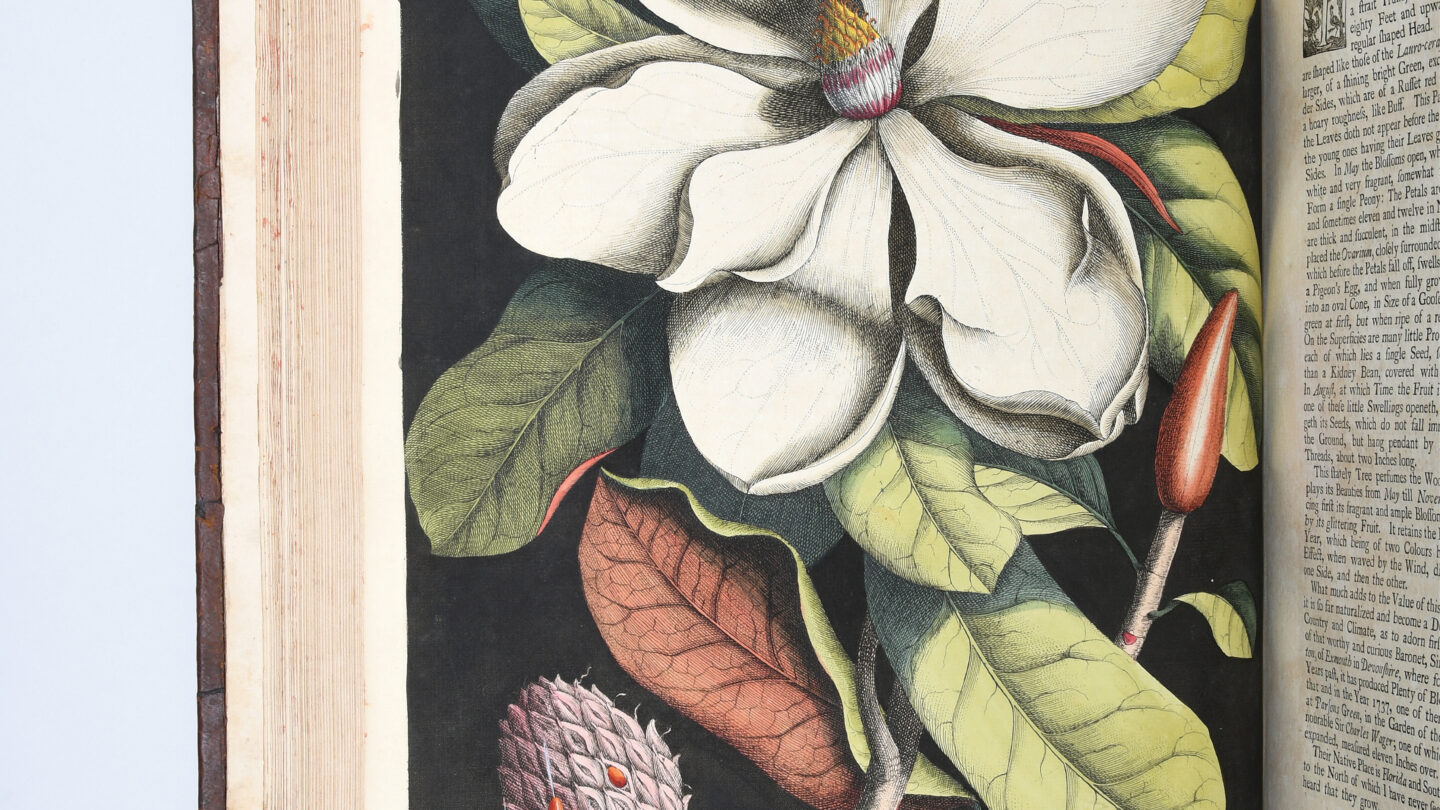
The Cherokee Garden Library at the Atlanta History Center has acquired a 1754 second edition of Mark Catesby’s The Natural History of Carolina, Florida, and the Bahama Islands, a milestone decades in the making for the library’s nationally recognized collection.
The purchase was funded by sponsors and patrons of the Cherokee Garden Library’s 50 Years & Growing event on May 7, 2025.
The acquisition anchors a collection that documents the first comprehensive scientific study of North American flora and fauna. English naturalist and artist Mark Catesby (1683–1749) published his two-volume magnum opus in installments in London between 1729 and 1747, presenting Part 1 to Queen Caroline in May 1729.
After his death in 1749, English naturalist and ornithologist George Edwards oversaw the 1754 second edition to provide for Catesby’s surviving family—his wife Elizabeth and their children. London bookseller Benjamin White published the third edition in 1771.
Catesby’s work remains a foundational scientific source, an early example of ecological awareness, and a critical historical record of lost or endangered species and habitats, including the passenger pigeon and the Ivory-billed Woodpecker. His detailed illustrations and observations demonstrate early recognition of ecological relationships and the impact of human activities on the natural world.
“Mark Catesby’s The Natural History of Carolina, Florida and the Bahama Islands, created during the British colonial era, has significance for multiple reasons. The work is a foundational scientific source, a declaration of exceptional artistry, an early example of ecological awareness, and a critical historical record of lost or endangered species and habitats.”
Catesby’s first American journey began in April 1712 when he arrived in Virginia with his sister, Elizabeth Catesby Cocke. His brother-in-law, Dr. William Cocke, served as personal physician to Lieutenant Governor Alexander Spotswood, granting Catesby access to colonial society. For seven years he focused on Virginia’s flora and fauna, traveling from the lower James River to its source in the Appalachian Mountains and visiting Bermuda and Jamaica.
Connections with William Byrd II and John Custis IV—two of the wealthiest and most powerful men in the Virginia Colony and keen naturalists themselves—proved vital. They recognized the importance of studying flora and fauna to the colony’s economic success. Catesby returned to England in 1719, sending specimens and seeds to contacts there to build his scientific reputation and secure patronage for future expeditions.
His second expedition, between 1722 and 1726, was organized and financed by a group of investors and Fellows of the Royal Society of London, including the influential sponsor Sir Hans Sloane, president of the Royal Society. Catesby arrived in Charleston, South Carolina, in May 1722.
Over four years he traveled hundreds of miles on foot, horseback, and by canoe through the Carolinas, Georgia, and Florida, following rivers to their sources in the Appalachian foothills. Between 1725 and 1726 he visited the Bahama Islands before returning to England in 1726.
Upon his return, Catesby undertook the arduous process of publishing The Natural History. Facing considerable financial hurdles, he managed the entire production himself—etching and coloring the plates and securing subscribers. The final two-volume work was issued in eleven separate parts, each containing twenty plates, a remarkable example of self-published monumental works from the eighteenth century.
Scholars emphasize that Catesby relied heavily on the expertise, labor, and guidance of enslaved Africans and Native Americans during his travels. In early 1723, while in the South Carolina Lowcountry, Catesby fell ill and wrote to his patrons asking for £20 to carry out what he termed a “designe to buy a Negro boy, which I cannot be without.”
The patrons approved the expense, and Catesby bought the enslaved young person in Charleston. This individual accompanied Catesby as a field assistant on his major collecting trip up the Savannah River in March 1723. There is no further mention of this enslaved person in Catesby’s letters and journals after that expedition; historians note the individual’s name and ultimate fate are not recorded in any surviving documents.
“Enslaved African people furthered his studies by sharing valuable information about the flora and fauna of the region. Some scholars highlight that Catesby interviewed enslaved individuals to understand their uses of plants for sustenance and medicine. Additionally, enslaved people had extensive knowledge of the landscape, which helped Catesby navigate challenging terrain.”
Native Americans served as Catesby’s guides and teachers. He interacted with the Muscogee and Cherokee nations, recognizing his debt for their hospitality and assistance as guides and porters, though his descriptions were often dismissive or biased. He did not fully acknowledge Indigenous individuals’ deep ecological knowledge, gained over centuries of experience, though it critically supplemented his European-based botanical understanding.
The Cherokee Garden Library invites researchers to schedule an appointment to view the Catesby volumes and explore related scholarly resources, including works by David Attenborough, Patrick Dean, Henrietta McBurney, E. Charles Nelson, and Stephen A. Harris.
Worth a look

Montana Legislature Splits 50-50 in Cat-Griz Poll of 113 Lawmakers
Montana lawmakers split exactly 50 to 50 between the University of Montana Grizzlies and Montana State University Bobcats...

Greater Manchester Production Fund Backs Seven Projects Including Bentham, Winterbottom Films
Manchester just landed its first £3 million down payment on a plan to become the UK's largest screen...
Seattle Hotel Restaurants Offer Memorable Meals and Scenic Views
Seattle’s hotel restaurants are serving some of the city’s most memorable meals, blending historic dining rooms with waterfront...

Nevada Gov.-Elect Aaron Ford Vows 30-Day Legislative Blitz on Drug Prices, Housing, School Meals
"Those are concrete things that immediately can bring some level of effect to this cost-of-living crisis that we're...