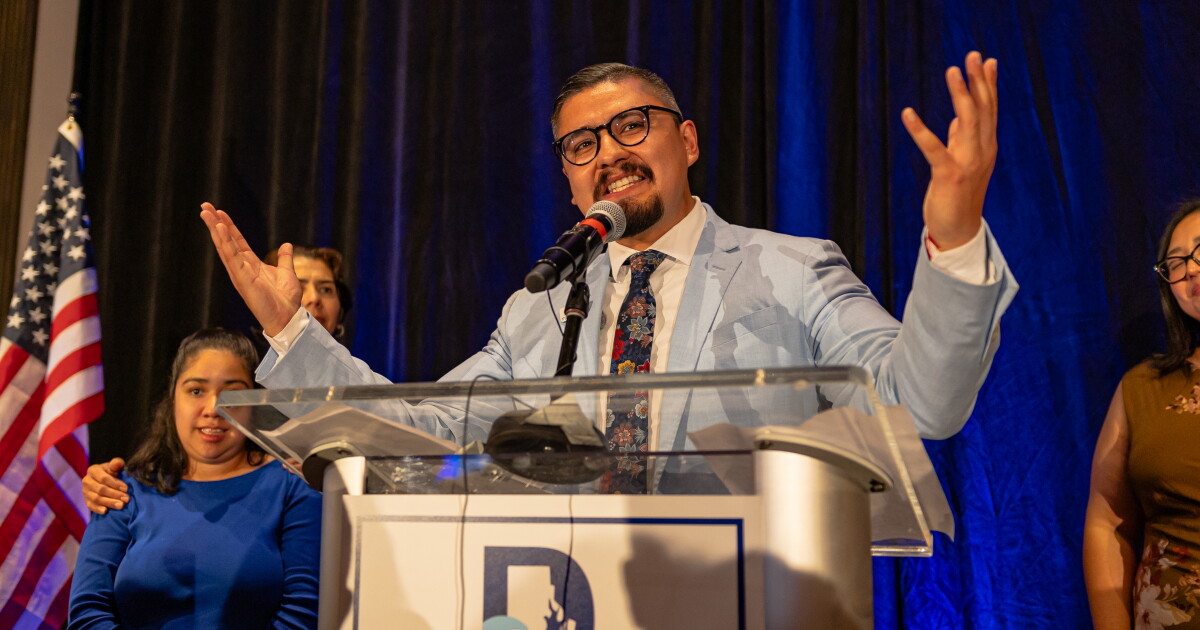
As David Morales stepped up to the microphone to claim victory in Providence’s mayoral race Tuesday night, he spotted a trusted supporter down in the crowd, stage right. The state representative, now mayor-elect, abruptly leaped from the platform as a wrestler springs from the ropes — not to confront anyone, but to embrace a friend. The move was pure Morales: the 28-year-old has moonlighted for years as a championship wrestler, and that physical, unscripted moment captured the energy of a campaign that promised to shake up Rhode Island’s capital city.
Ocean State Media reported that the democratic socialist won more than 80% of the vote against Republican David Talan, a margin that delivered what he called an overwhelming mandate. “Across Rhode Island, and right here in our capital city of Providence, our neighbors voted overwhelmingly for the change that they deserve,” Morales said in his victory speech. As Providence’s 40th mayor, he will be the youngest the city has ever elected, breaking the record held by Joseph Paolino Jr., who took office in 1984 at age 29. At 28, Morales is nearly a full year younger than Paolino was, and six years younger than New York’s Zohran Mamdani, the contemporary mayor with whom he is most often compared.
Thank you, Providence. 🫶🏽 pic.twitter.com/PuCkrMYY84
A Record Built Young
Morales is used to being the youngest in the room. He won his first campaign at 22, shortly after earning his Master of Public Affairs degree at Brown, where he was the youngest graduate in the program’s history. He took office representing District 7, which covers Providence’s Mount Pleasant, Valley, and Elmhurst neighborhoods, becoming the youngest state lawmaker at the statehouse. Even after three terms in that post, he remains the state’s youngest legislator, a status that has followed him from the campaign trail to the victory stage.
Famous for his colorful suits and progressive stance, Morales crafted his legislative achievements around concerns central to working people: increasing the minimum wage, reducing prescription drug prices, providing health coverage to low-income children irrespective of immigration status, and safeguarding tenants’ rights. Those same priorities defined his mayoral run, which he framed as a simple choice about affordable housing. His political mission statement, as he described it, is to take on corporate interests and fight for the needs of working people and families all across Providence.
The First 100 Days: Rent, Cameras, and Divestment
The transition from State House to City Hall comes with immediate, concrete promises. Within the first 100 days of his administration, Morales has vowed to reintroduce the rent stabilization ordinance that his predecessor vetoed. He has vowed to shut down the citywide network of Flock cameras that capture the license plates of every vehicle that drives past. And he strongly backs Question 7, the Providence ballot measure mandating that the city withdraw investments from nations and businesses gaining profits from genocide, apartheid, ethnic cleansing, and extended military occupation.
He will also take over a school system in turmoil, returned to municipal control following a seven-year state takeover. The housing affordability crisis that dominated the primary race remains the most urgent economic pressure facing the city, with rents continuing to climb across Providence neighborhoods.
A Break With Brett Smiley
Morales’s victory represents a sharp break with incumbent Mayor Brett Smiley, who is diametrically opposed on all three of Morales’s signature issues: rent stabilization, the Flock camera system, and Question 7. Following his defeat in a harsh primary contest, Smiley departed from custom and refused to back Morales in the general election, depriving the transition of the usual show of Democratic solidarity.
“As a young person of color, especially someone who was elected to a legislature at the age of 21, I’ve gotten used to having quote-unquote extra scrutiny and layers of scrutiny when it comes to decisions,” Morales said in an interview with Ocean State Media. “For that reason, I’ve always seen it to be a very significant responsibility to not only represent a generation of young people, to represent Latinos, to represent a progressive ideology when it comes to governing. And for that reason, I am prepared to take on that extra scrutiny.”
The Mamdani Connection
Morales’s campaign drew frequent comparisons with Mamdani, another young Democratic Socialist who has championed similar housing and transit policies. Similar to Mamdani, Morales aims to halt the ongoing rise in rents, believes school children should ride buses for free, and wants to construct additional affordable housing. Shortly after Morales clinched the Democratic primary, the two men connected by phone for the first time to discuss the importance of delivering for neighbors when it comes time to govern, including the critical transition period.
Morales has also spoken with three out of Rhode Island’s four members of Congress and with governor-elect Helena Foulkes, all focusing on the transition and housing needs. When asked how prepared he is to move from rebel backbencher to the city’s most prominent advocate, Morales quoted the saying about living long enough to see yourself become the villain. “No,” he said with a chuckle. “Our neighbors are tired of the status quo; they want to see change. To take on corporate interests and fight for the needs of working families across Providence. And that’s what I’m prepared to do.”
The mandate is clear, the record is young, and the challenges — from rent prices to school funding to surveillance technology — are already waiting at City Hall when he takes office.
Keep reading
Esther Elia’s ‘Diasporic Deities’ Redefine Assyrian Art in Santa Fe Exhibition
Ancient Guardians, Modern Homes: Esther Elia's Diasporic Deities Arrive in Santa Fe Across ancient Mesopotamia, lamassu figures assumed...

Millions in excess aid, millions in missed savings and employees who never passed background
"Millions in excess aid, millions in missed savings and employees who never passed background checks, and Newark calls...

Democrats secure NH’s 1st, 2nd congressional seats: Shaheen, Goodlander win Tuesday night – NHPR
Democrats held both of New Hampshire's congressional seats on Tuesday night, with Stefany Shaheen and incumbent Maggie Goodlander...

Melanie Johnson Claims 1st NHRA Lucas Oil Drag Racing Victory
Melanie Johnson captured her first career NHRA national event victory at Las Vegas, a breakthrough her team had...