
Roughly 35,000 North Korean defectors live in South Korea, where the law instantly welcomes them as citizens.
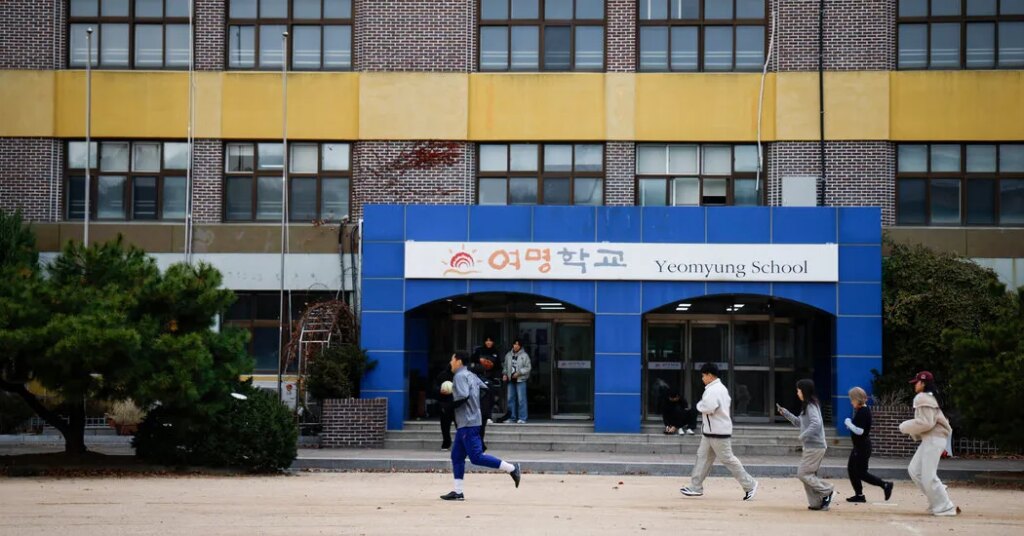
- Yeomyung School in Seoul serves about 100 middle and high school students who are teenage defectors or children of defectors.
- A survey conducted by Seoul National University found that fewer than 30% of South Koreans felt friendly toward defectors.
Inside Yeomyung School
Life at Yeomyung, one of five alternative schools of its kind in South Korea, appears unremarkable on the surface. Students practice the cello and harmonica, line up for lunch with plates in hand, and start their morning assembly by singing the national anthem. Yet students carry heavy psychological burdens from their journeys to the south.
During art therapy sessions, students have painted scenes of people hanged or shot by firing squads in North Korea. Another drawing depicted orphans huddling around a table where North Korean police officers ate, waiting for scraps to fall. A medical checkup showed that more than half of the roughly 100 students required dental implants.
They bear the pains of North Korean refugees.
Cho Myung Sook, principal
Daily Prejudice and Isolation
Despite legal citizenship, many defectors encounter prejudice at the bottom of the social ladder. Students report being singled out in regular classrooms. Kang Il-kwon, a 17-year-old student who arrived in the south as a toddler, recalled how his former classmates tested his loyalties by daring him to insult the North’s leader, Kim Jong Un.
Other students faced similar alienation in regular schools. Han, a student who asked to be identified only by her last name, recalled being rejected for a job because of her North Korean background. Il-kwon described the environment at his previous schools by saying “It’s unpleasant,” explaining why he later enrolled at Yeomyung. After crossing the border, youths also struggled with lessons and were taunted with derogatory slurs by peers.
The Campus Building Dispute
The school occupies a former primary school building that closed in 2020 due to falling enrollment.
At a town hall meeting in September, protesters shouted demands for the school to go elsewhere. Winnie Lee, a neighborhood resident for 45 years, said officials had promised to turn the closed school into a preschool facility to attract young families rather than a sanctuary for defectors. Authorities said most of the site would still serve the promised preschool center.
Confronting Local Resistance
When the institution announced plans to build its own permanent facility at its current rented site, local residents pushed back. NPR reported that protesters at a community briefing chanted opposition slogans, arguing that the land should be prioritized for their own children rather than defectors.
Neighborhood pushback was not an isolated incident. The school had been forced to withdraw a construction plan in 2019 within a different district due to similar local objections.
Public Attitudes Toward Defectors
Researchers say public support for newcomers remains theoretical rather than practical.
NPR reported that close to 35,000 people from the northern state reside in South Korea. After decades living under separate systems, many find that crossing the border does not automatically mean fitting in.
Societal Tensions
Local resistance reflects weariness among younger voters concerning the north’s nuclear threat, unemployment, and the rising cost of living. Kim Young-ho, a researcher at Seoul National University, said public sentiment is warmer when citizens focus on unification, but cools when defectors become immediate neighbors.
Ahn Ji-hyun, a local resident, expressed concerns from across the street, saying that North Korea remains unpredictable and questioning how people raised under brainwashing education could be safe.
Cho Myung Sook is the principal of Yeomyung School, having first encountered North Korean defectors as an activist in China in the late 1990s. Over a 10-year leadership history with the institution, she has navigated critical obstacles, including helping secure its status as the first state-accredited school for North Korean youth when the Seoul Metropolitan Office of Education recognized its high school curriculum in 2010.
Despite local backlash, students at the school look toward the future. Heo Seong-hun, a 14-year-old student who arrived at Yeomyung last year after struggling to make friends across three different primary schools, described the transformation he experienced. “I feel loved and changed here,” Seong-hun said while holding a piece of paper, adding that he now dreams of becoming a teacher to support his mother.

Rui Takahashi Comes Out as Gay, Breaking a Japanese Taboo
Japanese volleyball player Rui Takahashi came out as gay Friday, joining the few professional athletes in the country...

Kenya Court Orders Disclosure for US-Backed Ebola Facility
Kenya's High Court halted construction of a U.S.-backed Ebola quarantine facility at Laikipia Air Base on Thursday, ruling...

EU Leaders Test Budget Deal Hopes at Summit With Digital Tax Dispute
European Union leaders gathered in Brussels on Thursday for a two-day summit aimed at bridging deep divisions over...

Bardella, Le Monde publish antisemitic messages, claims denial
the far-right leader shows his hatred of Jews and his allegiance to far-right ideologist Alain Soral, said Le...