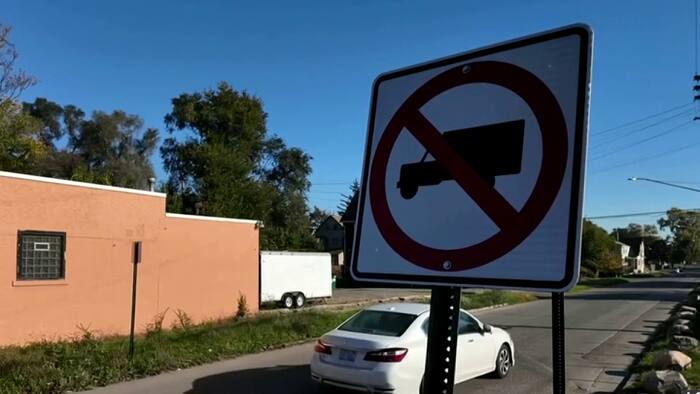
A brisk autumn morning in southwest Detroit, and the sound of birds chirping finally has a chance to be heard. People use the outdoor fitness equipment at Clark Park, walking laps without the constant rumble of 18-wheelers. This quiet, residents say, is a direct result of a city experiment that is fundamentally changing their streets.
Since October 2025, Detroit’s District 6 has been enforcing restrictions on heavy truck traffic, a move ClickOnDetroit reported has already led to hundreds of stops and violations. The city’s goal is clear: to push commercial trucks off neighborhood roads and onto designated routes, protecting residents from noise, pollution, and the constant threat of collisions.
Numbers Tell the Story of a Quieter Neighborhood
The impact is not just anecdotal; it’s measurable. According to the Detroit Police Department, the traffic enforcement unit has made 190 stops of commercial motor vehicles, issued 381 ordinance violations, and inspected 57 commercial vehicles since September. Enforcement, which followed a multi-month education period for drivers, officially began in July.
The restrictions themselves are specific. They prohibit truck traffic on several key stretches of road, including Livernois, Dragoon, Clark, Scotten, and West Grand Boulevard, as well as most residential streets. Trucks are funneled onto designated routes like Fort Street, Michigan Avenue, John Kronk, Dix, and the I-75 service drive. Limited access is still permitted for local deliveries, ensuring businesses aren’t completely cut off.
A Resident’s Perspective: From Constant Rumble to the Occasional Roll
“I’ve had conversations around trucks in this very same park years ago,” said Councilmember Gabriela Santiago-Romero, who represents District 6. “I’m telling you, if we were back then, you would have already seen three to five semi-trucks pass behind me.”
The new policy, she stated, has led to a “drastic reduction here in the neighborhoods of trucks.”
Mitch Batchelder, who lives on Clark Street, saw the semitrucks passing his home day and night. He says there has been “a lot less trucks,” a change he certainly welcomes. Yet, he’s quick to point out the work isn’t finished. Some trucks still appear to use restricted streets, and he believes continued driver education is just as important as enforcement.
Taneil Brock agrees with the overall direction of the policy but notes a lingering concern. While truck traffic has lessened, she said it can still feel dangerous when large trucks pass parked cars on narrower streets. Her support for the policy is firm—trucks belong on major arteries, not residential blocks—but the human factor remains.
The Economic and Logistical Tightrope
The city has been careful to frame this as a quality-of-life issue, not an anti-business one. The rules are designed to discourage cut-through traffic while maintaining access to businesses and freight facilities on the approved routes.
Santiago-Romero has indicated she wants to explore additional routes, specifically around Lonyo Street near Romanowski Park and in ZIP code 48217. The planning in that area is expected to be more complex, however, because it involves a web of city, county, and state roads, requiring coordination beyond the city’s direct control.
The success in District 6 is also being eyed elsewhere. Councilmember Santiago-Romero noted that other Detroit districts are now gathering resident feedback, hoping to launch similar truck traffic studies of their own.
What’s Next and How to Get Involved
The city’s experiment is ongoing. The initial data shows a clear reduction in truck traffic, but the policy’s long-term success will depend on consistent enforcement and community vigilance.
Anyone who sees a truck parked for long periods, idling unnecessarily, or traveling on a restricted route can report it through the city’s official online portal. This direct line of communication allows for real-time data collection and helps enforcement officers target problem areas.
Related reading

CSU breaks ground on Pezold Center for Emergent Technology
A $22.2 Million Bet on the Future: Columbus State Breaks Ground on Pezold Center Calling it a “transformative...

House of Scordatura performs long Feldman quartet on election day
A 6-Hour Stillness in a Roaring Nation As the midterm election results trickled in, a stark contrast emerged...

NHL Unites Pride Cup Set for 2027 All-Star Weekend
The fourth annual NHL Unites Pride Cup will occur during the 2027 Honda NHL All-Star Weekend, with games...

NJ REAL ID Appointment Wait Times Plunge From 73 Days to Three
New Jersey's REAL ID Wait Times Plummet from 73 Days to Just Three Imagine you needed a government...