Astronomers warn that measuring the rotation of distant exoplanets often captures atmospheric winds rather than a planet’s true spin. A new paper by University of California, Riverside astrophysicist Stephen Kane highlights the risk of miscalculating alien climates, as the European Space Agency prepares to launch the PLATO mission in March 2027.
Planetary rotation is often treated as a mere footnote in astronomy, but it dictates how a star’s heat distributes across a world and shapes its weather systems. For planets orbiting other stars, astronomers cannot simply watch a solid surface turn. Instead, they rely on visible changes in the atmosphere, a method that risks confusing wind speed with planetary spin.
Venus as the Ultimate Cautionary Tale
The root of the problem lies right next door in our own solar system. Venus takes 243 Earth days to complete a single rotation on its axis, ranking among the slowest spins in the solar system. Yet its upper atmosphere races around the planet in approximately four days, a phenomenon known as superrotation that makes the clouds appear to circle the globe roughly 60 times faster than the solid world beneath.
That discrepancy creates a massive hazard for climate modeling. According to the reporting, getting the rotation rate wrong means every climate model built on top of that figure inherits a foundational error.
“If you just look at the atmosphere of a planet like Venus, you’d think it rotates once every four days, and you’d be wrong by almost two orders of magnitude.”
Stephen Kane, planetary astrophysicist at the University of California, Riverside
Probing Deeper Atmospheric Layers
The issue, however, is not insurmountable. To solve the problem, researchers propose observing target worlds across multiple wavelengths. Infrared observations, for instance, allow scientists to probe deeper into the atmosphere where wind speeds drop significantly closer to the surface.
By stacking measurements taken at various depths, researchers can reconstruct changing wind patterns and strip away atmospheric noise to estimate the true rotation rate of the underlying planet. This multi-wavelength approach provides a reliable fix for a measurement trap that has long complicated exoplanet characterization.
The European Space Agency PLATO Mission
This methodological fix arrives just in time for a major expansion in exoplanet discovery. The European Space Agency scheduled the PLATO mission to launch in March 2027. Equipped with 26 ultra-sensitive cameras, the spacecraft will monitor a large portion of the sky to detect the tiny dimming of starlight as planets cross in front of their host stars.
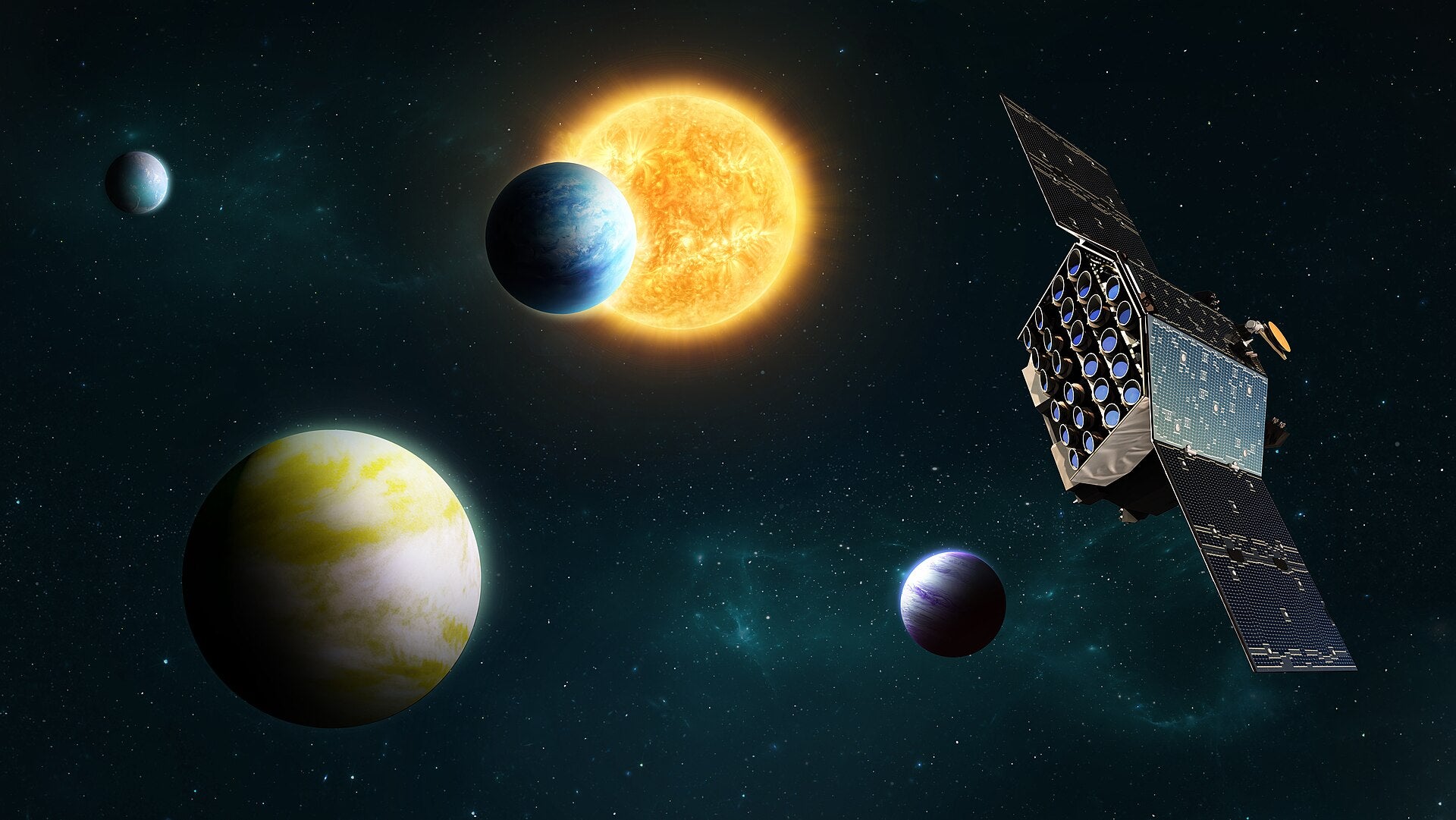
Unlike previous short-term transit missions, the PLATO mission will spend years observing specific regions, making it uniquely sensitive to worlds with longer orbital periods. Many of these newly detected bodies will also orbit relatively bright stars, turning them into ideal candidates for atmospheric follow-up observations using instruments such as the James Webb Space Telescope.
Unlocking the History of Exo-Venuses
In a companion paper published in the Publications of the Astronomical Society of the Pacific, Stephen Kane and doctoral student Emma Miles predict that the PLATO mission will discover several hundred Venus-like planets. This windfall will give researchers a proper population to study rather than a single, isolated data point.
“Exo-Venus candidates, which are Venus-like planets in other solar systems, are going to play a huge role in filling in that knowledge gap.”
Emma Miles, doctoral student at the University of California, Riverside
Comparing this new population of exoplanets against our local neighbor could finally resolve a decades-old puzzle: why Venus evolved into a crushing greenhouse hellscape while Earth retained its oceans and temperate skies. Furthermore, Miles pointed out that PLATO will measure the ages of host stars, allowing researchers to determine where individual exo-Venuses sit within their evolutionary timelines and better map the boundaries of planetary habitability.
Related reading

Brentford Canal Polluted With Dead Animals And Sewage Amid Cleanup Efforts
Dead animals, including a pet cat, have been discovered in stagnant water along a Brentford canal amid growing...

Super El Niño Projected to Cause 451,000 Excess Heat Deaths Worldwide
A developing super El Niño in the Pacific is projected to cause 451,000 excess heat deaths worldwide by...

Scientists Use Mount Vesuvius Eruption to Recalibrate Argon-Argon Dating
Researchers have recalibrated argon-argon dating using historical records from the 79 C.E. eruption of Mount Vesuvius, achieving 0.7...
New Iron Minerals Could Hold Primordial Water at Earth’s Core-Mantle Boundary
Newly discovered iron oxyhydroxide minerals stable at core-mantle boundary conditions could hold up to 15% water by weight,...