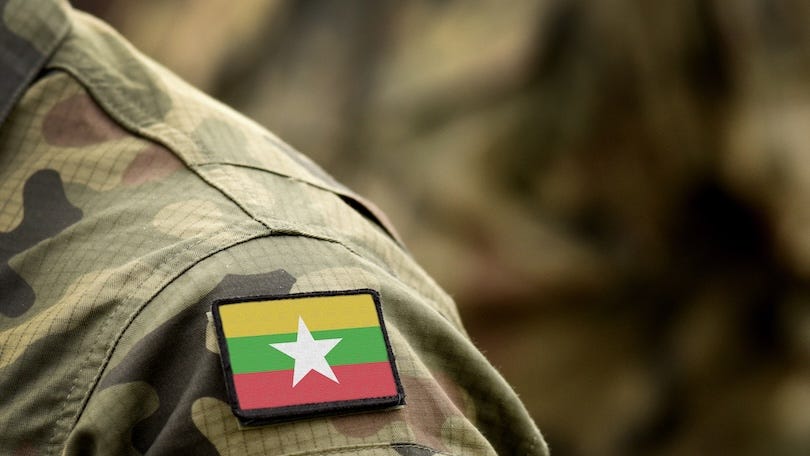
The Myanmar Junta’s Five-Year Survival Strategy
For more than half a decade, the military junta led by General Min Aung Hlaing has maintained its grip on Myanmar, surviving a multifaceted insurgency by leveraging a deepening network of authoritarian alliances.
While the “Spring Revolution” once threatened to dismantle the military’s control, the conflict has settled into a grinding, decentralized war of attrition. According to E-International Relations, this resilience is largely fueled by the emergence of a “neo-authoritarian bloc,” a collaborative network of states including Russia, China, and Belarus that have provided the diplomatic and material lifelines necessary to counteract Western isolation.
The conflict traces its origins to the February 1, 2021, coup, which triggered a nationwide non-violent protest movement before escalating into an armed struggle. The opposition, centered around the National Unity Government (NUG) and its armed wing, the People’s Defence Forces (PDF), initially gained territory.
However, the military’s recovery since 2024 has been stark. By re-introducing general conscription, the junta added more than 100,000 recruits to its ranks, stabilizing a front that had previously crumbled under the weight of Operation 1027.
The Material Cost of Isolation
The disparity in resources remains the most significant hurdle for the anti-junta coalition. An NUG spokesman based in Prague told E-International Relations: “If we received even five per cent of the weapons and equipment that Ukraine had received, we would have already won this war.” This lack of external military support has forced the PDF to rely on 3D-printed weaponry, black-market acquisitions, and salvaged arms.
The following table outlines how international support and military pressure have changed since the coup:
| Factor | Status/Impact |
|---|---|
| Russian Military Support | Over $400 million in arms, including aircraft and drones. |
| Internally Displaced Persons | Over 3 million civilians. |
| Junta Territorial Control | Less than half of the country. |
The junta’s survival is not merely a product of internal repression but of a strategic pivot toward non-Western partners. In February 2026, Russia and Myanmar formalized this relationship by signing a five-year military pact. This agreement, which follows years of Russian-sponsored economic projects such as the Dawei Special Economic Zone, provides the junta with a degree of international legitimacy that has rendered ASEAN’s regional diplomatic efforts largely ineffective.
A Fragmented Opposition
While the junta faces a unified front in rhetoric, the reality on the ground is more complex. Analysts describe the armed opposition as a “mosaic of rebel groups” rather than a singular, cohesive alliance. Some Ethnic Armed Organizations (EAOs) have been fighting the central government since the late 1940s and harbor long-term goals of independence that may conflict with the NUG’s vision for a post-junta state.
These internal divisions, coupled with a decline in Western humanitarian funding, have hampered the rebellion’s momentum. USAID ceased funding for civil society organizations challenging the junta in 2025, and both the British and Swedish governments have since reduced their contributions.
This withdrawal of support has left the NUG to rely on unconventional methods, such as the creation of the Spring Development Bank and the use of Starlink technology, to maintain operations in the face of the junta’s “Golden Firewall.”
The Global Ripple Effect
For the American public, the situation in Myanmar represents a microcosm of the broader shift toward multipolarity. As the junta continues to label the PDF and EAOs as terrorists while lobbying in Washington D.C., the conflict highlights the limits of Western influence in Southeast Asia.
The junta’s ability to withstand international pressure demonstrates the efficacy of the “neo-authoritarian bloc” in shielding members from the consequences of human rights violations.
Despite these gains, the junta’s control remains precarious. They have lost possession of vital trade routes and remain excluded from the governance of vast swathes of the country.
With the junta now entrenched through the sham elections of late 2025 and early 2026, the prospect of a negotiated settlement appears increasingly distant. The war continues to displace millions, while the international community remains divided, distracted by conflicts in Ukraine and the Middle East.
As the PDF is forced into increasingly remote and mountainous terrain, the future of the Spring Revolution rests on its ability to survive without the military aid it has requested for over five years. The conflict in Myanmar has evolved from a domestic protest movement into a test case for how authoritarian regimes can sustain power in an era of diminished Western intervention.
Worth a look

Thousands Protest in Ireland Demanding Moratorium on Data Centre Expansion
Thousands March in Dublin Against Data Centre Expansion Thousands of demonstrators converged on Dublin’s Parnell Square on Saturday...
IPPF FGM/C Provider Training Consultancy 2026: Apply Now
The International Planned Parenthood Federation (IPPF) is searching for a specialized consultant to develop comprehensive training materials aimed...

Six Killed in Krakow Mass Shooting Linked to Far-Right Ideology
Poland Declares National Mourning Following Krakow Market Square Attack Poland has entered a period of two days of...
Southeast Asian wildlife species face extinction Risks from habitat loss
Southeast Asian Wildlife Faces Extinction Risks The dense forests, sprawling river systems, and isolated islands of Southeast Asia...