
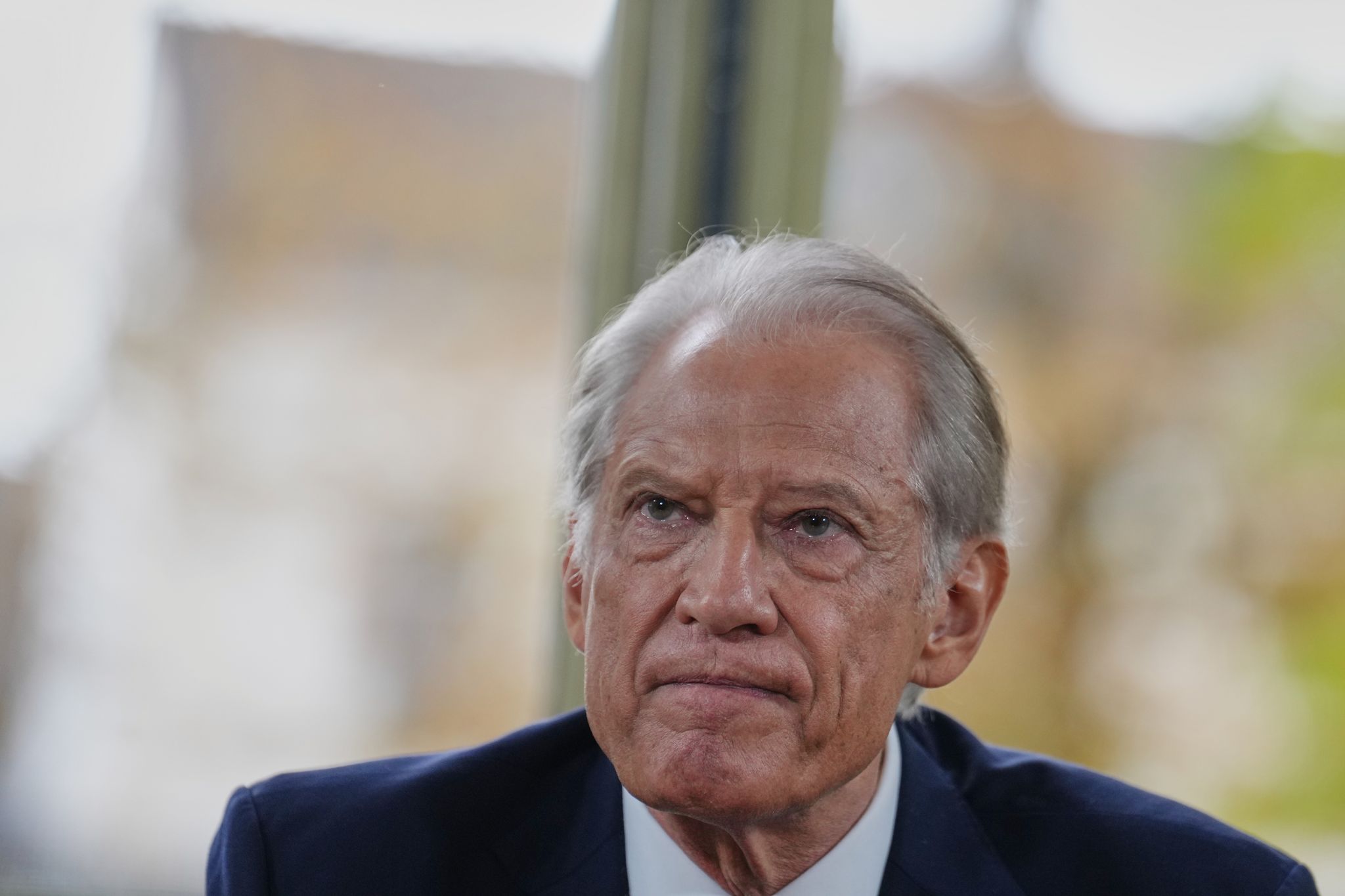
Former French Prime Minister Dominique de Villepin declared his candidacy for the 2027 presidential election on Friday, entering a fragmented race at 2 percent in polls while Marine Le Pen leads the field.
The 73-year-old Gaullist, best known internationally for his 2003 United Nations speech opposing the Iraq war, launched his bid at a Paris press conference framed as a “fight for the Republic” against what he called the “decay” driven by Le Pen’s National Rally, Emmanuel Macron’s centrists, and Jean-Luc Mélenchon’s France Unbowed.
“I am a candidate in the 2027 presidential election,” he declared, describing the decision as a “heavy, difficult decision” taken in full awareness of the “burden” awaiting the next president. He said he was standing to lead “the fight for the Republic”.
De Villepin’s entry complicates an already splintered center-right. Édouard Philippe polls at 15 percent while Nice David Lisnard has risen to 12 percent, according to Ifop and YouGov scenarios.
Le Pen remains the frontrunner, potentially advancing to the May 2 runoff as the first-round leader for the first time, a scenario de Villepin warned would not unfold peacefully. “Who can seriously believe that Marine Le Pen’s planned election next May would unfold peacefully?” he asked.

He drew a sharp distinction between the far right and the hard left, insisting Le Pen’s party carries a “legacy of xenophobia, racism and antisemitism” while also condemning Macron as a “ghost president” whose failures strengthened both extremes.
He named his adversaries: the National Rally and its “legacy” of racism and antisemitism, the Macronists who have “turned the French against one another” and France Unbowed with its “taste for constant division”. In his view, they are all responsible for the country’s “decay”.
De Villepin pledged to reduce France’s public deficit below 3 percent of GDP by 2031 from over 5 percent now, advocating a stricter fiscal approach alongside a restored wealth tax to ensure “the burden of economic adjustment is shared more evenly.” He proposed abandoning the “hyper-president” model embodied by Macron to restore the head of state’s role as “an arbiter, a guide for the country” as envisioned by Charles de Gaulle.
His movement, Humanist France, founded in June 2025, has secured pledges from 300 mayors toward the 500 signatures required for ballot access — a hurdle that blocked his 2012 bid. Campaign posters released Friday bear no image of the candidate, only the slogan: “what if we loved each other again?”
The first round is scheduled for April 18, 2027, with a runoff on May 2 if needed. On the center-left, former President François Hollande is weighing a run that would compete with MEP Raphaël Glucksmann, currently polling near 11 percent; Hollande has said he may wait until February to decide.
Born in Rabat, Morocco, in 1953, Dominique de Villepin spent part of his childhood in Venezuela and the United States, graduating from the Lycée Français de New York in 1971. He entered the diplomatic corps after attending the École nationale d’administration, serving in Washington, New Delhi, and as the Foreign Ministry’s top adviser on Africa before joining Jacques Chirac’s inner circle.
De Villepin has never been elected to office, serving instead as Jacques Chirac’s chief strategist, foreign minister, and prime minister from 2005 to 2007. His recent criticism of Israel’s Gaza campaign has drawn younger, left-leaning voters, though his support remains between 1 and 3 percent.

Taylor Swift Laughs at CMA Hosts’ Joke About Her Wedding
Taylor Swift returned to the CMA Awards stage on November 18 after a 13-year absence, performing a medley...

Pontins Owner Fined £1m Over Grandmother’s Death in Ceiling Collapse
Britannia Jinky Jersey, the parent company of Pontins, was fined £1 million on Friday after a grandmother died...
White House Installs Davies as Acting Cyber Director After Outages Force Cairncross Out
“Our opportunity is to dominate the cyber landscape for generations to come … but only if we modernize...
Burnham Announces EU Deals on Veterinary, Carbon, Youth Mobility
"This is a good day for Britain, and this is a good day for Europe," Prime Minister Andy...