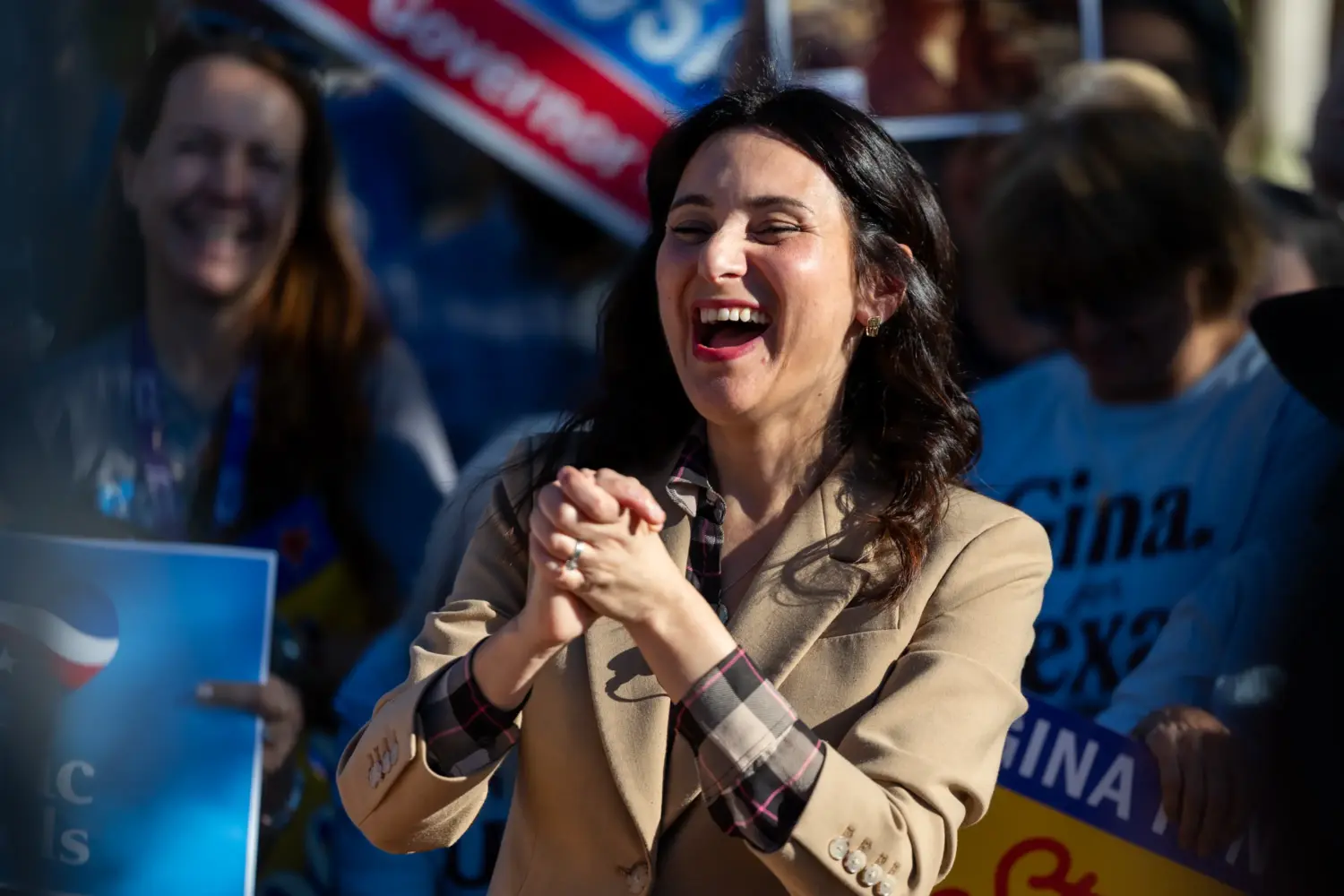
Gina Hinojosa defeated Gov. Greg Abbott in the Texas governor’s race Tuesday night, capturing nearly 53% of the vote in a stunning outcome that ends three decades of Republican control of the governor’s office and makes her the first Latina to ever lead the state, Houston Public Media reported.
The Associated Press called the race for Hinojosa at 10:17 p.m. Tuesday. By 7:15 a.m. Wednesday, with about 5,200 of 5,300 polling places reporting results, the Texas Secretary of State confirmed she held the commanding lead. It marks the first time Democrats have controlled the governor’s mansion since Ann Richards left office in 1995, and it denies Abbott a fourth term after 12 years in office.
Hinojosa Takes 53% as Abbott Concedes
Abbott, first elected in 2014, acknowledged the loss in a concession speech, telling supporters that “there are still votes to be counted, but mathematically, we are not going to be able to win this election.” He will leave office in January after a governorship marked by conservative policies on immigration, abortion, education and border security.
“It has been the joy of my life to have the opportunity to be the governor of the great state of Texas,” Abbott said.

Hinojosa, an Austin state representative who built her campaign around public education, household costs and criticism of the state’s Republican leadership, declared victory with a message aimed at voters who felt ignored by decades of GOP rule. “Here’s what Texas said today, loud and clear: Your government belongs to you,” she said in her victory speech. “As your governor, I will never forget it.”
Three Decades Since Ann Richards
The victory gives Democrats control of the governor’s office for the first time in more than 30 years. David Crockett, a political science professor at Trinity University, said before the election that a Hinojosa victory “would be perceived as an earthquake” because of Republicans’ decades-long dominance in statewide elections.
But Crockett cautioned that a single election would not necessarily signal a lasting partisan shift. Democrats would need to demonstrate they could govern effectively and defend their gains in future elections. “Can you get reelected or is this a one-off?” Crockett said, describing the challenge a Democratic governor could face.
School Vouchers Divided the Candidates
Education served as the central dividing line between the candidates. Hinojosa, a former Austin school board president, opposes the private-school voucher program that Abbott championed and that the Legislature created in 2025. The initiative lets families apply public money toward private schooling costs, and $1 billion has been set aside for the 2026-27 budget period.
Hinojosa also opposes state takeovers of local school districts. She has vowed to swap out Education Commissioner Mike Morath for an educator, boost public school funding, and revamp the state’s testing and accountability framework. Meanwhile, Abbott enacted an $8.5 billion public-school funding bill in 2025, which contained $4.2 billion for raises for teachers and staff, plus money for special education, early learning and school safety.
Both candidates also focused on lowering household costs, particularly property taxes. Abbott suggested doing away with school district property taxes for homeowners via a constitutional amendment and restricting property appraisal hikes, but removing those taxes would mean finding another major revenue stream for public schools. Hinojosa suggested slashing corporate subsidies to pay for property tax relief, as well as issuing one-time $1,500 checks to Texas households from the state’s Rainy Day Fund.
A Republican Legislature Awaits
How much of her agenda Hinojosa can accomplish will depend on the makeup of the Texas Legislature, which remains under Republican control. As governor, she will have the power to sign or veto legislation and appoint leaders of state agencies. According to Crockett, a Democratic governor could employ vetoes to stop legislation and appointments, thereby shaping how state policies are implemented.
However, significant changes to public school funding, property taxes and the state’s voucher program would need legislative approval. “Getting any meaningful legislation through is going to require them to find something they can agree on and that’s not going to be easy,” Crockett said. He identified public school funding as a potential area for compromise, though Hinojosa’s stance against vouchers might cause tension with Republican lawmakers who back the program.

National Winds Blew Through Texas
Hinojosa’s victory came as Democrats made gains in other major Texas races, including the U.S. Senate contest where James Talarico defeated Republican Attorney General Ken Paxton. Nancy Sims, a political science lecturer at the University of Houston, stated prior to the election that the national political climate could affect the governor’s race even without President Donald Trump on the ballot. “If Democrats win in Texas in 2026, it will be because of anger at the federal government and at Donald Trump,” Sims said. Sims added that Democrats who won would need to address voters’ concerns about the economy and public education.
Hinojosa will be sworn in during January as Texas’s first Democratic governor in over three decades. Her next task will be converting a historic election win into a governing agenda — and figuring out how much of the change she pledged to voters can pass through the Texas Capitol.
Related reading
- Oregon voters reelect Tina Kotek as governor; Democrats expand House supermajority ahead of 2027 session
- URI Engineering Dean Hails $2 Million Gertz Family Gift
- Cold Front Brings Near-Freezing Temperatures to Texas (world-today-news.com)
- Hinojosa Can Pause Texas Data Center Permits, but Not Repeal the Tax Break (daybreakwire.com)

Oregon voters reelect Tina Kotek as governor; Democrats expand House supermajority ahead of 2027 session
Oregon voters handed Gov. Tina Kotek another four-year term and positioned Democrats to open the 2027 legislative session...

URI Engineering Dean Hails $2 Million Gertz Family Gift
URI Engineering Receives $2 Million Gertz Gift to Fund Scholarships and Ocean Research Building "In commemoration of our...

Constructability Steel Delivery Planning Guide for Eastern Pennsylvania
Picture a Center City Philadelphia infill site where a narrow side street allows exactly one delivery truck at...

Oklahoma voters chose continuity Tuesday, electing Republican Mike Mazzei as the state’s 29th
Oklahoma voters chose continuity Tuesday, electing Republican Mike Mazzei as the state's 29th governor by a six-percentage-point margin...