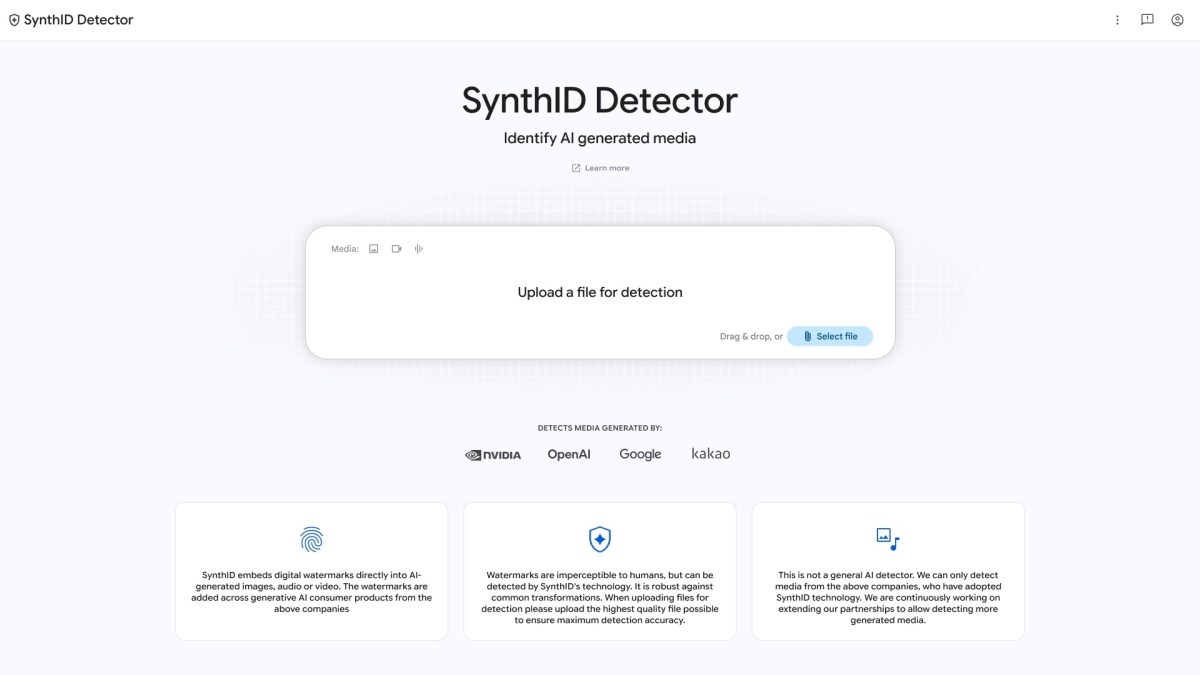
Google launched a global web portal at synthid.com allowing anyone to check images, videos, and audio files for invisible AI watermarks. The tool supports media generated by Google, OpenAI, NVIDIA, and Kakao, with upcoming support for Apple, addressing the challenge of identifying synthetic content online.
Google officially opened its standalone SynthID verification website to the public globally in English on October 7, 2026. In a post published on The Keyword, Google DeepMind VP of Science and Strategic Initiatives Pushmeet Kohli detailed this expansion, noting that the objective is to supply users with more context about the media you see online.
The web-based tool lets anyone upload a file to determine whether it carries an invisible digital watermark embedded by compatible generative artificial intelligence systems. Since Google initially introduced the watermarking technology in 2023, the system has been integrated into models across the industry. To date, Google has watermarked over 180 billion images and videos, along with 240,000 years of audio content.

Account Requirements and Usage Limits at SynthID.com
While the detection portal is free to use and available worldwide, accessing it requires logging in through a third-party or tech ecosystem account. Users can sign in using a Google, Apple, or OpenAI account to begin scanning files.
Behind the scenes, Google enforces limits to prevent automated scraping or attempts to reverse-engineer the software. Google engineers told Ars Technica that restricting access is necessary to keep bad actors from developing tools designed to strip or bypass the watermarks.
The portal processes uploaded files in real time and deletes them immediately after returning results, retaining only a digital signature of the file for 24 hours to enforce the daily quota.
Tech Companies Adopt SynthID Watermarking Standard
The newly opened website is not limited to Google’s own output. The platform can detect invisible signatures embedded by a growing roster of participating technology companies that have adopted the watermarking standard. According to Google’s May 2026 update, ElevenLabs, Kakao, and OpenAI were broadening the application of SynthID watermarks to a wider range of their AI-generated outputs, alongside the debut of an AI Content Detection API for business users on Google Cloud’s Gemini Enterprise Agent Platform.
Google’s proprietary models—including Nano Banana, Veo, Lyria, Gemini, Flow, ProducerAI, and Vids—automatically watermark their generated outputs. Google and external developers contribute to the ecosystem.

- Google: Applies watermarks across Gemini, Search generation tools, Chrome features, and media models like Veo and Lyria.
- OpenAI: Embeds compatible signatures and maintains a separate verification portal for its own models.
- NVIDIA: Integrates the watermarking technology into supported visual and audio generators.
- Kakao: Utilizes the framework across generative services.
- Apple: Listed as a forthcoming partner, with detection support for features like Apple Intelligence arriving soon.
- ElevenLabs: Committed to adding support for the watermark across audio outputs.
The portal supports a wide array of file formats. Images can be checked in JPG, JPEG, PNG, BMP, WEBP, AVIF, HEIC, HEIF, TIFF, TIF, and GIF formats. Video verification accepts MP4, MOV, and WEBM files, while audio checks support WAV, MP3, OGG, FLAC, AAC, and M4A.
Invisible Watermarks and C2PA Content Credentials
The technology functions by altering pixels in an image or video frame, or embedding data directly into the waveform of an audio file, rather than relying on modifiable file metadata. For instance, the audio watermark applied by Google’s Lyria music generator and NotebookLM podcast feature is designed to resist MP3 compression, added background noise, and shifts in playback speed.
Visual watermarks are engineered to survive common modifications such as cropping, color adjustments, brightness changes, and lossy compression. Google supplements these hidden marks with industry-standard C2PA Content Credentials, which help trace a file’s provenance and editing history.
Prior to today’s open launch, the SynthID Detector debuted on May 20, 2025, during the I/O developer conference as an authentication portal dedicated to media generated via Google’s own AI tools, with an initial version restricted exclusively to selected researchers, media professionals, and journalists. Google noted that built-in verification features inside Search, the Gemini app, and Chrome already handle more than 1 million requests daily.
Negative Results Do Not Guarantee File Authenticity
Industry analysts and Google’s own documentation emphasize that the tool is not a general AI detector. Because many companies use separate watermarking standards—such as Meta’s proprietary systems—or deploy open-weight models without any tracking, a negative result does not guarantee that a file is authentic.
“SynthID detected” and “SynthID not detected” don’t mean quite the same thing. A positive result can tell you immediately that an image is AI generated, but a negative one doesn’t always prove that what you’re looking at is real.
Tom’s Guide, AI Editorial Analysis
In addition, heavy file manipulation or editing can weaken the hidden signals. The website’s FAQ advises users to upload the highest-quality file available and gather multiple points of context before concluding whether a piece of media is synthetic.

One Nation AI Election Ad Sparks Intense Online Debate
An artificial intelligence-generated campaign advertisement released by Pauline Hanson's One Nation party for the upcoming Victorian state election...

Google Suspends Open Source Bug Bounty Due to Automated Reports
Google suspended product vulnerability submissions for its open-source bug bounty program on October 1, 2026, citing a surge...

Digital Realty Taps Swiss Franc Market for CHF 510 Million in Senior Green Notes
Digital Realty Trust is tapping the Swiss franc debt market with a CHF 510 million senior unsecured green...

Flydubai Co-Pilot Attacks Captain With Axe Over Saudi Airspace
An Israel-bound Flydubai flight narrowly avoided disaster on September 30, 2026, when its co-pilot attacked the captain with...