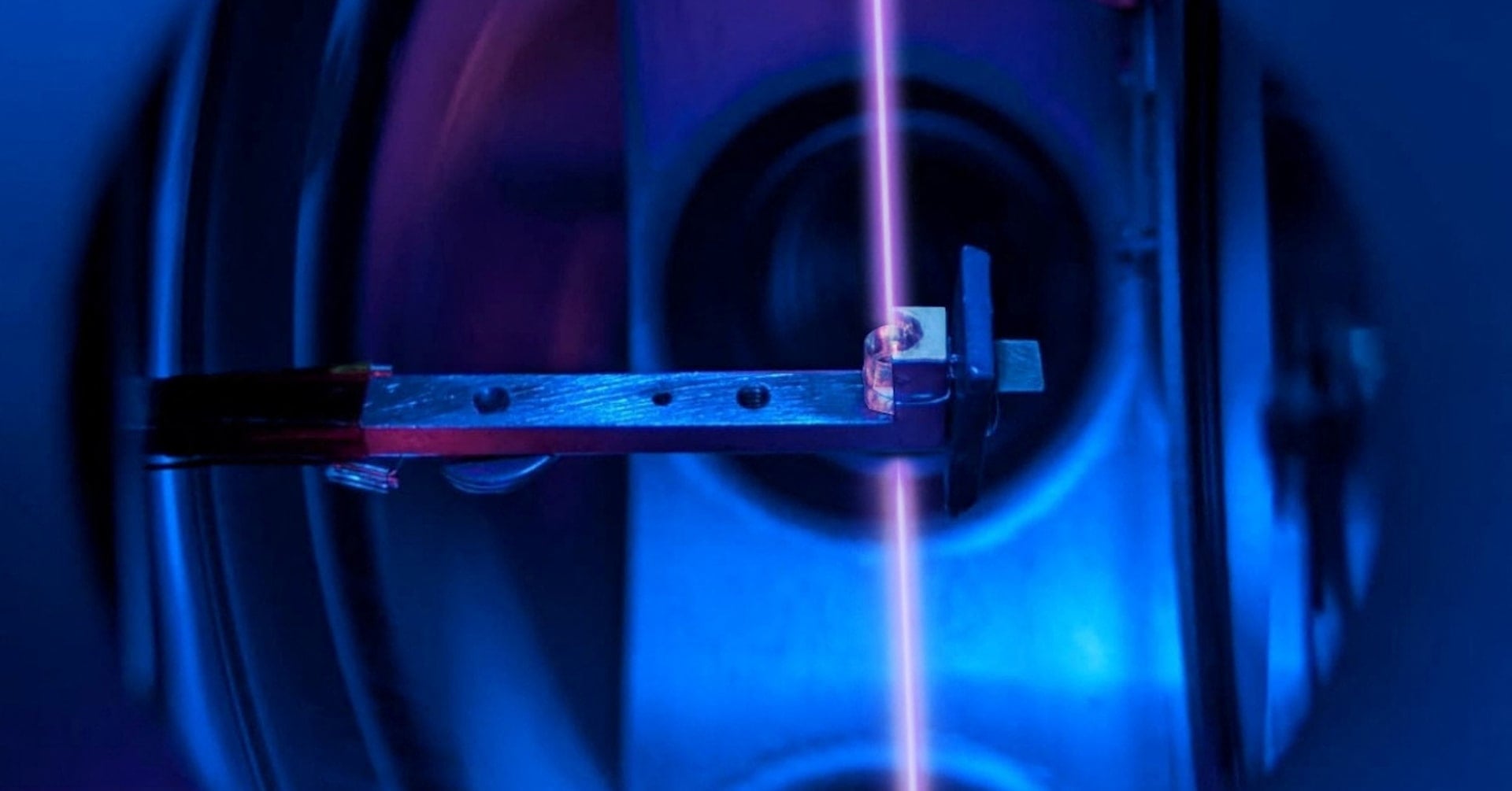
Operating independently in Beijing and Vienna, research groups have built the globe’s first pair of functional nuclear clocks, hailing the breakthrough as a major milestone for horology that opens up broad practical uses and introduces a novel instrument for probing foundational physics.
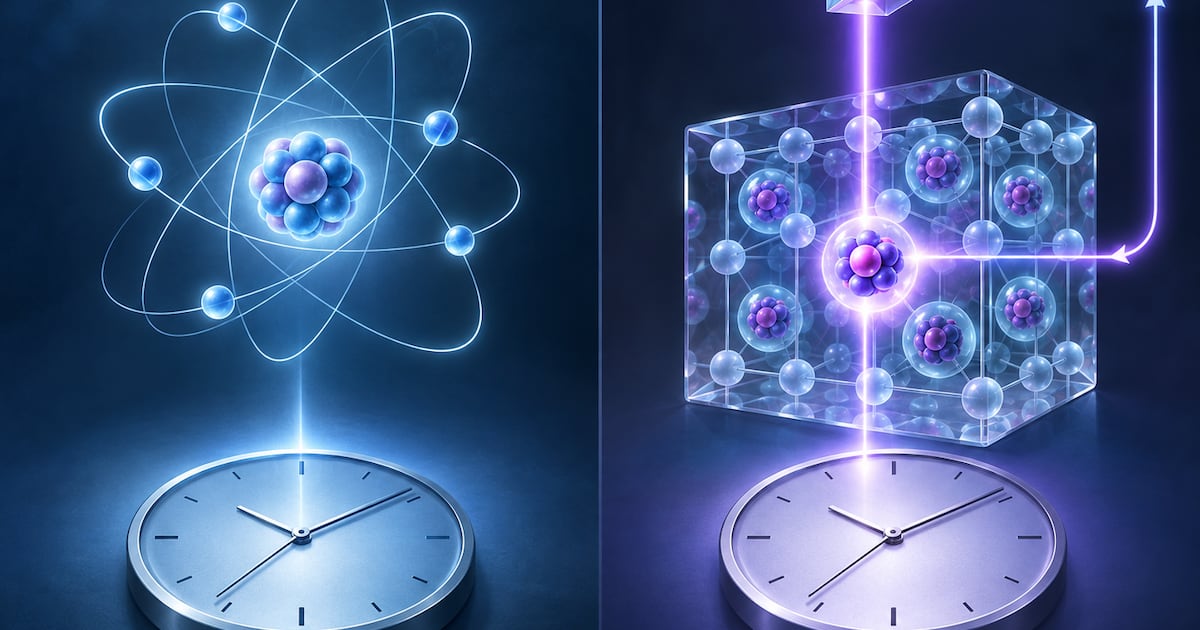
Timekeeping has officially entered its nuclear age. Two independent teams—one led by Thorsten Schumm of TU Wien in Austria and another led by Tsinghua University physicist Shiqian Ding in Beijing—have realized the first operational nuclear clocks. While conventional atomic clocks track electron shifts in elements such as cesium or strontium, these new devices measure time by tracking energy changes deep inside an atomic nucleus.
How Thorium-229 Enables Nuclear Timekeeping
Most atomic nuclei require excessively high energy levels to transition between states, making them impossible to manipulate with standard laboratory lasers. However, the isotope thorium-229 possesses an exceptionally low energy difference of approximately 8.4 electron volts. This unique property allows researchers to alter its nuclear energy state using a vacuum ultraviolet laser with a wavelength of roughly 148 nanometers, as noted in published technical details.
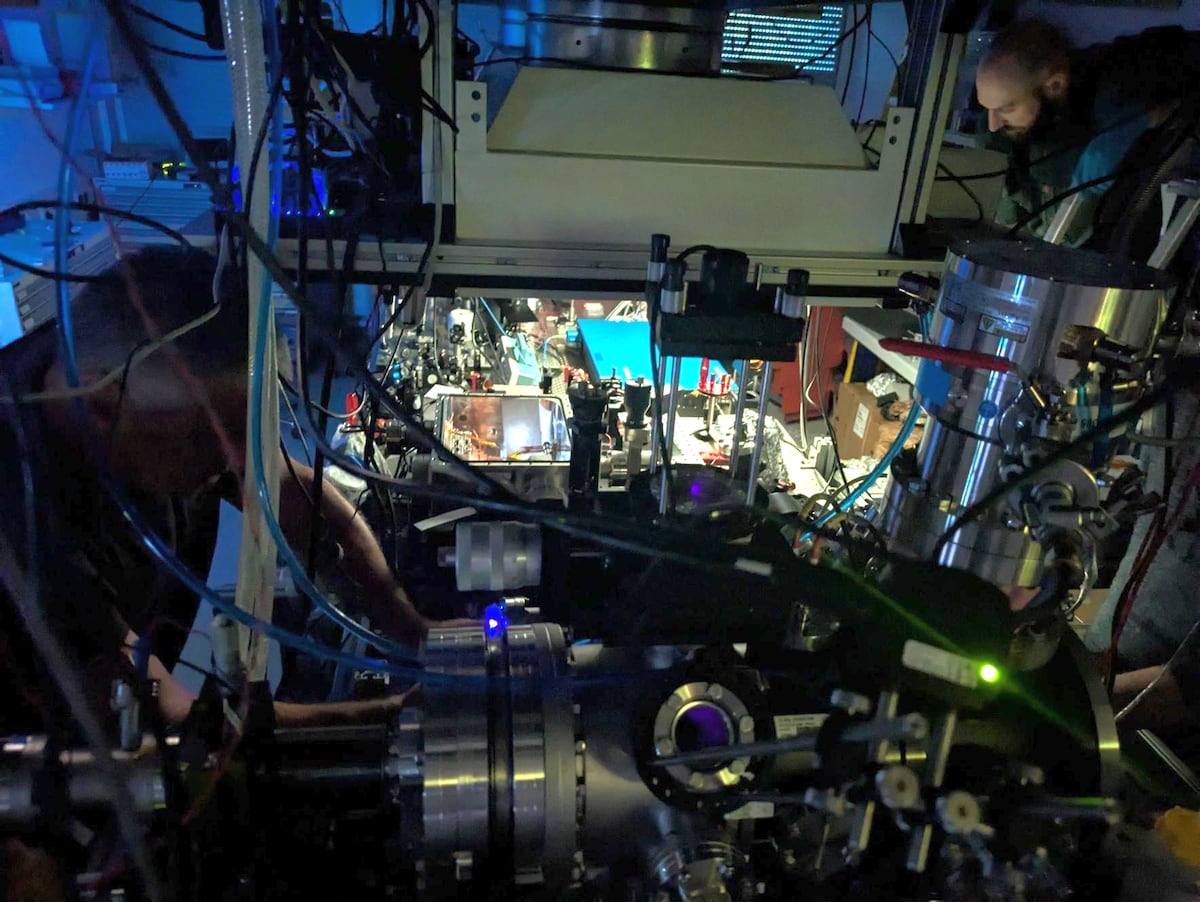
Both research groups embedded millions of thorium nuclei inside solid-state calcium fluoride crystals. The Beijing system generates its necessary ultraviolet light by passing laser beams through cadmium vapor heated to 600 degrees Celsius (or 1,112 degrees Fahrenheit, according to engineering analysis), directing the beam into a tiny crystal measuring less than a grain of rice that contains roughly one quadrillion thorium nuclei. The Vienna device utilizes a crystal containing about 200 times more thorium nuclei, according to engineering analysis. The instrument constructed at Austria’s Vienna University of Technology attained a precision level of 10⁻¹⁵, which translates to an inaccuracy of approximately one second across a span of 30 million years. Ding Shiqian, who led the Tsinghua work, said the result strengthens the case for reproducible nuclear clocks.
Stability Comparisons Between Beijing and Vienna Prototypes
Initial performance data published alongside the Nature papers show noticeable differences between the two working prototypes. Researchers at Tsinghua University found that their experimental setup ran about six times more steadily than the competing device in Vienna. The Chinese team demonstrated that separately grown crystals generated nearly identical clock signals, agreeing to roughly three parts per 10 trillion.
Meanwhile, the European team’s device successfully operated continuously for approximately one day. However, the Vienna researchers found that the clock’s signal changed slightly depending on where the laser passed through the crystal, causing the device to keep slightly different time each day, as reported in studies detailed by the South China Morning Post. Thorsten Schumm noted that the Vienna clock features slightly better thorium crystals with higher concentrations and optical properties, while the Beijing team benefits from a stronger laser. By lengthening the measurement duration, the researchers in China attained a frequency instability as small as a single part in 1,000 trillion with their nuclear clock.
“What is really nice here: the Vienna clock has slightly better thorium crystals — higher concentration, better optical properties — while the Beijing team has a stronger laser. So already by putting these components together, we can build a significantly better clock,”
Thorsten Schumm, TU Wien physicist, via Reuters
Despite these successes, neither prototype currently outperforms the best optical atomic clocks in pure stability. The current prototypes drift by about one second every 30 million years, which falls short of cesium clocks that can go hundreds of millions or billions of years without losing a second. Schumm acknowledged that the nuclear clock remains far from its target performance.
Nuclear Clocks Help Researchers Hunt for Dark Matter
The primary motivation for building these instruments extends far beyond ordinary timekeeping. Because atomic nuclei are roughly 100,000 times smaller than whole atoms and are bound by enormous nuclear forces, they are significantly less sensitive to external electric and magnetic fields. This isolation makes them exceptionally powerful tools for fundamental physics.
The Vienna team immediately used their device to hunt for dark matter. Although that initial search did not detect any elusive particles, high-precision analysis allowed researchers to rule out nearly three orders of magnitude in the possible interaction range for scalar bosons. Though no dark matter was actually found by the test, the nuclear device operated on par with top-tier atomic timepieces. It gives access to a whole new physics universe,
Schumm said.
“The two teams worked independently and reached operating thorium-229 nuclear clocks at the same time, using different experimental approaches. I think this is very encouraging because it shows that the concept is robust and not dependent on one particular technical implementation,”
Shiqian Ding, physicist at Tsinghua University, via Reuters
Both research groups agree that overcoming current limitations will require purer crystals with uniform thorium distribution alongside more powerful lasers. As development continues, these compact instruments could eventually transform satellite positioning, data synchronization, and our understanding of the universe's fundamental laws.

Moon Passes in Front of Jupiter During Rare Occultation
Observers across North America watched the Moon conceal Jupiter on Tuesday morning in a rare planetary occultation that...

Researchers Suggest Animals May Have Evolved 200 Million Years Earlier
Using scanning electron microscopy on more than 140 samples, researchers analyzed the Kheseen Biota in Mongolia to test...

University of Copenhagen Researchers Reveal Earth and Mars Formed Differently
Earth and Mars formed side by side from the same cosmic cloud roughly 4.5 billion years ago, yet...
Moon to Occult Jupiter Over Eastern North America on October 6
Skywatchers across much of eastern North America can watch a rare lunar occultation early Tuesday morning as a...