Walking across the Michigan State University campus today, you might assume the paved walkways were meticulously planned by civil engineers from day one. However, the very ground beneath your feet tells a story of student necessity. According to MSUToday, when the university was under construction, access to paving materials was limited, leaving the formal sidewalk system for last. In the interim, students carved out their own informal pathways through the dirt, creating a makeshift network that eventually dictated the permanent sidewalk system used by Spartans today.
This sense of organic growth defines the university’s identity, stretching from its earliest days as a small settlement to its current status as a massive educational engine. As of the fall 2026 semester, MSU has grown into a massive community, welcoming 50,941 students. While the campus serves a global population including students from 50 states and 127 countries, its roots remain deeply embedded in the local soil. The university continues to educate more Michigan students than any other institution, with 37,244 in-state students currently enrolled.
The evolution of Collegeville and the rise of Beaumont Tower
The geography of the region has shifted significantly since the mid-19th century. Long before it was known as East Lansing, the area surrounding the campus was called Collegeville. Historical markers located outside East Lansing City Hall on Abbot Road provide a window into this era. In the 1850s, the community consisted of just seven campus buildings and seven farmhouses located within a two-mile radius of College Hall, the site where Beaumont Tower now stands. The community took a more formal shape in 1887 when Professors W.J. Beal and Rolla C. Carpenter platted the first subdivision, officially naming it Collegeville.
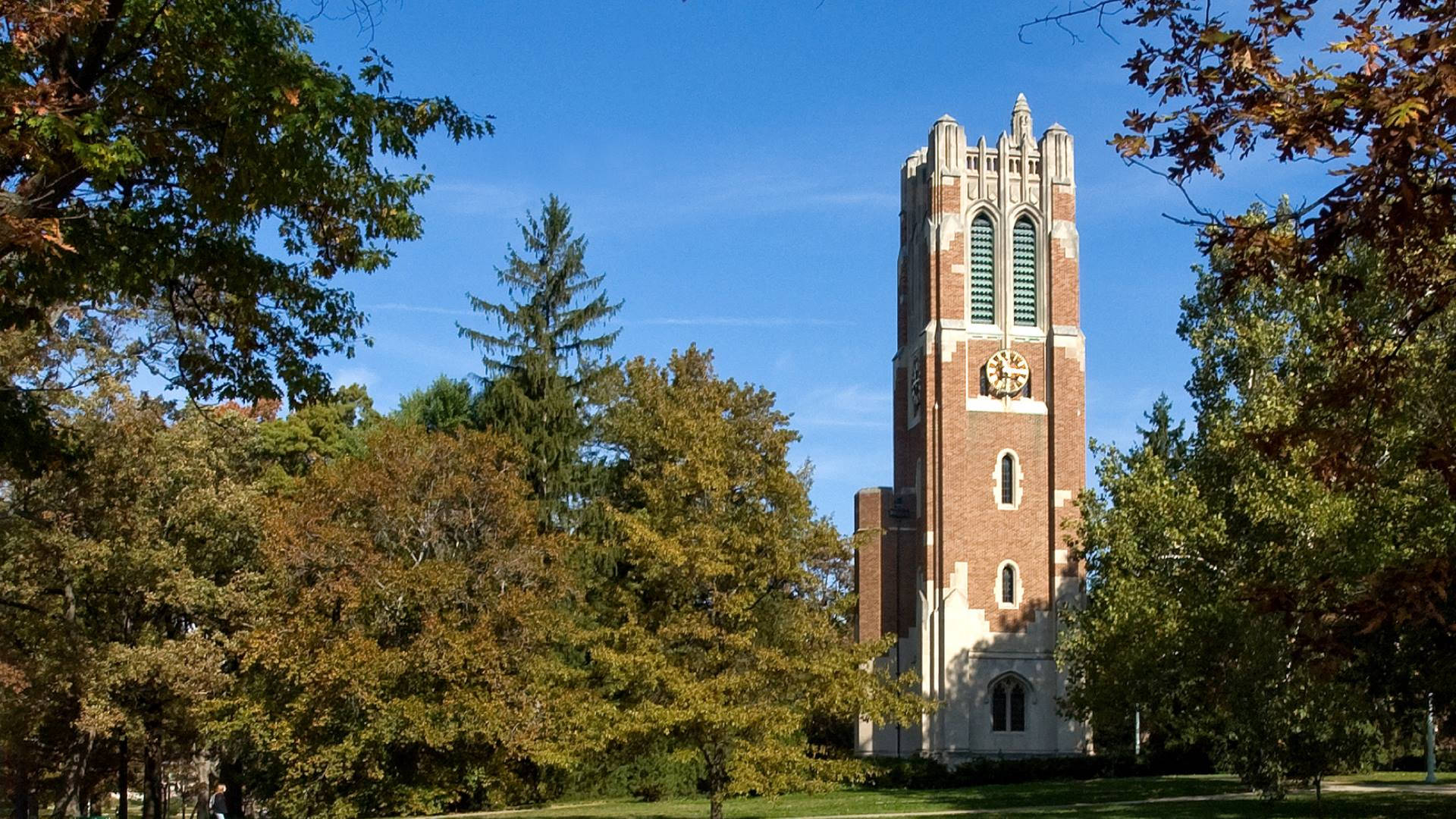
As the settlement expanded, Collegeville and its neighboring areas were eventually chartered as East Lansing in 1907. This transition marked the shift from a small collection of faculty homes—known as Faculty Row—to a structured municipality. Much of the campus’s architectural symbolism stems from this period of rebuilding and remembrance.
Beaumont Tower, a central icon of the university, was dedicated on June 22, 1929. It serves as a memorial to the classes taught in College Hall, the university’s first building. The tower’s history is one of resilience; in 1918, two walls of College Hall collapsed due to poor construction, leading to the eventual demolition of the original structure. Today, the tower’s design carries a specific intentionality. According to MSU archives, the tallest finial on the tower rises above the others to symbolize the university’s “ever greater aspirations.”
Scientific longevity and campus landmarks
While architecture changes, some traditions are built to last centuries. The university is home to one of the longest-running scientific experiments in the world: the Beal Seed Experiment. Started in 1879 by Professor William J. Beal in the Beal Botanical Garden, the study seeks to determine how long seeds from common plants can remain dormant in the soil before they are able to germinate under favorable conditions. The experiment is still active today, with researchers periodically excavating bottles of seeds to test their viability.
The campus also maintains a significant biological legacy through its historic arboretum, established in 1873 by William J. Beal. The landscape is more than just aesthetic; it is a living laboratory. The university manages over 22,000 trees, some of which are estimated to be between 350 and 400 years old. This commitment to the natural environment traces back to 1863, when the university’s third president, Theophilus C. Abbot, and his wife, Sarah, planted the first commemorative tree on campus to celebrate the birth of their daughter.
Other landmarks serve as cultural touchstones for the student body. “The Rock,” the university’s oldest landmark, was donated by the graduating class of 1873. It functions as a campus billboard where students and organizations paint messages to celebrate milestones or promote events. To protect the surrounding environment, the university relocated the Rock from its original position near Beaumont Tower to Farm Lane in September 1985, after it was discovered that painting the monument was causing damage to nearby trees, bushes, and sidewalks.
| Student Demographic (Fall 2026) | Total Count |
|---|---|
| Total Enrollment | 50,941 |
| In-State Students | 37,244 |
| New Undergraduate Students | 10,984 |
| Michigan-based New Undergraduates | 8,541 |
Even the university’s art and athletics are intertwined with its history. The original terra cotta Spartan statue, dedicated in 1945, eventually began to crumble due to age. To preserve the original monument, it was moved to its current home inside the lobby of Spartan Stadium, while a new bronze version was unveiled in 2005. Meanwhile, the Eli and Edythe Broad Art Museum, designed by architect Zaha Hadid, has achieved a level of cultural recognition that extends into popular media; the building served as the home for the character Lex Luthor during the filming of Batman v Superman in 2014.
As MSU continues to implement its “MSU 2030: Excellence for Global Impact” strategic plan, the tension between preserving this deep-rooted history and fostering a “future-focused” contemporary institution remains a central theme of the university’s growth.
Keep reading

St. Louis Man Facing Federal Charges for Felon Firearm Possession
A St. Louis man faces federal charges after a Columbia shooting Iseah Christopher Jackson, a 23-year-old resident of...

Minnesota Immigrant Voters Turn Out in High Numbers to Protect Communities
Minneapolis immigrant communities turn out to vote following immigration enforcement surge Immigrant voters in Minneapolis are heading to...

Central Catholic Secures Top Seed in Tournament Bracket
Central Catholic and Brookline lead the MIAA Division 1 Volleyball seeds Central Catholic enters the 2026 MIAA Fall...

How to Dissolve an LLC or Corporation in Louisiana
To dissolve an LLC or corporation in Louisiana, owners must follow specific statutory procedures that include formal approval,...