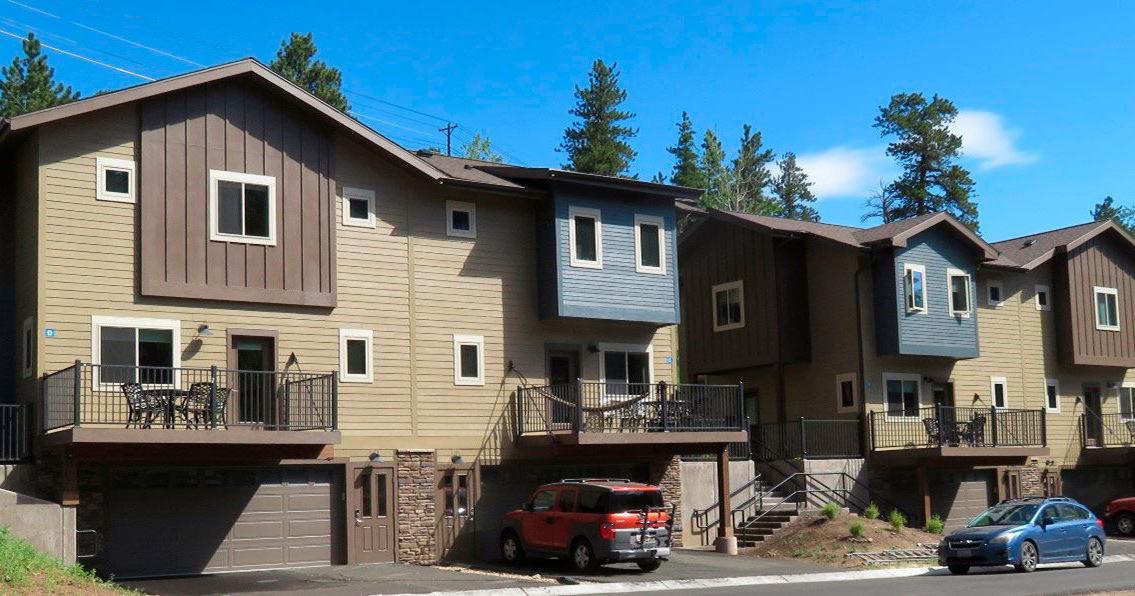
New housing units are providing a much-needed bridge for Colorado’s rural workforce. Prospector Apartments, a 94-unit development in Estes Park, has opened to address the growing gap between subsidized housing and expensive market-rate rentals.
The project, built by Four Points Funding, utilizes a combination of HUD financing and Opportunity Zone incentives to serve middle-income families, seasonal workers, and younger professionals. According to HUD USER, the development fills a specific market niche in resort areas where the local economy relies heavily on tourism, yet the people powering that economy often cannot afford to live nearby.
“The decision to include larger units stems from a market study showing increased demand for shared housing with adult roommates,” Stephanie Copeland, a managing partner at Four Points Funding, told HUD USER.
This demand follows a trend across the state. While the Front Range remains a primary focal point for growth, nonmetropolitan Colorado is among the fastest-growing regions in the country, placing immense pressure on existing housing stocks.
Density bonuses drive project scale
The physical footprint of the Prospector Apartments was significantly expanded by local policy. Without specific zoning incentives, the 5.8-acre site would have only supported 50 units rather than the 94 currently available. This increase was made possible by a 2017 ordinance passed by the town of Estes Park that provides density bonuses for workforce housing projects located within the Multi-Family Residential zoning district.
Under these rules, workforce housing is eligible for the maximum permitted density bonus, which effectively doubles the base maximum allowed for the site.
The town defines these attainable units as being available to households earning up to 150 percent of the area median income, provided rent does not exceed 30 percent of that income limit. For residents who work within the Estes Park School District boundaries, no income limits apply to the units.
The development features four buildings containing a mix of unit sizes designed to accommodate different living arrangements:
| Unit Type | Number of Units |
|---|---|
| One-bedroom | 25 |
| Two-bedroom | 45 |
| Three-bedroom | 24 |
Financing the rural development gap
Building in rural Colorado presents unique economic hurdles, most notably the high cost of labor. To make the $33 million project feasible, developers had to stack multiple layers of capital and debt. The financing structure included a $20 million HUD Section 221(D) (4) loan, a $6.6 million mezzanine loan, and $6.1 million in equity investment.
‘Historic’ new funding launches Colorado into a post-TABOR era https://t.co/4J00GSiElM pic.twitter.com/gCx15hHK88
The involvement of HUD financing proved critical during periods of economic volatility. Copeland said that the HUD loan helped the project move forward even when higher interest rates were prevalent. The long-term nature of these loans—often involving hold periods of 10 or 15 years—provides developers with the flexibility to consider future refinancing or rate writedowns.
Opportunity Zone funding serves as the foundation for this investment strategy. By targeting nonmetropolitan areas, Four Points Funding aims to attract private capital to communities facing rapid growth and housing shortages. As of 2026, the firm has developed 11 Opportunity Zone properties, totaling 809 new units of housing.
Critics of Opportunity Zone programs often argue that the tax incentives primarily benefit wealthy investors rather than the communities themselves. However, proponents point to projects like Prospector Apartments as evidence that the profit motive, when paired with municipal density bonuses, can direct capital toward essential infrastructure like workforce housing.
Amenities tailored to mountain life
The apartments are designed with the specific lifestyle of the Rocky Mountain region in mind. Beyond standard features like stainless-steel appliances and hardwood floors, the site includes facilities for tuning and maintaining bikes and skis. Residents also have access to a dog-washing station, a picnic area, and a preserved preexisting log cabin on the property.
Copeland explained that the selection of amenities was a deliberate effort to maximize value for tenants while keeping overall costs low. Looking ahead, the property may eventually include an onsite daycare center once the development matures and stabilizes.
“The property may add an onsite daycare center after it matures and stabilizes,” Copeland told HUD USER.
Worth a look

Missouri School Funding Lags Despite Lottery and Casino Revenue
Missouri's public schools are facing budget cuts despite hundreds of millions of dollars flowing into the state from...

South Dakota Women’s Basketball Defeats Creighton 54-49
Creighton women’s basketball hit a wall in Sioux Falls on Wednesday, November 11, falling 54-49 to South Dakota...

MS GOP Chair Mike Hurst Congratulates Scott Colom on Senate Win
Mississippi Republican Party Chairman Mike Hurst congratulated Senator-elect Scott Colom on Wednesday following his victory over incumbent Cindy...

BMI Promotes Shannon Sanders to AVP, Creative, Nashville
BMI is promoting Shannon Sanders to Assistant Vice President, Creative, Nashville, changing the organization’s leadership in one of...