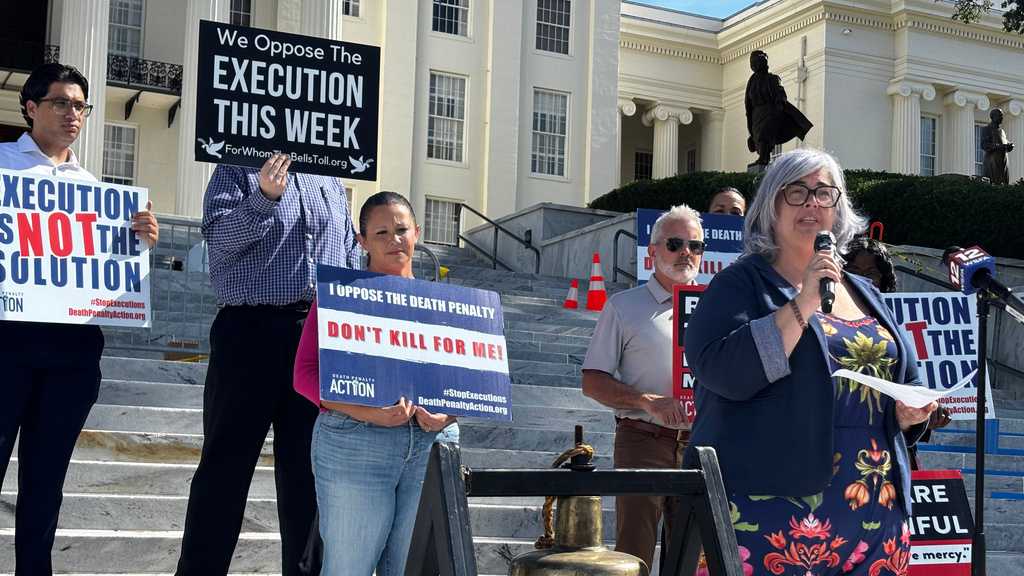
Three men are scheduled to be executed by lethal injection on the same day Thursday, in a stark convergence of capital punishment cases across Indiana, Florida, and Alabama, KCRA reported. The coordinated executions mark just the second time this year that three people will be put to death on a single day, highlighting a steady pace of judicial sanctions in a system perpetually fraught with legal and moral debate.
A Nation Under the Needle: The Human Calculus of Execution
The human and procedural stakes are high, with each case presenting a unique set of circumstances. In Indiana, 50-year-old Jeffrey Weisheit is set to die for setting a fire in 2010 that killed his girlfriend’s two children, ages 8 and 5. The murders were apparently related to the couple’s deteriorating relationship. His legal team, fighting to the end, had asked Republican Gov. Mike Braun to allow brain scans to support their argument about a history of head injuries and mental health problems. Braun declined. Weisheit’s final objection centered on the state’s use of lethal drugs from a pharmacy facing a disciplinary hearing next week. The Indiana Department of Correction expressed confidence in its ability to “humanely carry out” the execution.
In Florida, the pace is relentless. Jesse Guardado, now 64, faces execution for confessing and pleading guilty to the 2004 fatal stabbing of a 75-year-old woman in Walton County. He stole her jewelry box and $80 to support a drug habit, even after she had helped him find a job and housing. A federal appeals court in 2024 affirmed his conviction, stating he had received a “full and fair” hearing. His execution would be Florida’s 19th this year under Republican Gov. Ron DeSantis, matching a record set in 2025. DeSantis, who leaves office in January, has consistently framed his actions as delivering justice to families who have waited decades.
The Alabama Complication: Age, Remorse, and the Weight of Time
Alabama’s case involves Michael Taylor, 54, who is scheduled to die for the 1989 fatal beating of an older couple with a metal bar during a robbery in Gadsden. He was arrested just an hour later in Birmingham with the victims’ Cadillac. Death penalty opponents urged Republican Gov. Kay Ivey to commute his sentence to life, citing his extreme youth at the time—he was just 19—and arguing he had transformed into a “mature, well-respected, God-fearing man” in the 35 years since.
“If the state kills Michael, it is not the 19-year-old who made the worst mistake of his life [whom] it kills. But the mature, well-respected, God-fearing man sitting in that cell today,” said Esther Brown of Project Hope to Abolish the Death Penalty.
Ivey declined. The state plans to use lethal injection after a judge declared its alternative method, nitrogen hypoxia, unconstitutional. This creates a final layer of legal conflict, as Taylor had selected nitrogen gas years ago. His attorneys object to the last-minute switch, but a judge has ruled against him.
3 executions scheduled for the same day in Indiana, Florida and Alabama @WashTimes https://t.co/vRpIYL5XYn
The backdrop to this trio of executions is the renewed scrutiny the death penalty faces nationwide. The failed execution of Christa Pike in Tennessee last month, where she survived two lethal doses of pentobarbital, has intensified questions about drug protocols and the reliability of the process. While courts have since rejected efforts to halt other executions, the Tennessee incident lingers as a potent symbol of the system’s potential for error.
From a statistical perspective, the concentration of executions in a few states is undeniable. Florida has accounted for more than half of the 32 total executions in the U.S. so far this year. This geographical disparity fuels the central argument of death penalty opponents: the application of capital punishment is not uniform, but is instead a patchwork shaped by local politics, judicial philosophies, and the resources available to defense teams. The system, they argue, is less about justice and more about where a crime was committed.
Supporters, however, counter that the focus should remain on the severity of the crimes and the rights of victims’ families. For them, the delay between sentencing and execution is a profound injustice. The push to carry out long-standing death sentences is a powerful political force, particularly in states like Florida where the governor has made it a signature issue. The perspective is simple: justice delayed is justice denied for those who have lived with the loss for decades.
The practical reality for these three men is a final day of legal appeals and personal reckoning. For the public, the day serves as a mirror, reflecting a nation’s enduring and unresolved conflict over state-sanctioned killing. The debate is not abstract; it is played out in the lives of the condemned, the memories of the victims, and the conscience of a society that continues to grapple with the ultimate punishment.

Nashville Mayor O’Connell releases statement on election results
Nashville Mayor O'Connell Responds to State Election Shifts Nashville Mayor Freddie O'Connell issued a statement on the midterm...

Victoria Chang on Poetry, Nature, and Her National Book Award-Finalist Tree of Knowledge
A Portland Tree’s Fall Ignites a National Book Award-Finalist Conversation Across the street from her home, a towering...

NYC to Ban Horse-Drawn Carriages in Central Park by 2028
A Vote to End a 160-Year Tradition The legislation, named Romanch's Law after an 18-year-old Indian tourist who...

How Columbus Hospitals Use Art for Healing
Art Becomes Medicine in Columbus Hospitals Walk into a hospital in Columbus, and you might find a pianist...