
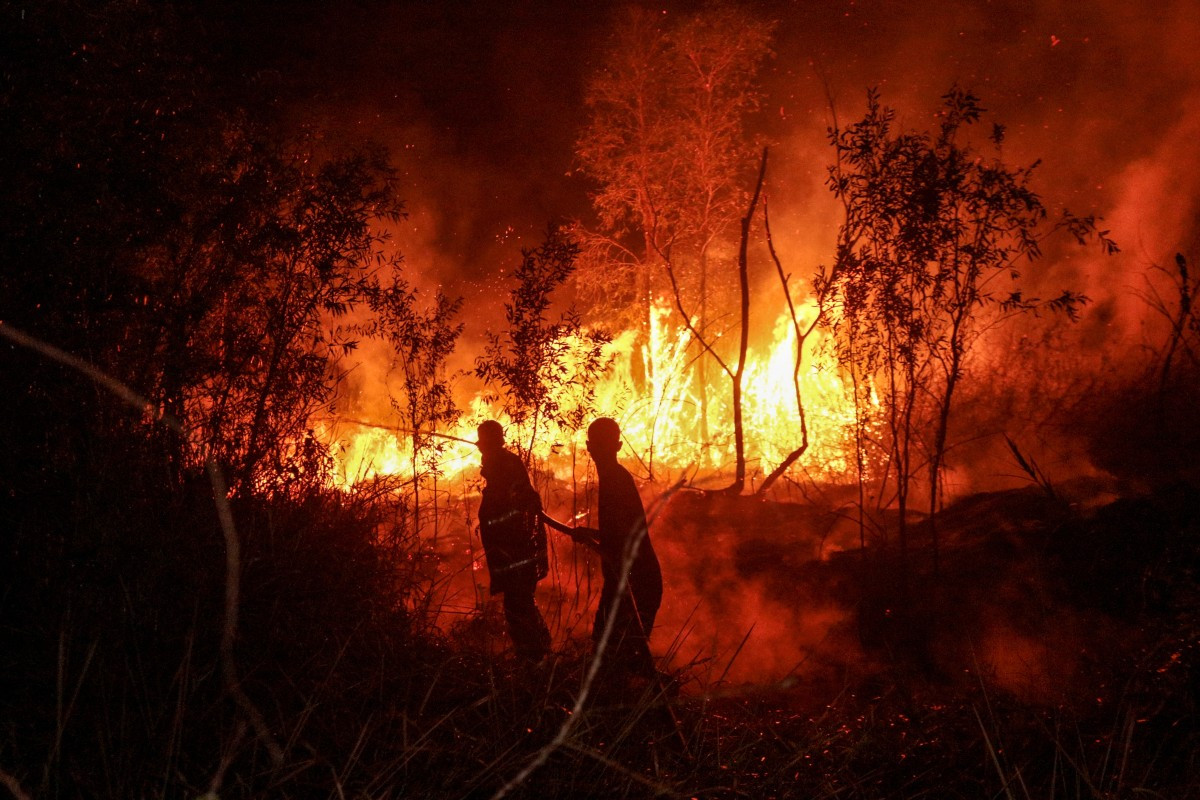
Indonesia’s 2026 fire season has scorched 2.88 million hectares — an area 18 times the size of London — and the economic toll could exceed $30 billion, Cambodianess reported Friday.
That figure, detailed in a study by the Jakarta-based Center of Economic and Law Studies (CELIOS), combines an estimated Rp 340 trillion ($18.6 billion) in physical asset losses and disrupted economic activity with up to Rp 225 trillion ($12.3 billion) in health costs from acute respiratory infections. Together they equal roughly 2.69 percent of Indonesia’s gross domestic product.
“There are also economic costs borne by the public, both directly and indirectly,” CELIOS director Nailul Huda, a co-author of the report, told AFP.
The fires have burned across Borneo, Sumatra and Papua, driven by a strong El Niño pattern, climate change, and extensive peatland drainage for mining and plantations. Researchers said last week that those factors have supercharged this year’s season well beyond the typical dry-season baseline.
The health burden is staggering. CELIOS estimates 17.4 million people across 12 provinces face heightened risk of acute respiratory infections, the Jakarta Globe reported. The Health Ministry had recorded 401,586 cumulative ARI cases linked to the fires as of November 2 across seven provinces and 63 districts and cities.
Health costs for diagnosed upper respiratory tract infections alone are estimated at Rp 19.2 trillion ($1.1 billion), potentially rising to Rp 224.65 trillion if symptomatic but undiagnosed cases are included, according to the Jakarta Globe. Smoke pollution is also estimated to have caused 1,700 deaths in August alone.
“Respiratory infections in West Kalimantan once surged to 1,337 cases in a single day, yet pregnant women, breastfeeding mothers, and newborns have not been designated as vulnerable groups and remain excluded from disaster response protocols.”
said Rizky Pontiviana Akbari, chair of the Indonesian Breastfeeding Mothers Association (AIMI) in West Kalimantan. Without smoke-free safe spaces and emergency breastfeeding guidelines, she said, mothers and infants are forced to bear multiple health risks.

Because forest and land fires are an almost annual occurrence, physician and health researcher Celline Wijaya said that health consequences should be prepared for well in advance of the fire season. She advocated for a specific government budget to safeguard public health in areas prone to fire, suggesting that funds be triggered automatically by declining air quality instead of depending entirely on emergency response measures.
Social protection has also come under scrutiny. Amid concerns regarding environmental protection and public access to healthcare, Trend Asia Campaign Officer Meike Inda Erlina pointed to the deactivation of 11 million to 13.5 million recipients of the BPJS Health premium subsidy, known as PBI.
Borneo, the world’s third-largest island, spans 748,168 square kilometres and straddles the equator at the centre of Maritime Southeast Asia. Its ancient rainforests, among the oldest on Earth, host seven distinct ecoregions and vast carbon-rich peatlands that have been extensively drained for mining and plantations.
Politically divided since decolonisation, the island comprises Indonesia’s five Kalimantan provinces, the Malaysian states of Sabah and Sarawak, and the sultanate of Brunei. It is also the site of Indonesia’s planned future capital, Nusantara.
“Social protection must not merely be a reactive, charitable ‘remedy’ applied after the forests have burned.”
Erlina said.
Worth a look

Robredo Casts Vote as Naga Seeks HUC Status on Nov 21
Naga City voters head to the polls Saturday to decide whether their city cuts its final administrative ties...
Infection Triggers Acute Myocardial Infarction A Narrative Review
When you come down with a severe infection, your primary concern is usually managing the fever or the...

Ultra-Processed Foods Linked to Higher Blood Cancer Risk in Large UK Study
A massive new study tracking more than 200,000 adults in the United Kingdom suggests that a diet heavy...

US Police Warn Players: What Happens in GTA 6 Stays in GTA 6
Police departments across the United States seized on the launch of Grand Theft Auto VI on Thursday to...