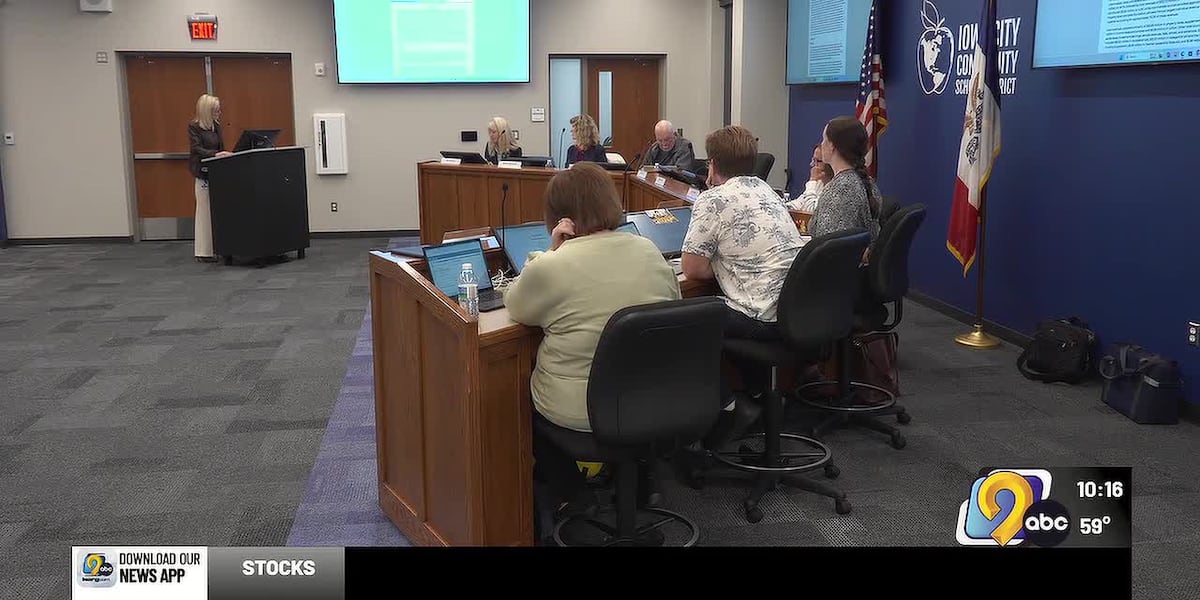
The Iowa City School Board is preparing to unveil a series of aggressive budget cuts on March 9, targeting a $13 million shortfall for the upcoming fiscal year and an additional $18 million over the following three years. This financial tightening comes as parents and students demand accountability for the district's current fiscal crisis, KCRG reported.
For the families in the district, this isn’t just a line item in a ledger. It is a looming question of where the scissors will fall. When a school district looks for tens of millions of dollars, the conversation inevitably shifts from “administrative efficiency” to the actual classrooms. The stakes are high: the potential loss of programs, the redistribution of students, and the very real possibility of closing school buildings.
The fight over school closures
During a recent board meeting that stretched into hours of public testimony, the primary fear echoing through the room was the possibility of school closures. The board didn’t offer a blanket guarantee against it. Instead, they confirmed they have hired an outside firm to analyze the district’s needs, explicitly stating that closing schools remains an option on the table.
Parents expressed a deep frustration with the board’s perceived lack of ownership over the financial instability. The consensus among many speakers was clear: the board should prioritize cuts that do not directly degrade the quality of education or disrupt the daily lives of students. They are pushing for a strategy that protects the classroom first, though the sheer scale of the $31 million total deficit over four years makes that a daunting mathematical challenge.
Board explores selling land to monetize district assets
To avoid the most painful cuts, the board is exploring ways to monetize district assets. Two specific ideas are currently under discussion: the sale of land owned by the district near Weber Elementary and the “reutilizing” of the Educational Services building.

Selling land is a one-time infusion of cash, not a sustainable revenue stream. While it can plug a hole in the current budget, it doesn’t solve the structural deficit the district faces over the next three years. This creates a tension between short-term relief and long-term stability.
Students argue against abandoning joint indoor pool project
While the board weighs real estate sales, a specific point of contention has emerged regarding a joint indoor pool project with Coralville. The district has indicated it may pull out of the agreement to save costs.
Students have stepped forward to argue against this move, viewing the pool not as a luxury, but as a vital resource for the swim team and a broader opportunity for the district. For these students, the pool represents an investment in athletic and community infrastructure that, if abandoned, cannot be easily recovered once the partnership with Coralville dissolves.
Budget requires 31 million dollars in four-year cuts
The scale of the required cuts is significant when viewed across the four-year horizon. The board is not looking for a single fix, but a sustained reduction in spending.
| Timeline | Required Budget Reduction |
|---|---|
| Next Fiscal Year | $13 Million |
| Following Three Years | $18 Million |
The board’s reliance on an outside firm suggests a desire for an objective, data-driven roadmap to these cuts. However, data cannot replace the community’s emotional and educational investment in their local schools. The gap between the board’s financial necessity and the parents’ expectations for “non-educational” cuts is where the coming conflict will reside.
As March 9 approaches, the community is left waiting to see if the board will find a way to balance the books through asset liquidation and administrative shifts, or if the burden will eventually land on the students and teachers in the classroom.
Worth a look

Attorneys: Psychosis Overwhelming Mother Accused of Murder
Attorneys for Corie Walsh, a 40-year-old Illinois mother accused of killing her 2-year-old son, report that she is...

Deep Fission Signs Commercial Power Deal With GPDA in Kansas
Deep Fission has converted a preliminary letter of intent into a definitive contract with the Great Plains Industrial...

Nelson Peltz Offers to Take Wendy’s Private as Shares Jump
Wendy’s shares jumped 15% at Wednesday's opening bell after activist investor Nelson Peltz launched a bid to take...

Indiana Parole Board recommends Governor Braun deny Jeffrey Weisheit clemency
The Indiana Parole Board has unanimously recommended that Mike Braun deny clemency to Jeffrey Weisheit, a death row...