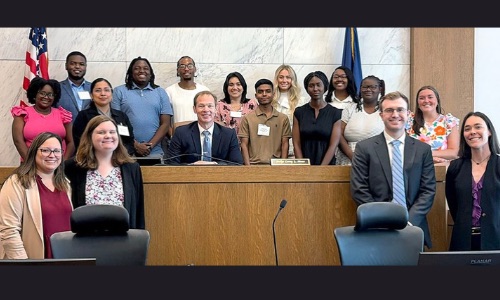
Eleven Jacksonville State University students recently completed the Leadership, Education and Development (LEAD) Program, a collaborative initiative between the university and the Calhoun County Area Chamber & Visitors Center designed to anchor college talent within the local economy. By pairing students from diverse academic backgrounds—including engineering, nursing, and criminal justice—with regional businesses and civic leaders, the program aims to bridge the gap between classroom theory and the professional realities of Calhoun County.
The goal is to show them that the infrastructure for a “dream job” already exists in their own backyard.
Connecting Classrooms to Calhoun County
The program operates on the premise that students often overlook local opportunities simply because they aren’t exposed to them. Savannah Dempsey, the Chamber’s business development director and LEAD program director, noted that the initiative was created to provide a connection to the business and community side of the region while students are still enrolled. By introducing them to local leaders early, the program seeks to influence the decision-making process regarding where a graduate will settle after receiving their degree.
For students like Greesh Sah, an applied manufacturing engineering major focusing on automation and robotics, the impact was immediate. Sah credited the program with opening his eyes to the local job market through direct interactions with representatives from the Anniston Army Depot, Regions Bank, First Bank of Alabama, and the Chamber of Commerce. He also highlighted the role of his mentor, Laurel Harp, in encouraging him to view the region as a viable site for a long-term career.
The diversity of the cohort shows the program's breadth. The 11 graduates represented a wide array of disciplines:
- Engineering: Akeriyah Powell, Greesh Sah, and Vintavious (VJ) Billingsley (Applied Manufacturing Engineering)
- Healthcare & Science: Joy Lawrence (Nursing), Paige Glaspie (Master of Public Health), and Tytianna McDonald (Biology)
- Business & Social Sciences: Delaney Whiddon (Marketing), Isaac Brown (Economics/Finance), RaShaud Drake (Integrated Studies/Public Relations), and Teresa E. Alvarado (Criminal Justice/Criminology)
- Education: Kailyn Minnifield (Early Childhood/Elementary Education)
Beyond the Resume: Civic Empathy and Legal Literacy
While career readiness is the primary driver, the LEAD program integrates “soft skill” development and civic awareness to ensure graduates are engaged citizens, not just employees. This included a LinkedIn workshop and the Dominance, Influence, Steadiness, and Conscientiousness (DiSC) assessment. Sah noted that the DiSC assessment was particularly useful in teaching him how to communicate across diverse personality types—a skill he argued is just as vital as technical engineering knowledge for creating a lasting impact.
In partnership with United Way of East Central Alabama, students participated in an Asset Limited, Income Constrained, Employed (ALICE) simulation.
“Programs like LEAD help students understand the communities they serve and strengthen their ability to work collaboratively across sectors,” said Dr. Kelley Swatzell, associate professor and director of the Master of Public Health Program. “These experiences prepare future healthcare and public health professionals to lead effectively, build partnerships, and address the complex challenges that impact community well-being.”
The immersion extended to the federal judicial system via a visit to the federal courthouse. Under the guidance of U.S. District Judge Corey L. Maze, students participated in a courtroom simulation involving an accident case, providing a firsthand look at legal procedures and the role of U.S. Marshals.
The Economic Stake of Local Retention
For Vintavious (VJ) Billingsley, the takeaway was about resilience and team dynamics. He stated that he learned the importance of overcoming adversity and the ability to continue learning, which he views as essential tools for becoming part of Alabama’s next generation of leaders.
As Dempsey puts it, the goal isn’t just about filling a vacancy at a local firm. It’s about helping students see that they can be a part of the community, build lasting relationships, and make a tangible difference in the place they already call home.
Carol Jean Marsh Billings Warden Dies at 84 in Crumpler, NC
Mrs. Carol Jean Marsh Billings Warden, an 84-year-old resident of Crumpler, North Carolina, died in peace on the...

FEMA Approves More Than $86 Million for Southeast Disaster Recovery
Federal disaster relief efforts in the Southeast received a massive infusion this week as the Federal Emergency Management...

Scott Fitzpatrick: GOP Auditor Defends Independent Record for Reelection
Auditor Fitzpatrick Touts GOP Independence in Missouri's 2026 Statewide Race “And my record, going all the way back...
Feeding Our Future Architect Salim Said Sentenced to 30 Years in Prison
Salim Said, a central figure in the massive Feeding Our Future fraud scheme, was sentenced to 30 years...