A 250-Foot Arch on the Brink, but a Judge Could Stop Trump’s D.C. Monument
It’s down to the wire for one of the most controversial projects in Washington’s recent history. The Trump administration is poised to break ground on a 250-foot triumphal arch in the nation’s capital, but a federal judge may intervene to block the construction. The National Capital Planning Commission is set to meet Thursday to give the final sign-off on the arch, which would stand near the Arlington Memorial Bridge, between the Lincoln Memorial and Arlington Cemetery. If the commission approves it, the Department of the Interior has said construction could begin immediately, as reported.
The administration has steamrolled through the process, rubber-stamping designs and cutting corners on federal reviews to get to this moment. The Commission for Fine Arts, entirely appointed by Trump, approved an incomplete design back in May. Then, just last month, a federal council packed with Trump allies abruptly terminated a historic preservation review that had already been criticized as rushed. Now, all of it hinges on a single, five-hour meeting on Thursday.
A City Divided on the Arch
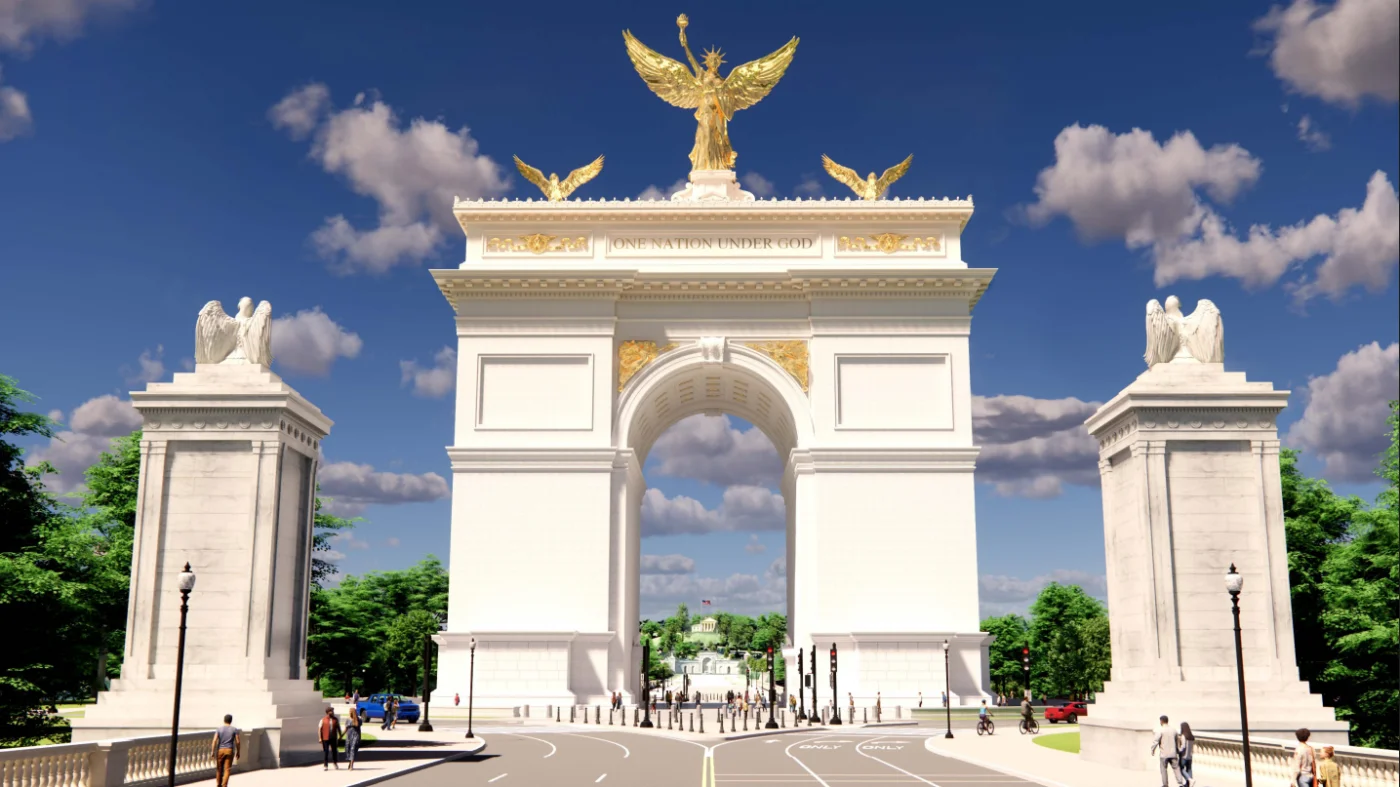
The planned arch is a colossal structure, more than twice the height of the Lincoln Memorial, that would dominate the skyline. Renderings provided by the Department of the Interior show an arch topped with three gold statues and an eternal flame. The Trump administration has touted it as a landmark that will “enhance the visitor experience at Arlington National Cemetery,” but the proposal has ignited fierce opposition. Three Vietnam veterans are among those suing to stop construction of the proposed 250-foot-tall triumphal arch at the center of Memorial Circle between the Lincoln Memorial and Arlington National Cemetery.
More than 100,000 people have submitted written comments against the project. Democratic lawmakers, veterans groups, historic preservationists, and local officials have all spoken out. Their concerns are layered: the arch would obstruct a key historical view linking the Lincoln Memorial to Arlington Cemetery, insult the solemnity of the hallowed ground where service members are buried, and add a new layer of risk to the already complex airspace over the nation’s capital.
Protesters have rallied at Memorial Circle. On Thursday, ahead of the commission vote, the National Parks Conservation Association organized a demonstration near the Lincoln Memorial, where a 17-foot bamboo model of the proposed arch was erected. One demonstrator captured the raw emotion driving the opposition. “I drive up here; The minute I start onto the circle, my visit to my husband’s grave begins then,” they said.
The Legal Fight to Stop the Shovels
While the planning commission votes, a parallel legal battle is reaching a fever pitch. The push for the arch has been met with multiple lawsuits, all arguing the project is unlawful without a direct act of Congress. The first was filed by three Vietnam veterans and an architectural historian. They claim the administration is stretching a century-old authorization for a pair of never-built columns to justify this massive new structure, as reported.
A federal judge, Tanya Chutkan, is considering a preliminary injunction to block construction. On Monday, she issued a strict order, demanding the government notify the court within an hour of any decision on the arch and within 30 minutes of any activity related to construction. The move came after the government informed the court that a contractor, Grunley Construction Company, may already be making off-site preparations. The judge’s order suggests she may wait to rule until after the commission’s meeting adjourns at 6 p.m. ET on Thursday.
The administration pushed back, asking Chutkan for a 24-hour notice window, arguing it needs time to communicate decisions through its chain of command. The plaintiffs countered by pointing to a recent incident in another part of the city where the government cut down 430 trees with less than a full day’s notice. “Indeed, Defendants recently demonstrated just how much they can change the status quo in a matter of 24 hours,” their lawyers wrote, and the judge ultimately kept her original timeline intact.
Over the weekend, the conflict escalated further when the governments of Washington, D.C., and Virginia jointly filed their own lawsuit, calling the arch “flagrantly illegal.” They argue it violates federal laws on environmental review and historic preservation, as well as D.C.’s own height restrictions. Their 55-page complaint details a “battery of irreplaceable injuries” their communities would suffer, from traffic disruptions and environmental degradation to threats to public safety and emergency preparedness. The jurisdictions claim an arch would hinder emergency response along a major corridor between D.C. and Virginia and complicate flight paths for Ronald Reagan National Airport.

Adding another layer of complexity, the Trump administration has suddenly rebranded the arch as a military facility. Just days after the FAA cleared it from an airspace perspective, President Trump announced on social media that it would house snipers and ammunition serve as a military complex. Legal experts saw this as a transparent attempt to frame the project as a matter of national security, an argument that has so far helped the administration proceed with its controversial White House ballroom. The final renderings sent to the planning commission, however, make no mention of drones or snipers. Instead, Defense Secretary Pete Hegseth filed a seven-page declaration calling it a “generational national defense opportunity.” Judge Chutkan was openly skeptical of this new claim during a hearing last week, questioning how a structure meant for 22,000 daily visitors could also function as a military installation.
The Clock is Ticking on a Monumental Decision
The Trump administration’s own timeline adds to the sense of urgency. They have said construction will take two to three years, with crews working 20 hours a day, year-round. The first six months would involve underground excavation and foundation work.
With a new Democratic majority in Congress after the midterms, the long-term future of the arch is far from certain. Susan Douglas with Third Act DMV captured the hope of many opponents when she said, “In order to build a monument on federal property, Congress needs to approve it. I’m hoping very much that the newly electeds come together, find their collective spine and put an end to this nonsense.”
For now, the arch remains caught between an administration determined to move ahead and a federal court demanding that every procedural step be followed. The coming days will determine whether one of the most consequential areas in Washington, D.C., will see the beginning of a new era—or the latest chapter in a bitter legal fight.
Related reading

Durvalumab and FLOT show promise for gastroesophageal cancer
How New Cancer Therapies Are Forging a New Standard for Gastroesophageal Cancer A new treatment approach for gastroesophageal...

Early Intervention is Crucial for Treating Pediatric Eating Disorders
The Rising Pediatric Eating Disorder Crisis Eating disorders have quietly become one of the most significant public health...
Citadel Outlets to Host Tree Lighting Ceremony on November 7
If you have spent any time driving the 5 freeway just south of East Los Angeles lately, you...

Childhood myopia prevalence rose to 35.8% by 2023, study shows
The Silent Rise of Pediatric Myopia When Cassia van der Hoof Holstein noticed her 8-year-old daughter, Viva, struggling...