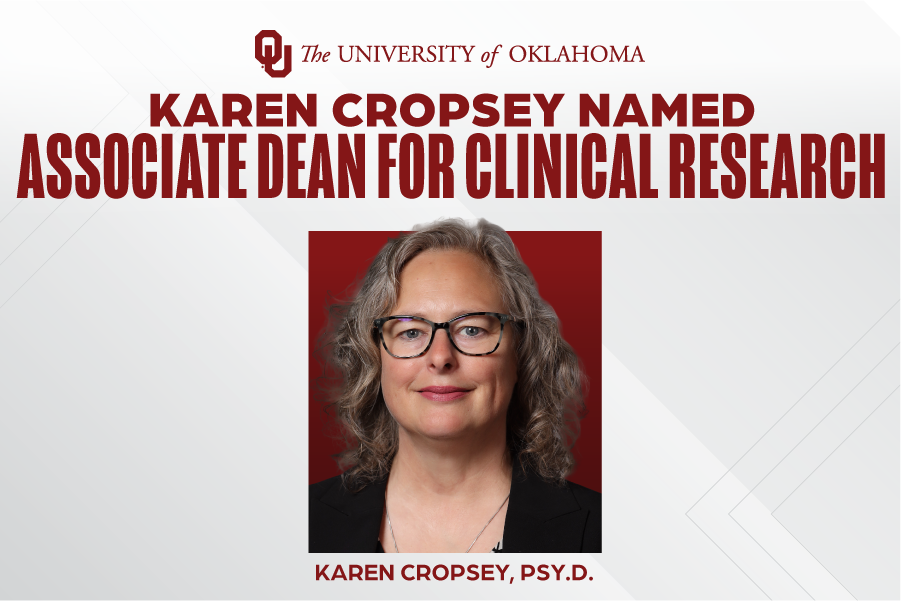
“This is an exciting time to be at OU,” said Karen Cropsey, Psy.D., the newly named Associate Dean for Clinical Research at the University of Oklahoma College of Medicine.
She steps into the role on the OU Harold Hamm Health Campus this week, bringing a portfolio of more than $20 million in National Institutes of Health funding and a research agenda fixed squarely on addiction among people living with HIV and those caught in the criminal legal system.
“Clinical research is sometimes associated primarily with cancer, where clinical trials are an important part of advancing treatment,” Cropsey said. “But research involving patients takes place across all areas of medicine, from psychiatry and neurology to geriatrics and family medicine.”
Cropsey arrives from the University of Alabama at Birmingham School of Medicine, where she served as professor and Vice Chair for Clinical Research in the Department of Psychiatry and Behavioral Neurobiology and directed the Center for Addiction and Pain Prevention and Intervention.
Her recent work has expanded into sleep and circadian disruption in substance use disorders, deploying telehealth, social media recruitment, and digital health tools to reach populations that standard clinic models often miss.
“Our goal is to translate our basic foundational knowledge into treatments that reach all people who need them.”
Karen Cropsey, Psy.D., Associate Dean for Clinical Research, OU College of Medicine
Cropsey said she sees opportunities to use AI and large datasets to accelerate the development of new treatments. “We want to leverage technology to generate bigger, more meaningful findings that then accelerate the process of bringing treatments to patients,” she said.
The Harold Hamm Health Campus, which serves approximately 4,000 students across more than 70 degree programs in Oklahoma City and Tulsa, positions itself as one of the few academic health centers in the nation with seven health profession colleges on a single campus. Cropsey’s dual appointment as a professor in the Department of Psychiatry and Behavioral Sciences embeds her directly in the clinical mission she is charged with expanding.
In 2019, she provided expert testimony to the U.S. Senate Committee on Appropriations on the opioid overdose epidemic. She holds master’s degrees in educational psychology from the University of Wisconsin–Madison and in biostatistics from Virginia Commonwealth University, a Psy.D. from Indiana State University, and completed postdoctoral training at the University of Mississippi Medical Center and Virginia Commonwealth University.
The University of Oklahoma College of Medicine, founded in 1900, is the only medical school in the state granting the M.D. degree. It began as a department in Norman before merging with Epworth College of Medicine in Oklahoma City in 1910 and consolidating into the Health Sciences Center by 1928.
A Tulsa community-based campus opened in 1974 and expanded to a full four-year program in 2015, graduating its first four-year class in 2019. The college enrolls approximately 650 M.D. students and sponsors residency training in 74 specialties with roughly 755 residents and fellows.
The university, founded in 1890, frames the hire as a play for “top talent” to grow the research engine.

Anchorage Weekend: Great Alaska Shootout, Made in Alaska Market, Zine Fair & Holiday Markets
Anchorage heads into the weekend with a collision of high-stakes basketball, statewide craft commerce, and hyper-local culture that...

Colom Plans to Bring ‘Mississippi Values’ to Democratic Party as He Enters U.S. Senate
Mississippi Sen.-elect Scott Colom told SuperTalk Mississippi Media on Thursday that he intends to bring "Mississippi values" to...

10,000 Light Years Band, Jon Davison Tribute John Lodge at Rams Head Nov. 29
John Lodge’s bass lines will echo through Rams Head On Stage on November 29, six months after the...
Utah Zero-Emission Homes Reach Positive Cash Flow in 9.6 Months to 3.2 Years, Analysis Finds
Utah families buying new homes built to modern efficiency standards see positive cash flow in under three years,...