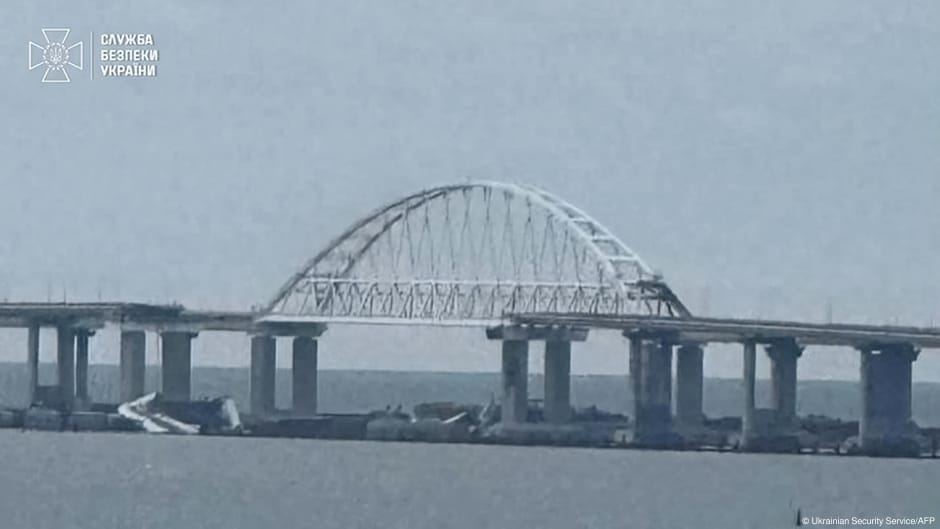
Ukrainian drones and missiles collapsed a 227‑metre road span of the Kerch Strait Bridge on the night of November 17, cutting the direct road link between Russia and occupied Crimea.
The strike, which President Volodymyr Zelenskyy called the seventh stage of an operation, followed systematic suppression of Russian air defences along the approach corridor. One of the bridge’s two steel arches fell into the Kerch Strait, leaving the rail line — damaged but still standing — as a crossing.
Our technologies and companies are developing very well. Today, it was Ukrainian-made weapons that hit the Crimean Bridge. We responded to Russian strikes, and we will continue to respond. We cannot falter before the Russians. God willing, there will be de-escalation and the war… pic.twitter.com/VnB4ojxFZI
Drones cleared the way for missiles
On the nights of November 15 and 16, waves of Ukrainian drones overwhelmed Russian air defences protecting the bridge. That cleared a path for cruise missiles to hit the structure’s weakest points. The Institute for the Study of War confirmed the automobile sections collapsed completely and the railway section sustained damage. Ukraine’s Security Service (SBU) said one metal arch and the road span beneath it were destroyed.
Zelenskyy disclosed that the operation used domestically produced drones and missiles, including the FP‑5 Flamingo cruise missile and R‑360 Neptune missiles. The Flamingo cruise missile was used in the Ukrainian attack on the Kerch Bridge. Ukrainian forces also employed a mesh‑radio relay network — adapted from a Russian battlefield innovation — that let operators more than 250 km away guide missiles and drones around remaining air defences.
First, the SBU and armed forces systematically neutralized the enemy’s air defense system. After that, the direct attack on the bridge began.
Ukrainian Security Service statement
Bridge anchored Russia’s hold on Crimea
The 19 km crossing, built at a cost of $3.8 billion and opened in 2018, was the physical manifestation of Russia’s 2014 annexation. Before the full‑scale invasion, the bridge served as the sole dependable route for supplying Crimea by road and rail from Russia. The invasion created a land corridor through occupied southern Ukraine, but the bridge remained a vital supply line for Russian forces in Crimea and the southern front.
With the road span gone, Russia must rely on the R‑280 highway and the rail link. Losing the bridge will also compel the Russian military to lean more heavily on overland transport via the M-14 and M-18 highways.

Moscow vows to rebuild
Kremlin spokesman Dmitry Peskov vowed the bridge would be rebuilt “even better than before”, and the Investigative Committee opened a terrorism case. Russian‑installed governor Sergei Aksyonov announced a “temporary suspension” of traffic and reported a third strike on November 18, though that attack could not be independently verified. The rail corridor resumed limited operations within days.
“If there is a resource shortage during attacks or in defense, then either the attacks or the defense will fail.” Oleksandr Kovalenko, a Ukrainian military expert with the Information Resistance Group, said.
Engineers say repairing the road span could take about a year under ideal conditions. The entire Sea of Azov coastline lies within 300 km of Ukrainian‑held territory, exposing any reconstruction effort to the same drone and missile threat.
Strike landed days before APEC summit
The attack arrived days before Putin was scheduled to meet U.S. President Donald Trump and Chinese leader Xi Jinping at an APEC summit in Shenzhen. Atlantic Council analysts called it a personal humiliation for a leader closely associated with the seizure of Crimea. Zelenskyy framed the strike as retaliation for Russia’s strikes on Ukrainian infrastructure.
The Crimean Bridge has been partially destroyed. Road traffic between temporarily occupied Crimea and Russia is cut off, and bridge debris has blocked the shipping channel. With fewer routes, Russia’s logistics will be under much more strain, especially in the Zaporizhzhia and… pic.twitter.com/9M2VfUdcXZ
Russia is attacking our infrastructure every day, particularly bridges in Zaporizhzhia, Dnipro, Kyiv, and the Odesa region. We are rebuilding our infrastructure, but we also remind Russia that the war always returns to where it began.
Volodymyr Zelenskyy, President of Ukraine
Ukraine’s General Staff says the bridge no longer functions as a transport artery. With the APEC summit underway and the Kerch Strait shipping channel blocked by debris, the fallout from the November 17 strike continues to unfold.
More on Kerch Strait Bridge
❗️🌉The Crimean Bridge’s entire 227-meter road arch span has collapsed into the Kerch Strait following another Ukrainian attack overnight, blocking the navigable channel beneath the bridge. The adjacent railway arch span has also sustained damage. pic.twitter.com/n9M8QowRHM
Part of the Crimean Bridge collapsed into the Kerch Strait early on Nov. 17, rattling Kremlin supporters and raising fresh questions about Russia's air defenses and the Kremlin's broader strategy for the war in Ukraine.https://t.co/YwqBPxKY84
Ukrainian President Volodymyr Zelenskyy says Ukrainian forces struck the Crimean Bridge over the Kerch Strait overnight in the seventh stage of what he called an operation carried out over several weeks, in response to Russian strikes on Ukrainian infrastructure. Ukraine’s… https://t.co/cujPAjkB70 pic.twitter.com/qCFsPjesTn
The Defence Forces hit the Crimean Bridge: span down, road traffic to occupied Crimea halted During the night of 17 November, the Defence Forces of Ukraine struck the Kerch Bridge. For years, russia built the myth of a “forever russian” Crimea around this bridge, and now that… pic.twitter.com/AyfvzIwg8r
🇺🇦🇷🇺 A road span and arch of the Crimean Bridge collapsed into the Kerch Strait after Ukraine struck it overnight, its third attack on the bridge in about 24 hours, Ukraine's military General Staff confirmed Tuesday. "The arch and the span of the bridge's road section have… https://t.co/19z6HzHnXu
Keep reading

European Commission Proposes €45 Billion Ukraine Loan, Repayment Tied to Russian Reparations
The European Commission proposed a €45 billion loan for Ukraine in 2027, structured so Kyiv repays only after...

Trump, Xi, Putin Trilateral Summit in Shenzhen Set for Nov 19
Trump arrives in Shenzhen as Xi greets him on the tarmac President Donald Trump landed at Shenzhen Bao'an...
Trump Arrives in Shenzhen for Historic Trilateral Summit With Xi and Putin
President Donald Trump arrived in Shenzhen on Wednesday for a historic trilateral summit with Chinese President Xi Jinping...