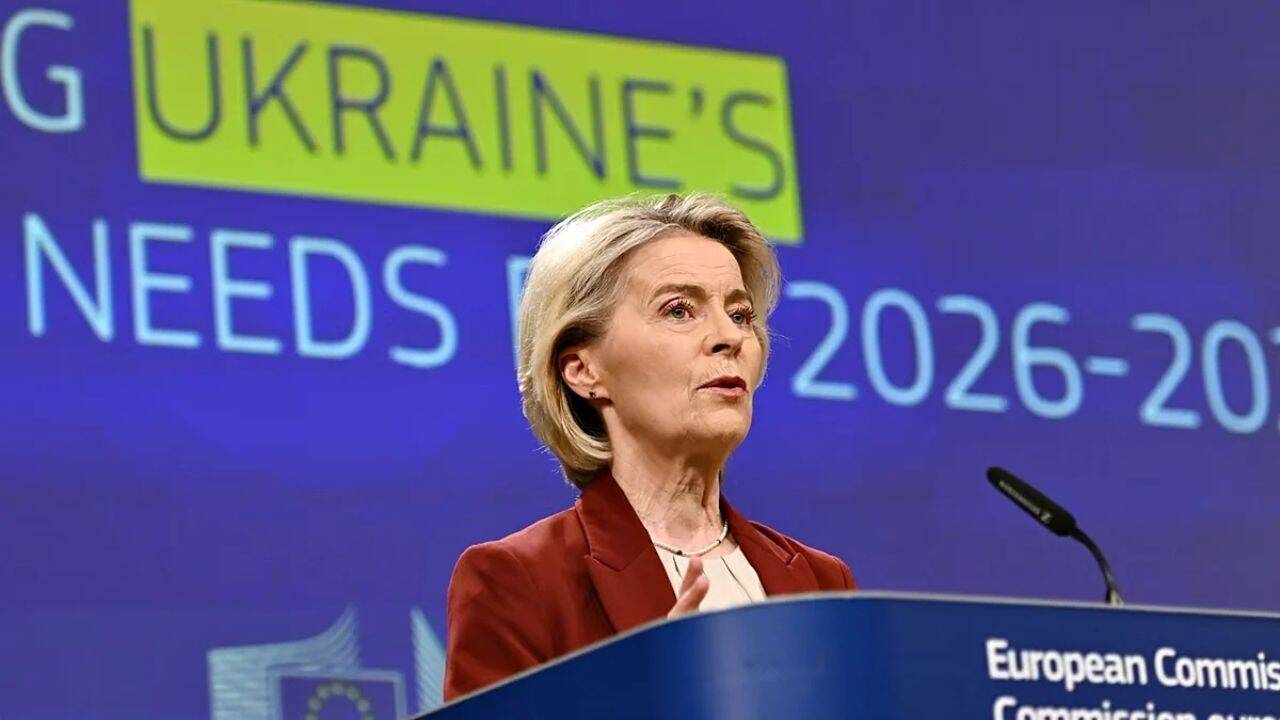
The European Commission proposed a €45 billion loan for Ukraine in 2027, structured so Kyiv repays only after Russia pays reparations for the invasion that began in February 2022.
The plan, announced by Commission President Ursula von der Leyen in Brussels, would cover roughly two-thirds of the €70 billion shortfall Ukraine projects for next year.
It splits the new money into €25 billion for military needs and €20 billion for budget support — keeping schools, hospitals and essential civilian services running. The borrowing would be backed by the EU’s long-term budget headroom, with interest serviced from windfall profits on frozen Russian assets held in Europe.
“Five years since the start of this war of aggression, Europe stands united. We are as committed as ever to support Ukraine in war and in peace,” European Commission President Ursula von der Leyen said.
Unlike conventional lending, the proposal makes Ukraine’s repayment conditional: the principal comes due only once Moscow compensates Kyiv for war damage, through reparations, indemnities or another financial settlement. The mechanism mirrors the €90 billion Ukraine Support Loan agreed in December 2025 for 2026–2027, which also links repayment to future Russian payments. Von der Leyen framed the approach as giving Ukraine “a strong hand at the negotiating table”, according to the Associated Press.
The Commission estimates that around €204 billion ($224 billion) in Russian sovereign assets are immobilized in the EU, mostly at the Belgian clearing house Euroclear. Euroclear has already transferred about €8 billion ($9 billion) in windfall profits to the EU. Belgium has blocked using the principal of those assets directly, so the new loan would rely on the interest stream instead.

Four hold‑outs, one budget lever
Hungary, Slovakia, the Czech Republic and Bulgaria opted out of the €90 billion loan and have signaled they will do so again. Slovak Prime Minister Robert Fico said “Slovakia will not participate in providing another loan to Ukraine … Period. We’ve done enough” ahead of an informal leaders’ summit in Dublin last week.
Von der Leyen countered that she is “very confident that we will agree by 27” — meaning all 27 member states — and backed German Chancellor Friedrich Merz’s push for full participation.
The Commission’s new tactic: embed the loan in the EU’s next multiannual budget (2028–2034) so that “shared budget, shared responsibilities” applies, and separate civilian from military spending in the legal text from the start. That design lets reluctant capitals direct their share to the €20 billion budget‑support pillar rather than the €25 billion military pillar.
What President Ursula @vonderleyen and I discussed earlier could become a reality and GREATLY help Ukraine, our resilience, and our diplomacy. I thank her and the @EU_Commission for the proposal to establish the Instrument for Coordinated Support to Ukraine, under which the EU…
The maneuver also ties the Ukraine vote to the broader budget negotiation. Merz has reportedly threatened to withhold German approval of the 2028–2034 budget unless every member state joins the Ukraine loan, raising the stakes for the special European Council summit set for November 26–27 in Brussels.
Allies asked to cover the remaining third
The Commission expects non‑EU partners — Canada, Norway, Australia, Liechtenstein and Switzerland — to fill the remaining portion of Ukraine’s €70 billion gap. Ukrainian President Volodymyr Zelensky welcomed the plan on Wednesday, saying he “hoped for the swift adoption of this decision by the European Parliament and the Council and count on the support of all EU member states”, according to Arab News PK.
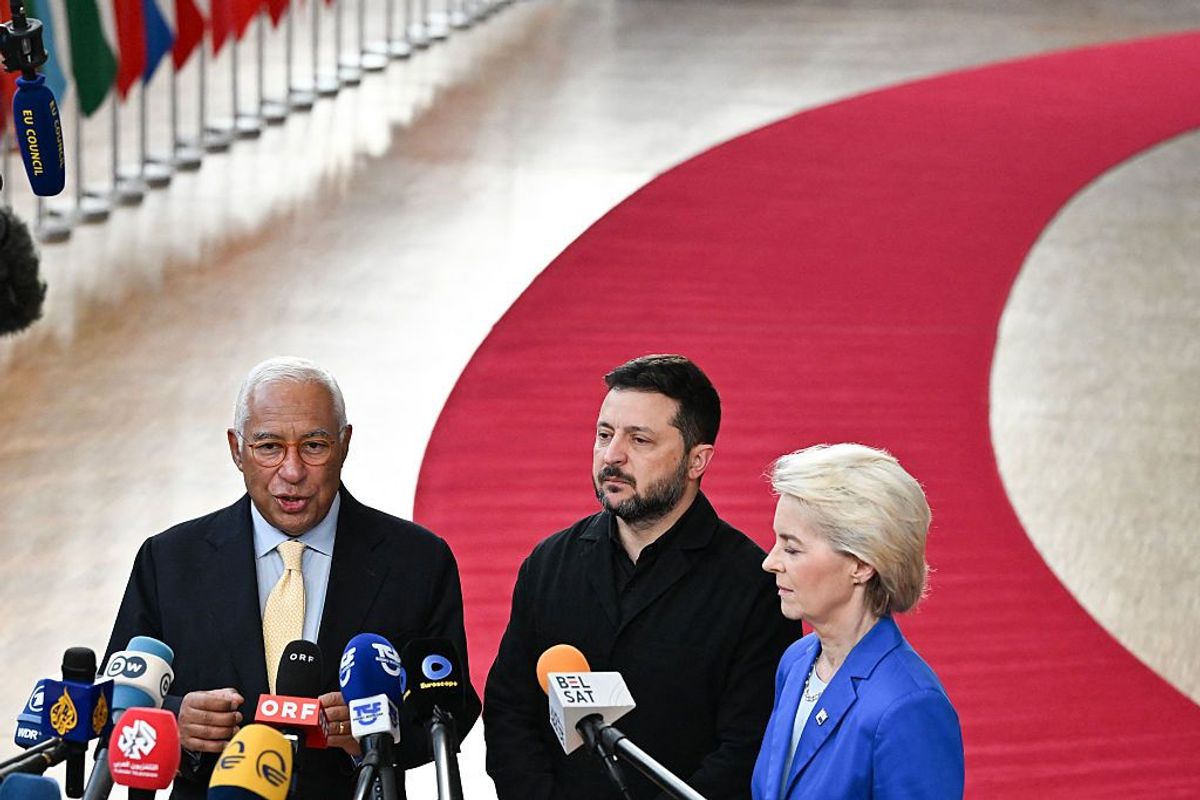
A Versailles echo, without the defeat
The reparations linkage draws inevitable comparisons to the 1921 Allied Reparations Commission bill that fixed Germany’s World War I liability at 132 billion gold marks (about $33 billion at the time). That burden became a major source of economic and political turmoil in the country. Europe is instead trying to front‑load Ukraine’s reconstruction costs while keeping the legal claim on Moscow alive.
EU leaders will debate the proposal and the 2028–2034 budget at the November 26–27 summit. The European Parliament must also approve the loan. Meanwhile, the IMF board meets in December and wants confidence that Ukraine’s economy will hold up over the next 12 months before releasing its next $1.66 billion tranche.
Keep reading
Trump, Xi, Putin Trilateral Summit in Shenzhen Set for Nov 19
Trump arrives in Shenzhen as Xi greets him on the tarmac President Donald Trump landed at Shenzhen Bao'an...
Trump Arrives in Shenzhen for Historic Trilateral Summit With Xi and Putin
President Donald Trump arrived in Shenzhen on Wednesday for a historic trilateral summit with Chinese President Xi Jinping...

Ethiopia Chief Accuses Eritrea of Directing Tigray Offensive
Ethiopia's military chief accused Eritrea of directing a new Tigrayan offensive with Egyptian weapons on November 14, saying...

Knesset Votes 66-52 to Elect Yashar’s Matan Kahana as Speaker, in Boost to Eisenkot Bloc
Israel's parliament elected Matan Kahana of the Yashar party as Knesset speaker on Tuesday in a 66-52 vote...