
“It's the precision that led us to develop our theoretical model. We found that the atomic clock's motion becomes entangled with its internal energy,” said Joshua Foo, associate professor at Kyushu University’s Institute for Advanced Studies.
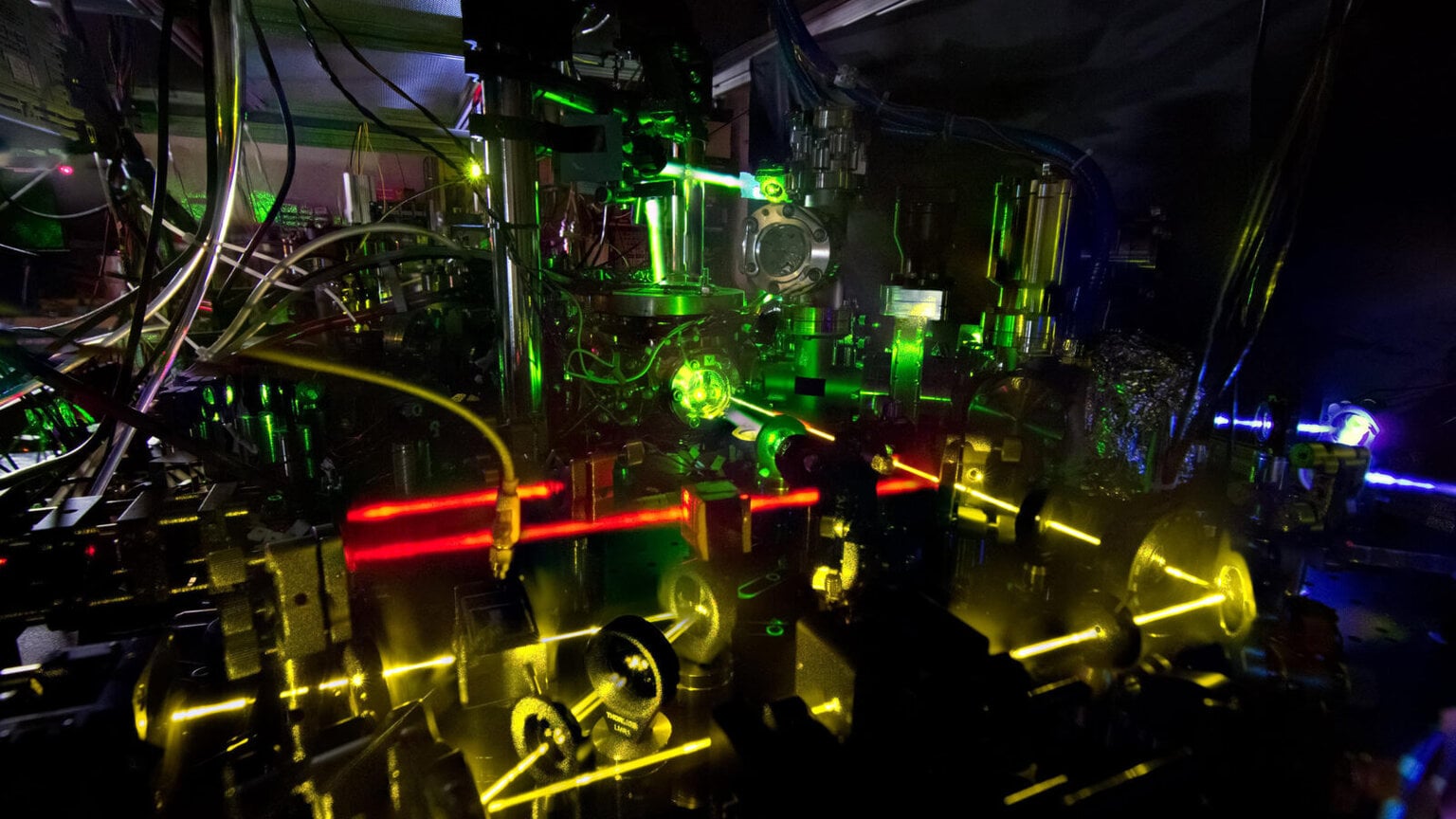
An international team led by Kyushu University has proposed a way to test whether a single clock can tick at two different rates at once, a study published April 20 in Physical Review Letters shows. The theoretical framework uses today’s most advanced trapped-ion atomic clocks to hunt for a “quantum superposition of times” — a phenomenon where quantum mechanics and Einstein’s relativity intersect.
The paper, titled “Quantum Signatures of Proper Time in Optical Ion Clocks,” lists Gabriel Sorci, Joshua Foo, Dietrich Leibfried, Christian Sanner, and Igor Pikovski as authors. It appeared in Physical Review Letters on April 20, 2026, with DOI 10.1103/qhj9-pc2b.
Proposed test hunts quantum superposition of time
Atomic clocks measure time through steady atomic frequencies. They are already sensitive enough to detect relativity’s prediction that time passes faster at higher altitudes — even across a few millimeters of vertical separation. The new proposal exploits that precision.
When an ion’s motion enters a quantum superposition, its velocity becomes uncertain. Because velocity changes the rate of time through relativity, the clock would effectively experience multiple time rates simultaneously.

The researchers found that this superposition entangles the ion’s motion with its internal energy state. The signature of that entanglement is a measurable loss of quantum coherence — the clock “loses some of its quantum properties,” Foo said. Detecting that loss would be the first direct observation of quantum mechanics affecting the flow of time itself.
Technique boosts sensitivity 100 to 1,000 times
The team also developed a technique to control the trapped ion’s motion with unprecedented precision. “We introduced a new technique for controlling the atomic clock's motion, improving its sensitivity to this effect by 100 to 1000 times,” Foo said. That improvement could bring the subtle predicted signal within reach of existing optical ion clock technology, including aluminum-ion clocks modeled by collaborators at the Stevens Institute of Technology.
One model from the Stevens group, led by Igor Pikovski, predicts the interference contrast would drop to nearly 93 percent — a clear, quantitative target for experimentalists to aim for.
Funding sources named
Funding comes from the National Science Foundation, the National Aeronautics and Space Administration, the Alfred P. Sloan Foundation, the Gordon and Betty Moore Foundation, the John Templeton Foundation, the Simons Foundation, the Banting Postdoctoral Fellowship, and the Novartis Science Scholarship.
Next step: move from theory to laboratory
The work remains theoretical. No experiment has yet been run. “Naturally, bringing our theoretical model to reality is the big next step, and developing a detailed experiment that accounts for real-world unpredictability will give us further insight into our model,” Foo said.
The team also wants to explore whether atomic clocks could eventually probe the quantum realm of gravity — the other fundamental question in physics.
Kyushu University traces its origins to a medical school established by the Fukuoka Domain in 1867, the final year of the Edo period. It was founded as Kyushu Imperial University in 1911, becoming the fourth Imperial University in Japan, and was renamed Kyushu University in 1947. The university operates the Institute for Advanced Studies, where associate professor Joshua Foo is based, and hosts 16 faculties and 18 graduate schools.
If successful, such experiments would give physicists a new way to investigate how quantum mechanics and relativity fit together, potentially offering clues about quantum gravity at the smallest scales of nature.

Trade Minister: Indonesia-EU Pact Opens New Export Markets
Indonesia and the European Union signed the Comprehensive Economic Partnership Agreement on Saturday. This IEU-CEPA deal opens new...

PM Modi’s Post Triggers BJP-Congress Political Meme War Over GTA 6 Launch
Thirteen years. That is the gap between Grand Theft Auto V and VI, and it maps almost perfectly...

Indonesia EU Sign IEU-CEPA on Nov 21, 2026, Says ANTARA News
Indonesia EU sign trade pact November 21, 2026 Indonesia and the European Union sealed the Comprehensive Economic Partnership...

PAGASA: Shear Line Brings Rains Over Parts of Luzon; ITCZ in Mindanao – GMA Network
PAGASA forecasts scattered rains and isolated thunderstorms over Northern and Central Luzon on Sunday, Nov. 22, driven by...