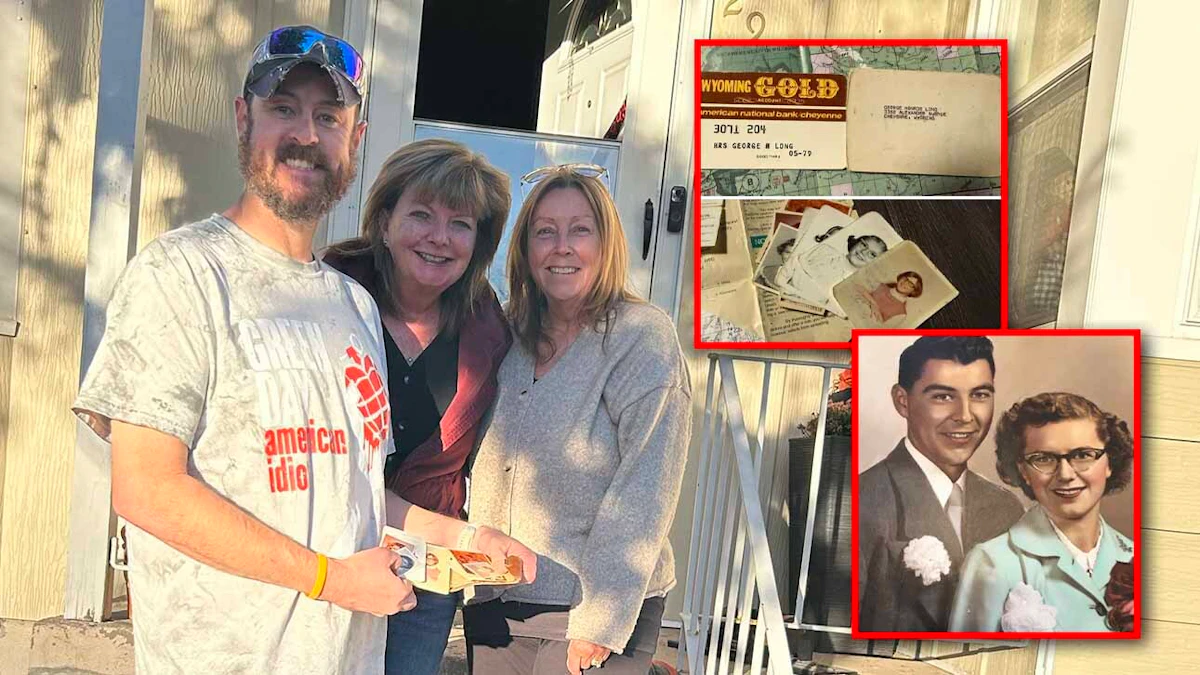
A hidden ledge in a closet on Henderson Drive in Cheyenne, Wyoming, held a secret for decades: a weathered wallet, a stack of faded photographs, and an envelope addressed to a man named George Monroe Long. When J.R. Larsen, a father of three, stumbled upon the items while hiding Christmas presents for his own daughters, he didn’t know George Long, but he knew these pieces of history belonged to someone. After a post on the Cheyenne Community Connections Facebook page, the items were reunited with the four daughters of George Long, 20 years after his death, as reported by the Cowboy State Daily.
For the sisters—Cindy, Kathy, Janet, and Sandy—the recovery of the wallet was more than just finding an old accessory. It was a sudden, tangible bridge to a father they remembered as a “wonderful all-around guy” who balanced the demands of three jobs with the patience to teach them tennis and kickball. The wallet’s return surfaced a narrative of resilience, from the battlefields of the Korean War to a family’s grueling fight against hereditary heart disease.
The soldier behind “Gorgeous George”
To his children, George Long was the man with the Elvis-style slicked-back hair and a permanent wallet-shaped wear mark in his Levi’s 501s. His brother called him “Gorgeous George.” But the documents recovered from the wallet revealed a side of the man his daughters had only known in fragments. Among the keepsakes was an Army registration document and a Presidential Memorial Certificate honoring his service in the U.S. Armed Forces.
A commendation dated October 23, 1952, provides a glimpse into the intensity of George’s military service. It recognizes the officers and men of Company A, 74th Engineer Combat Battalion, for their role in preparing an assault on “Snipers Ridge” during the Korean War. The mission was a grueling feat of engineering and bravery; the unit had to move four tanks up a steep mountain slope with 1,700 feet of elevation while operating within 150 yards of enemy snipers under an “almost constant enemy artillery and mortar barrage.”
George rarely spoke of the courage required to survive such an operation. He returned home to build a life in Cheyenne, eventually earning his pilot’s license before his driver’s license. His daughters remember him as a pilot and a dad who raised four girls with his wife, Arlene.
A family’s battle with “the torpedo”
The recovered writings of George Long also detailed a darker, more personal struggle. He once described his family as the target of a “torpedo of heart disease,” a phrase that captured the sudden and violent nature of the health crises that struck his wife, Arlene, and their youngest daughter, Sandy.
Arlene’s struggle began during her pregnancy with Sandy, leading to a high-stakes open-heart surgery in Denver. George recalled the terror of hearing the intercom call “Red 228″—the code for his wife—and seeing a specialist pounding on her chest to revive her. After a 17-hour ordeal involving two operations, she survived. However, the trauma didn’t end there. In July 1969, three-year-old Sandy was diagnosed with a hole in her heart “the size of a silver dollar” and required her own surgery at Children’s Hospital Colorado.
The cycle repeated a year later when Arlene suffered another cardiac crisis during a family vacation in Washington. The trip home to Wyoming became a trial of maturity for the oldest daughters, Cindy and Kathy, who acted as “mini-mothers” to their younger sisters. Arlene eventually underwent a third surgery on her birthday, July 28, where surgeons replaced her valve with a stainless steel one. George wrote that the survival of his wife and daughter was evidence of “God’s protection.”
The mystery of the Henderson Drive closet
Despite the deep history attached to the wallet, its path back to the Long family remains a puzzle. The item was found in a home on Henderson Drive where Janet Long and her husband, Mike, had lived decades ago. It had managed to remain undetected through multiple owners and years of residency, tucked away on a small ledge in a closet.
George Long passed away in September 2006, leaving behind a legacy of bravery and devotion. The wallet, once lost to the architecture of an old house, now serves as a physical archive of a man who survived the ridges of Korea and the fragility of his family’s health to raise four daughters in the heart of Wyoming.
Keep reading

Judge Rejects DOJ Request to Block 20,000 California Ballots
A federal judge has blocked a Department of Justice attempt to force California to segregate 20,000 ballots from...
Asa Montgomery commits to Duke as No. 3 recruit in 2027 class
Asa Montgomery, the No. 3 overall recruit in the 2027 class, committed to Duke on Wednesday afternoon, choosing...

Trump Returns to Ohio to Campaign for Husted and Vivek Ramaswamy
President Donald Trump returned to Ohio on October 28, 2026, for a campaign rally at Ohio University Chillicothe’s...

Villa Vie Residences leaves passengers stranded in Cambodia
The suspension of the MV Odyssey’s global voyage in Cambodia followed unsustainable financial pressure caused by extraordinary increases...