
An Unmanageable Club? Michael Carrick Becomes the Latest Casualty of Manchester United’s Faded Grandeur
If any football institution fits the Great Man theory of history, it is Manchester United. Over the past century, only two managers—Matt Busby and Alex Ferguson—have successfully knocked the club into enduring shape. A pair of 20th-century Scotsmen, born just 15 miles apart in Bellshill and Govan respectively, found the key to mastering an inherently volatile environment. Otherwise, the club has functioned as a managerial dustbin, with Michael Carrick now standing as the latest figure likely lobbed onto the pile, as reported by The Guardian.
Busby and Ferguson built the club around their own formidable presences, possessing enough raw charisma to convince the rest of the organization that theirs was the only path to follow. Carrick, an insider and a dedicated club man, is currently falling victim to the exact same isolation that consumed his predecessors. When Bruno Fernandes and Lisandro Martínez went off-piste in recent television interviews to depth charge Carrick, they were essentially following established club tradition. With glamour comes a deep-seated decadence—the faded grandeur that has historically chased managers out of Old Trafford.
Decades of Infighting and Executive Intrigue
Beyond Busby and Ferguson, every single United manager who has attempted to steady the ship has felt the lash of desperation from a falling giant. Each defenestration has featured internal infighting worthy of ancient Rome. Favouritism, nepotism, self-interest, entitlement, complacency, and sentimentality have repeatedly betrayed the institution. Living with the outsized legend and lingering influence of Busby and Ferguson sits atop the long list of difficulties every successor faces.
United supporters know this painful history intimately. In December 1970, Brian Kidd confronted his teammates with a blunt assessment when the axe fell on Wilf McGuinness, Busby’s immediate successor, noting that they had let him down. Busby himself had administered the blow. Two years later, a December 1972 meeting at Selhurst Park as Crystal Palace defeated United 5-0 hastened the end for Frank O’Farrell.
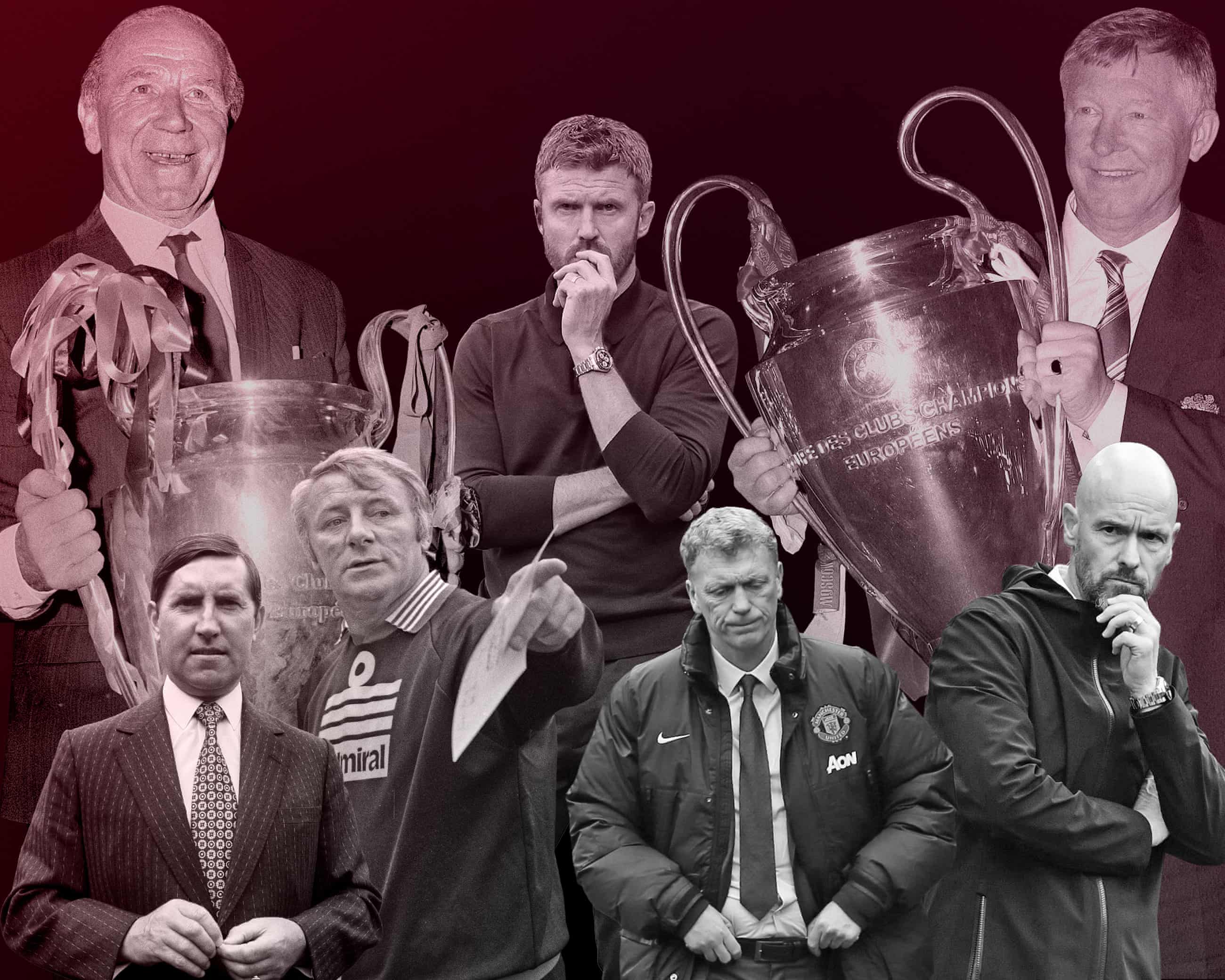
Tommy Docherty’s tenure ended abruptly in 1977 following an affair with the club physiotherapist’s wife, a dismissal announced by club secretary Les Olive from behind the oak door of chairman Louis Edwards’ Cheshire mansion. Dave Sexton was shown the door in 1981 despite winning his final seven matches, undone by falling attendances at what critics began calling “Cold Trafford.” Ron Atkinson turned his November 1986 dismissal into an office party that featured the club’s sunbed, leaving behind hangovers that greeted Ferguson on his very first day in charge.
The Long Shadows of Busby and Ferguson
Ferguson’s predecessors were routinely intimidated by the literal and figurative fog of pipe smoke wafting down the corridors of Old Trafford. O’Farrell famously had to ask Busby if the former manager could vacate the manager’s office, later describing the environment as a fantasy world populated by a coterie of gossipy former players who teed off with “the old man” at Davyhulme golf course.
Managing the superstars of past eras proved equally perilous. Busby’s indulgence of George Best as he careered toward oblivion created problems O’Farrell could not solve. While Docherty showed the political wiles to jettison Best in January 1974, offloading Bobby Charlton, Denis Law, and Paddy Crerand simultaneously generated powerful enemies within the club.
Ferguson’s successors have had to cope with his perpetual presence in the stands, a familiar face sought out constantly by photographers and television directors. His public patronage of Malcolm Glazer’s 2005 takeover remains a dubious legacy dragging down those who followed. Although Ferguson mostly kept his own counsel as a well-remunerated club ambassador, that arrangement shifted when Jim Ratcliffe cancelled a £2-million annual stipend in 2024. Occasional slips, such as Ferguson telling mixed martial arts fighter Khabib Nurmagomedov in 2021 that a manager should “always start with your best players” when Ole Gunnar Solskjær dropped Cristiano Ronaldo, routinely escaped into the public sphere.
Ferguson’s direct involvement in Ronaldo’s disastrous return to Old Trafford echoed the earlier dynamic with Busby and Best. During a recent press conference, Carrick mentioned holding chats with his former boss, while the omission of Fernandes for a match against Bournemouth—leaving him to sulk on the bench in a club tracksuit—bore all the hallmarks of classic Ferguson political maneuvering.
Corporate Restructuring Versus Innate Anarchy
Attempting to act as a Ferguson facsimile has consistently proven to be a fool’s errand. Carrick may have absorbed the lessons dished out to Solskjær, whose assistant he once was.
Time has softened perceptions of the Louis van Gaal and José Mourinho regimes as subsequent failures have piled up.
David Moyes, the immediate successor painted as an afterthought, was initially celebrated as the rightful heir by kingmaker Ferguson in July 2013.
Moyes’s reputation has similarly been burnished by the failures that followed, including Mourinho’s fractious tenure. Emerging reluctantly from his hotel bolt-hole, Mourinho eventually reduced his defense to mocking club history with “football heritage” rants. That scorched-earth approach found echoes in Ruben Amorim, while Erik ten Hag’s retention by Ineos in the summer of 2024 left both the manager and observers thoroughly confused.
Whether Manchester United remains an unmanageable club is a question written into its modern history. Busby and Ferguson proved that success is attainable, but the probability of building another lasting empire recedes with every passing cycle of vanity, internal plotting, and self-interest. In that ongoing reality, Busby and Ferguson themselves ultimately share a portion of the blame.
Related reading

Early Voting Begins in Morton County as Statewide Turnout Hits 13,000
Early Voting Begins in Morton County as Statewide Turnout Climbs Early voting is officially underway in Morton County,...
Runners Criticize NYRR Over Marathon Entry Changes and Higher Fees
The 50th Anniversary Brings a Reckoning for New York City Marathon Entry This August, marathon hopefuls across New...

Final OSAA Boys Soccer Coaches Polls Reveal Top State Rankings
Statewide Coaches Release Final 2027 Boys Soccer Polls The final statewide high school boys soccer brackets are set...

Carlos Condit and Lando Vannata Join Kingdom Muay Thai in Albuquerque
Albuquerque's New Combat Hub on Irving Boulevard Mark Entenberg walked a vacant Westside lot nearly six years ago,...