
Michigan voters on Tuesday overwhelmingly approved a ballot measure barring regulated utilities and large government contractors from spending money in state elections, while soundly rejecting a once-in-16-years question on whether to hold a constitutional convention, Michigan Advance reported.
The two statewide proposals drew starkly different outcomes. Proposal 2, the “Michiganders for Money Out of Politics” initiative, was called by the Associated Press at 9:38 p.m. with less than 10% of the vote counted, taking 81.2% of the “yes” vote for a 62-point margin. Proposal 1, the constitutional convention question, was called at 9:40 p.m. with 15% of votes in, failing with “no” votes taking 75.5% — a 50-point margin. The convention question is constitutionally required on the ballot every 16 years, but has not passed since 1961, when Michigan’s current constitution was written; it also failed in 1978, 1994 and 2010.
What Proposal 2 Actually Does
The winning measure changes state campaign finance law to ban campaign spending from regulated electric and gas utilities, contractors holding more than $250,000 annually in government contracts, and people and organizations with substantial connections to those utilities or contractors, Michigan Advance reported. In practice, that means regulated gas and electric utilities — and the people and organizations with substantial connections to them or to those contractors — can no longer put money into Michigan political campaigns.
Supporters framed the vote as a direct rebuke of pay-to-play politics. “Tonight, David beat Goliath,” said Ken Whittaker of Michigan United when the campaign claimed victory just after 9 p.m.
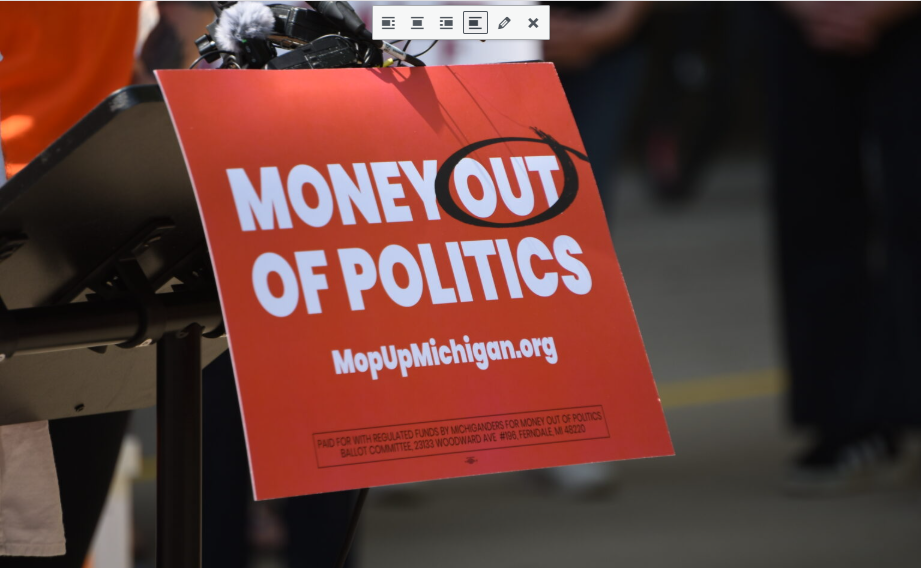
“We’re the ones that make change. Our representatives failed to deliver on holding corrupt pay to play politics accountable, so we said enough. And tonight Michiganders delivered.” — Christy McGillivray, executive director of Voters Not Politicians and co-chair of the ballot effort
The path to the ballot was itself a political fight. Republican leaders in the state House tried to keep the measure off the ballot by enacting a version of it as statute in the Legislature — an action Democrats warned could have made it simpler to amend or repeal later. However, Senate Majority Leader Winnie Brinks, who is also the Democratic nominee for lieutenant governor, chose not to bring it up in the Senate, which left the decision to voters. An opposition group, Protect MI Free Speech, filed a lawsuit against the Board of State Canvassers alleging the petition fell short of the required valid signatures; the Michigan Supreme Court declined to hear the case in early September.
A Broad Coalition Defeats the Convention Question
Proposal 1’s defeat came thanks to an ideologically broad opposition coalition. Groups ranging from Planned Parenthood of Michigan to Right to Life of Michigan opposed the convention, fearing special interests would use the process to rewrite the constitution in their favor. Business groups, labor unions, educators and advocates who disagree on plenty of issues worked side by side on the campaign, according to John Sellek, CEO and chief strategist of Harbor Strategic.
“We’ve never seen this many business groups, labor unions, educators and advocates, who disagree on plenty of issues working, side by side on the same campaign. These organizations recognized a common cause, brought their own networks and perspectives to the table, and worked together toward this important goal. That kind of partnership doesn’t happen every day, and these results show what it can accomplish.” — John Sellek, Harbor Strategic
When the measure was defeated, the organizing group, Protect MI Constitution from Special Interests, issued a simple statement: “THANK YOU! WE DID IT — TOGETHER.”
Why This Matters Beyond Tuesday Night
The 62-point margin on Proposal 2 was a decisive win for the ballot effort. Democrats had warned that if the House had adopted the measure into statute, it could have been easier to amend or overturn later. Meanwhile, the convention question is constitutionally mandated to appear on the ballot every 16 years. The initiative alters state campaign finance law to ban campaign spending by the regulated utilities, large government contractors and connected people and organizations covered by the measure.

2026 USA Fencing National Championships named economic impact champion
When more than 6,100 fencers descended on Portland for ten days this summer, they carried more than foils,...

Massachusetts voters reject ban on recreational marijuana sales in 2026 midterms
Nearly 76 percent of Massachusetts voters said no to Question 8, with the Associated Press calling the race...

Thrive Academy’s perfume-making STEM event inspires Baton Rouge students
At Thrive Academy in Baton Rouge, the boundary between a beauty aisle and a chemistry lab blurred recently...

Christ Episcopal Church Hosts Free Violin and Piano Recital
NEWTON, N.J. (Sussex County) — According to WRNJ Radio, Christ Episcopal Church at 62 Main St. will host...