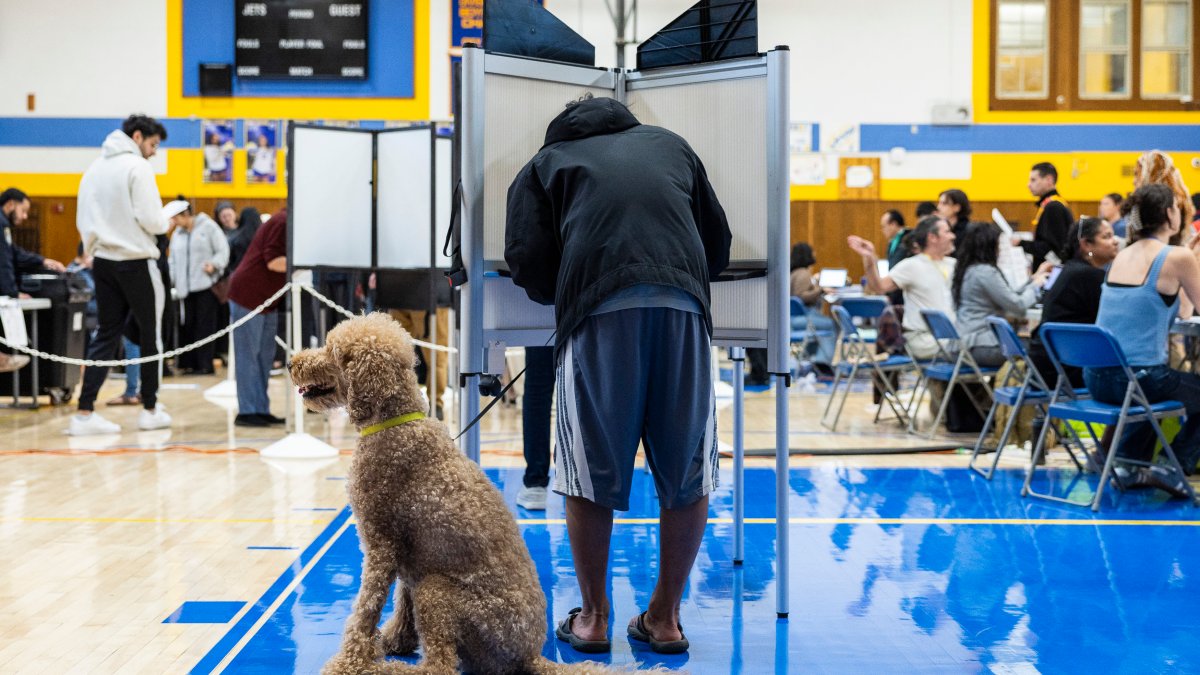
Massachusetts voters faced nine statewide ballot questions Tuesday—the most ever placed before them in a single election—and by Wednesday morning the Associated Press had projected winners on all but two, delivering a verdict that rejected the most sweeping political overhaul while greenlighting new conservation funding, Election Day registration, and the state’s 2024 gun safety law.
The results, still incomplete for Questions 5 and 7 as of midnight, revealed an electorate eager to bypass a Legislature they view as unproductive. Five of the nine measures appeared headed for passage, including a measure subjecting the governor and Legislature to the public records law and a unionization measure for employees at the Committee for Public Counsel Services, while the high-profile primary reform and the cannabis repeal were rejected.
The Primary Fight Ends in a Status Quo Victory
The most closely watched contest, Question 3, sought to replace Massachusetts’ partisan primary system with all-party “jungle” primaries where all candidates compete on one ballot regardless of party. By midnight, roughly 60% of counted votes rejected the measure, a result that preserved the existing dynamic where Democrats and Republicans separately steer their nominees through primaries.
Jordan Berg Powers, chair of Voter Rights MA which opposed Question 3, framed the outcome as a defense against outside influence.
“We did not have millions of dollars in private equity money… But what we had mattered: community activists, labor unions, grassroots organizations, and elected officials united in a broad ideological coalition to say ‘no’ to billionaires buying our democracy,” Powers said in an 11 p.m. statement.
Charlie Baker and Deval Patrick, who had endorsed the measure last month. Baker argued it would “give voters more choice” and force elected officials to “reach across the aisle.” Danielle Allen, chair of the Coalition for a Healthy Democracy behind Question 3, acknowledged the uphill battle.
“And when you throw grit into the gears of a political machine, the machine fights back…
The people who benefit most from the way things are fought hard for this result,” the coalition said.
Election Day Registration and Public Records Win
Less controversial but still significant, Question 4—allowing Massachusetts residents to register to vote on Election Day—was on track to pass with about 56% support.
Voters also overwhelmingly backed Question 1, which subjects the governor’s office and the Legislature to the state’s public records law. Question 2, allowing employees at the Committee for Public Counsel Services to unionize, also appeared headed for passage.
The Money Questions Split
Two questions dealing with state finances produced divergent outcomes. Question 6, which redirects sales tax revenue from sporting goods, recreational vehicles, and golf courses into a new fund for water and land conservation, celebrated an apparent victory around 10:30 p.m. Supporters projected the measure could generate up to $100 million. The law would take effect July 1, 2027, with 50% of tax revenues earmarked in the first year and 100% in subsequent years, though the money remains subject to legislative appropriation.
Katie Theoharides, a campaign leader and former energy and environmental affairs secretary, told supporters at the Fairmont Copley in Boston that Massachusetts is losing the opportunity to protect more land and that supporters saw a different pathway to correct what they viewed as an underfunded issue. “It means so much — not just to us here tonight, but to everyone across the state and beyond. This will ripple across the country,” she said.
By contrast, Question 5—a measure to limit state tax collections to a specific amount based on previous revenue plus average wage and salary growth—was on the path to failing, with 53% of voters opposing it based on nearly half of votes tallied.
Gun Laws and Cannabis Protections Confirmed
The clearest mandate of the night came on Question 9, where approximately 67% of voters chose to uphold the 2024 gun safety law, fending off an effort to repeal it. The law, crafted in response to the Supreme Court’s 2022 Bruen ruling, includes new oversight of ghost guns, strengthened red flag provisions, tightened licensing requirements, and updated assault weapons restrictions.
Ruth Zakarin, chair of the Yes on 9 for a Safe Massachusetts campaign, said the result sent a message beyond state lines.
“When we heard that our opposition wanted to use this as a playbook to take to other states with strong gun laws around the country, voters across Massachusetts said absolutely not,” she said.
Voters also rejected Question 8, an effort to roll back recreational cannabis legalization, maintaining the status quo on marijuana policy.
Zoning Reform Remains Uncertain
As of Wednesday morning, two questions remained uncalled. Question 7, which would allow homes to be built on lots of at least 5,000 square feet, appeared too close to call.
Nine questions about legislative inaction highlight growing frustration among Bay Staters, as candidates increasingly skip the usual State House process. While the approach rankled top Democrats in the Legislature, lawmakers ultimately declined to strike compromises or take direct action on the measures, leaving voters to decide the fate of everything from primary elections to public records access.
Whether Beacon Hill will respect these results remains the open question. The Legislature’s track record of altering voter-approved laws—and its resistance to the 2024 voter law for a legislative audit—leaves uncertainty over how quickly, or whether, Tuesday’s mandates will be implemented.
Related reading

2 of 4 East Lansing Ballot Proposals Pass in Midterm Election
East Lansing voters split their decision Tuesday night, approving exactly half of the four ballot measures on the...

2026 USA Fencing National Championships named economic impact champion
When more than 6,100 fencers descended on Portland for ten days this summer, they carried more than foils,...
Massachusetts voters reject ban on recreational marijuana sales in 2026 midterms
Nearly 76 percent of Massachusetts voters said no to Question 8, with the Associated Press calling the race...

Thrive Academy’s perfume-making STEM event inspires Baton Rouge students
At Thrive Academy in Baton Rouge, the boundary between a beauty aisle and a chemistry lab blurred recently...