In majority-Black Hinds County, the acceptance rate fell to 34 percent from 60 percent in 2024, Associated Press data shows.
Democratic lawmakers in Mississippi are demanding an investigation after the state’s voter rolls showed a spike of nearly 60,000 people listed as “inactive” ahead of the November midterms, a shift that coincided with the use of credit-bureau data to verify addresses.
The increase — from 171,000 inactive voters in the last presidential election to more than 230,000 this fall — came after Republican Secretary of State Michael Watson integrated Experian data into the list-maintenance process in 2025. Democrats say the timing, just before Democrat Scott Colom unseated Republican Sen. Cindy Hyde-Smith by just over 8,000 votes, suggests eligible voters may have been wrongly sidelined.
“We need answers to give to our constituents, because the question is still out there: Did my vote count?” said Rep. Kabir Karriem, chair of the Mississippi Legislative Black Caucus, which scheduled a news conference Thursday to press for legislative oversight hearings. “It was disenfranchisement called by another name.”
Mississippi deactivates voters immediately upon mailing
For years Mississippi relied almost exclusively on U.S. Postal Service change-of-address records to flag voters who may have moved. Under the Experian partnership, county officials gained access to credit-header and Social Security data to supplement those postal records. State law requires election officials to move a voter to inactive status at the same time they mail a confirmation card; the voter must return the card to reactivate.
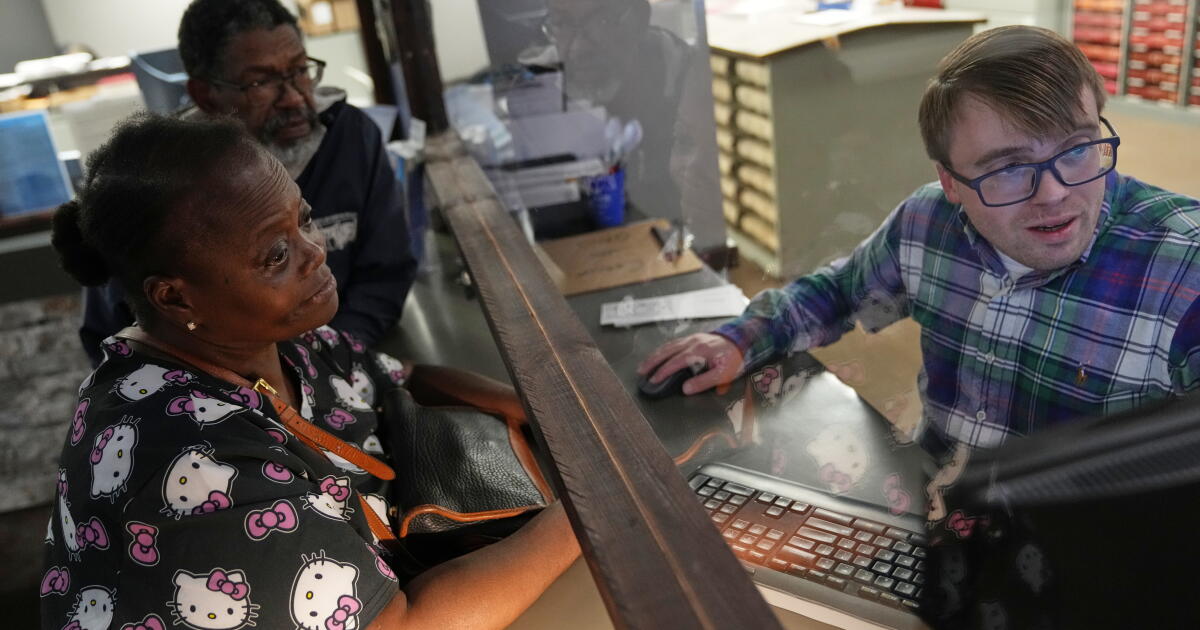
That immediate deactivation sets Mississippi apart. According to the MIT Election Data and Science Lab, states including Delaware, Maryland, Oklahoma and Rhode Island generally allow voters time to respond before changing their status. In Mississippi, many voters learned they were inactive only when they arrived at the polls and were handed a provisional ballot — called an affidavit ballot here.
Hinds County provisional acceptance rate plummeted
The secretary of state’s office said 21,484 provisional ballots were cast in the midterms, nearly identical to the 21,321 cast in the 2024 presidential election despite lower turnout this year. Statewide, 75 percent of those ballots were approved. But in Hinds County — majority-Black and home to Jackson — the acceptance rate fell to 34 percent, down from 60 percent in 2024, Associated Press data shows.
It is not clear from the available data whether the Experian integration drove the Hinds County drop. Elizabeth Jonson, a spokesperson for Watson, said the 230,000 figure “accumulated over more than five years of maintenance by local officials” and that the state does not classify voters as inactive solely based on Experian data. Watson has since moved to a new vendor, Interactive Data, which draws from all three major credit bureaus.
In a social media video, Watson said, “I don’t apologize for cleaning voter rolls. That is my job.”
Experian spokesman Scott Anderson said the company has not provided services to Mississippi since early 2025 and that “decisions regarding voter registration policies, procedures and record updates are made solely by election officials in accordance with applicable local, state and federal laws.”
Legislative response taking shape
Rep. Cheikh Taylor, chair of the state Democratic Party, plans to introduce legislation in the upcoming session that would require voters to be given a chance to confirm their address before being moved to inactive status and would add transparency around how credit data is used. He said he hopes to win Republican support.

“This is not a partisan issue,” Taylor said. “The right to vote and the freedom to vote belongs to us all.”
Republican state Sen. Jeremy England signaled openness to the idea. “I don’t think there was anything nefarious involved with it, but look, Mississippi also does have a dark past when it comes to elections,” England said. “It’s something we definitely need to look at more and make sure that we’re doing it in a better way.”
Scott Colom, born in Columbus, Mississippi, in 1982, has been district attorney for the 16th Judicial District since 2016 and was the first Black person elected to that post in a majority-white district. In 2022, President Joe Biden nominated him for a federal district judgeship, but the nomination was blocked by Hyde-Smith.
Colom then became the Democratic nominee for U.S. Senate in 2026 and unseated Hyde-Smith by just over 8,000 votes, making him the first Black senator from Mississippi since Reconstruction and the first Democrat to win a Senate seat there since 1982.
With the governor’s race and legislative seats on the ballot next year — and Gov. Tate Reeves termed out after winning reelection by just three points in 2023 — both parties are watching the rolls closely.
Related reading

Portland Parents Poke Holes in District’s Recommended School Closure Plan – OPB
Portland families learned Tuesday that a plan to close 10 elementary schools would cut more teaching positions than...

Father and Son Die After Home Explosion Southwest of Lincoln
A father and son died Wednesday night after an explosion tore through their home southwest of Lincoln while...

Hyde Development Plans $150M Light-Industrial Campus on Former Smurfit Westrock Site in St. Paul
Hyde Development announced Monday it plans to acquire the former Smurfit Westrock plant in St. Paul's Midway neighborhood...
Undue Hardship and the Problem of Hypothetical Costs After Groff v. DeJoy
The Supreme Court's decision in Groff v. DeJoy rewrote the standard for religious accommodations in the workplace, but...