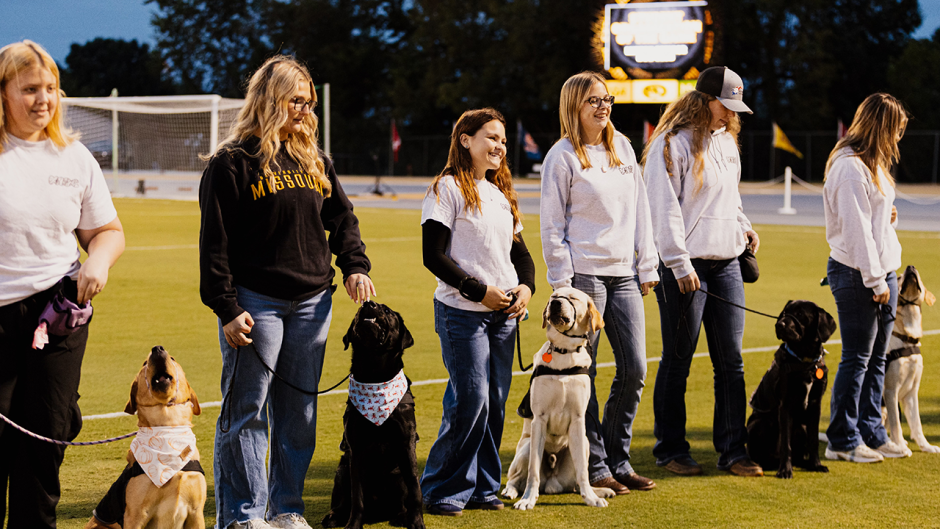
“Knowing they will go to someone in need reminds us how life-changing this work is,” said Amaris Vazquez, a student at the University of Missouri.
Vazquez, who studies social work in the College of Health Sciences, is currently raising Newt, an 11-month-old yellow Labrador retriever. Through the Mizzou Service Dog Club, she and her peers spend up to a year preparing puppies to eventually serve as companions for veterans and children with autism, showme.missouri.edu reported.
The club has seen rapid expansion since its inception. Founded in 2024 with roughly a dozen students, the organization has grown to more than 100 members.
The puppies arrive at the university when they are approximately 12 weeks old. Students manage their development for a year before the dogs move toward their final placements.
Some dogs transition to further training with students in the Mizzou Army ROTC program. From there, they work with Retrieving Freedom, a nonprofit based in Sedalia, Missouri, to prepare for life with a permanent partner.
For veterans living with mobility challenges, service-related disabilities, or post-traumatic stress disorder, these animals provide more than companionship. The dogs are trained to perform specific tasks, such as flipping light switches, opening doors, or retrieving items that have been dropped.

Training involves rigorous exercises to ensure the dogs can function in unpredictable environments. Recently, club members worked with the dogs to complete obstacle courses filled with distractions like toys on stairs, food on the ground, and leashes in hallways.
Every Tuesday, a trainer from Retrieving Freedom travels from Sedalia to Columbia to review progress reports and help students refine their training strategies.
The program serves as a dual training ground, developing both the animals and the students. For those in the Army ROTC program, the work is tied to their future military careers.
Cadets Joey Novotny and Logan Bolin both train Labradors—Lovie and Valley, respectively—as part of their development. Novotny, a senior studying animal science, noted that the program allows cadets to support the soldiers who served before them.
Bolin, a sophomore studying hospitality management, emphasized the social impact of the club’s mission. “Being able to provide help to someone for free is empowering and truly moving,” Bolin said. “It not only helps the heroes who came before us, but it also creates better heroes of ourselves.”
The emotional weight of the work is a constant factor for the student handlers. Vazquez noted that while they build deep bonds with the dogs, they must prepare for the eventual separation when the animals are paired with their lifelong partners.
The impact of the club is already visible. Just two years after the group was founded, at least four of the earliest dogs have already been paired with their permanent partners.
Newt’s own progress highlights the patience required for the role. Vazquez described the puppy as a “sassy boy” who initially struggled with crate training and patience. However, after being voted the club’s “Top Dog” for significant improvement, Newt has moved past his earlier reputation as the “Biggest Drama King.”
Vazquez’s time with Newt is scheduled to conclude in January 2027.
Keep reading

NASA Tracks 47,000 MPH Meteor Fireball Over North Carolina and Tennessee
A fireball streaked across the sky at 47,000 mph A bright meteor traveling at 47,000 mph lit up...
Brown University Report: $26M NIH Grant to Fund RI Research
Advance RI-CTR secures $26 million for biomedical research A federal grant of $26 million will fund the next...

Adrian Fire Chief George Martin Dies After 44 Years of Service
Chief George Martin died Saturday, Nov. 7, 2026, after suffering a medical emergency while responding to a motor...

Oklahoma Farm Bureau Concludes 85th Annual Meeting in Oklahoma City
Oklahoma Farm Bureau sets 2027 policy priorities Oklahoma Farm Bureau members convened in Oklahoma City from Nov. 6-8...