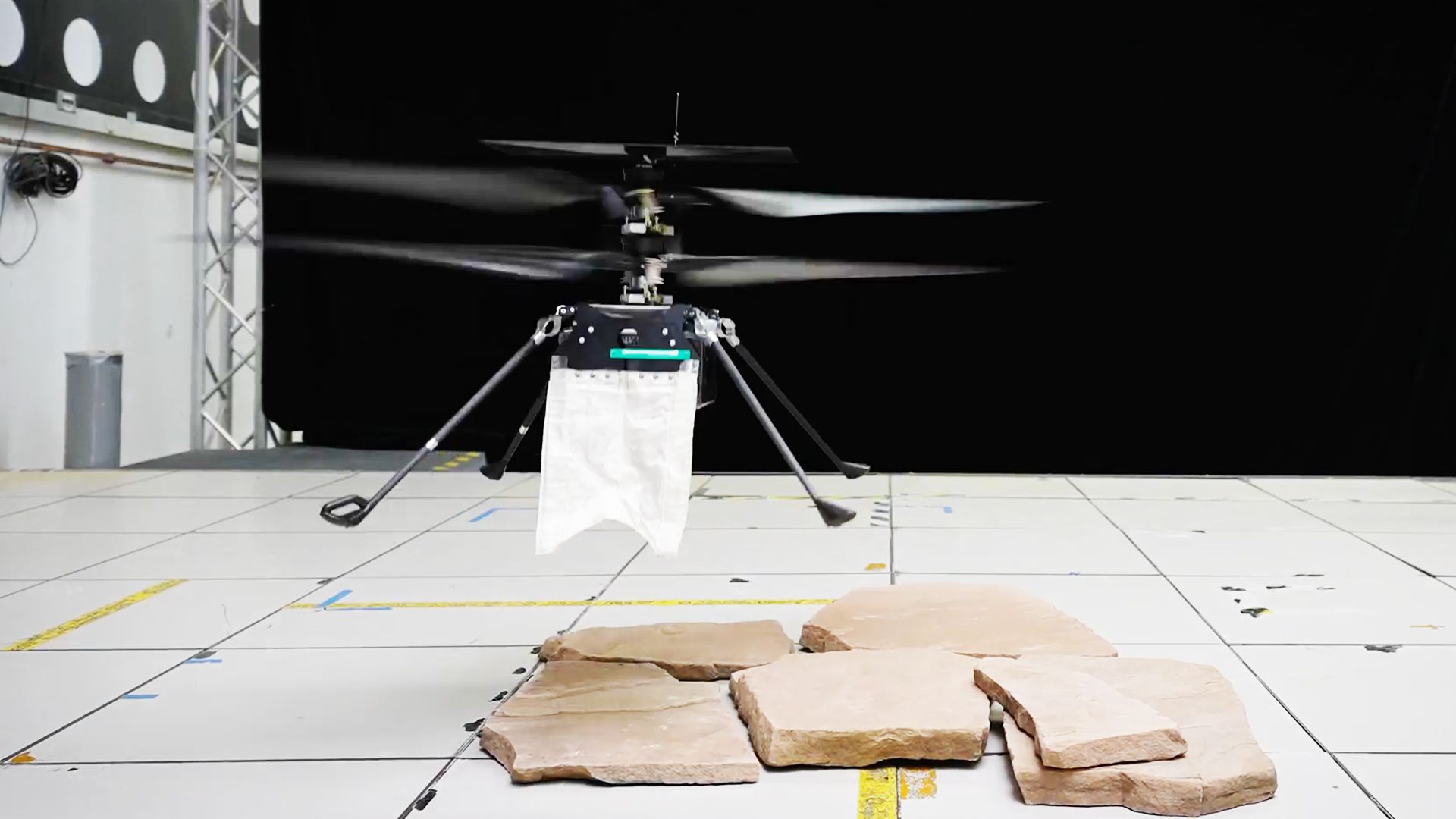
Engineers at the Jet Propulsion Laboratory have developed 5-ounce flexible radar antennas that act like tiny capes, allowing the rotorcraft to map shallow subsurface ice during dozens of planned flights.
Orbiting spacecraft have spent decades mapping Mars from above, but those high-altitude instruments cannot see the first few feet of material lying just beneath the surface. To bridge that gap, NASA’s upcoming SkyFall mission will send a trio of mini rotorcraft to peer directly into the upper layers of Martian soil. Scheduled to launch in December 2028, the mission follows in the footsteps of the Ingenuity Mars Helicopter, which proved that powered, controlled flight is possible in the thin Martian atmosphere across 72 flights over nearly three years.
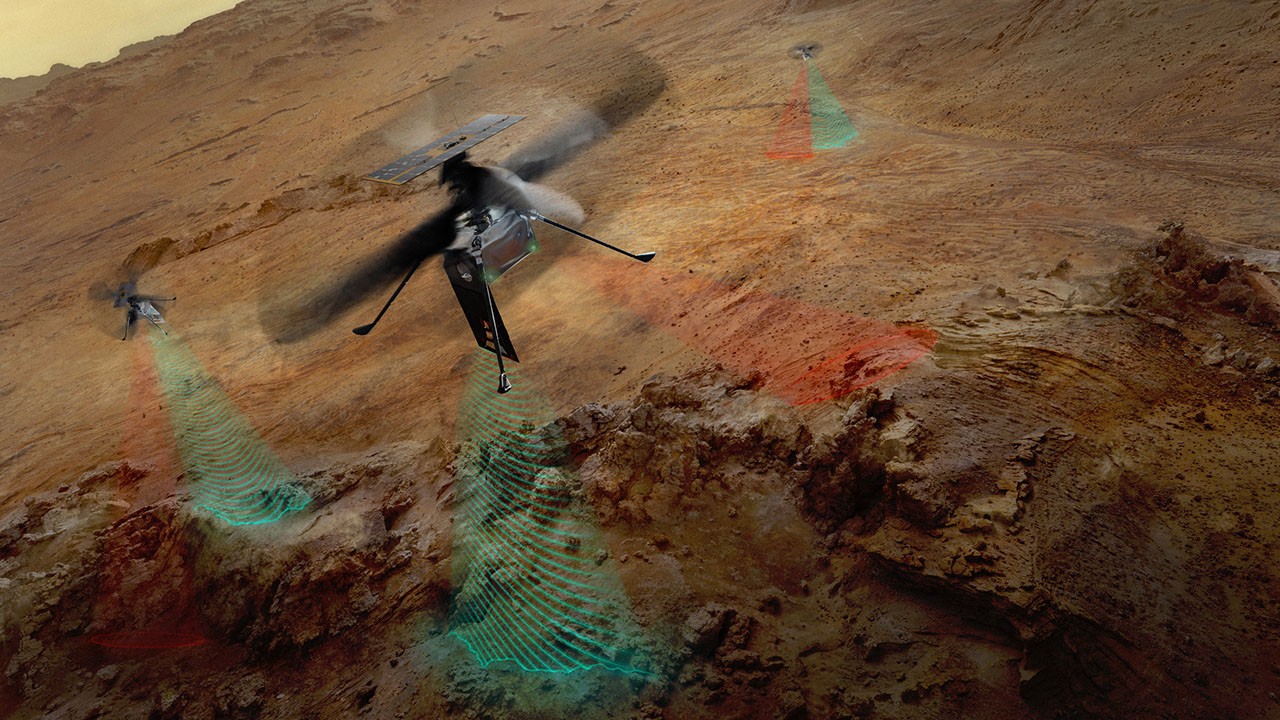
While Ingenuity demonstrated the viability of aerial exploration, SkyFall is designed for heavy science work. AeroVironment of Arlington, Virginia, which co-designed and co-manufactured Ingenuity with JPL, will also co-design and co-manufacture the SkyFall helicopters. Each of the three rotorcraft will carry four instruments, including near-infrared imagery to examine surface regolith and ground-penetrating radar to detect subsurface water ice. That ice data will help future explorers locate accessible drinking water, oxygen, and fuel, while also giving the Perseverance rover team valuable route-planning insights from an aerial perspective, according to NASA.
Engineering the Vivaldi Antenna for Martian Landings
The central technical hurdle for the mission’s ground-penetrating radar was physical scale. Detecting shallow subsurface ice requires a low-flying aircraft equipped with a specialized antenna design known as the Vivaldi, which was invented in 1978. But a standard Vivaldi footprint was far too large to clear the ground when mounted on a helicopter that sits just 6 inches above the surface at rest.
JPL engineers successfully miniaturized the radar so it can survey up to 16 feet below the Martian regolith—a material that blocks radio waves far less than Earth’s soil. Even after downsizing, however, the antenna remains noticeably oversized relative to the aircraft.
“Although we managed to shrink the antenna quite a bit, it is about 1½ times longer than the helicopter’s legs,”
Christine Gebara, SkyFall ground-penetrating radar mechanical lead at JPL
That physical disparity creates a constant mechanical challenge during field operations. As Christine Gebara explained, the antenna has to bend completely out of the way when the helicopter touches down, flexing even further if it lands on a rock. When the aircraft lifts off again, the hardware must spring immediately back into shape to collect accurate radar data without degrading performance over dozens of flights.
Materials and Environmental Testing in Southern California
To withstand extreme physical stress and harsh environmental shifts, the 5-ounce (142-to-150-gram) radar capes require advanced aerospace materials. Engineers sheathed the antenna in polyester followed by layers of Vectran—the same flexible, high-strength material used for the landing airbags that cushioned the Spirit and Opportunity rovers during their 2004 Mars touchdowns. The structure is reinforced with flexible fiberglass tape springs and a lightweight magnesium mounting frame.
Before clearing the hardware for flight, the team tested the assembly rigorously in the Environmental Test Laboratory at NASA’s Jet Propulsion Laboratory in Southern California. Engineers simulated the extreme Martian day-night cycle, where temperatures swing by as much as 170 degrees Fahrenheit (94 degrees Celsius), while running mechanical fatigue checks.
Working in the lab’s electromagnetic interference testing chamber, radar engineer Maya Román and her colleagues repeatedly flexed the antenna to simulate dozens of landings, pausing periodically to verify that signal transmission and reception remained intact. According to JPL, the antenna successfully endured 200 simulated Mars landings during testing and continued to function without operational loss.
Mission Architecture and Upcoming Launch Timeline
The rotorcraft are slated to launch in December 2028 aboard the Space Reactor-1 Freedom mission, carrying a fission reactor designed to provide nuclear power. That power source will support an expanded operational tempo for the trio of helicopters as they survey shallow ice deposits across multiple flight paths.
While orbiting satellites continue to map planetary features from high above, SkyFall’s low-flying rotorcraft will provide the high-resolution, centimeter-scale subsurface data required to evaluate landing safety and resource extraction for future human missions. With laboratory stress testing complete, the JPL team will continue preparing the featherweight radar systems for their eventual journey to Mars.
Keep reading
NASA Roman Telescope Powers Up 300-Megapixel Instrument in Space
NASA’s Nancy Grace Roman Space Telescope launched aboard a SpaceX Falcon Heavy rocket and has now successfully powered...
Perseverance Rover Finds Volcanic Rocks at Mars’ Jezero Crater Rim
NASA’s Perseverance rover found volcanic igneous rocks instead of expected sedimentary layers along the inner rim of Mars’...
SpaceX Targets First Orbital Flight for Starship on September 28, 2026
SpaceX is targeting September 28, 2026, for Starship's 14th test flight from Starbase, Texas, with a 75-minute window...
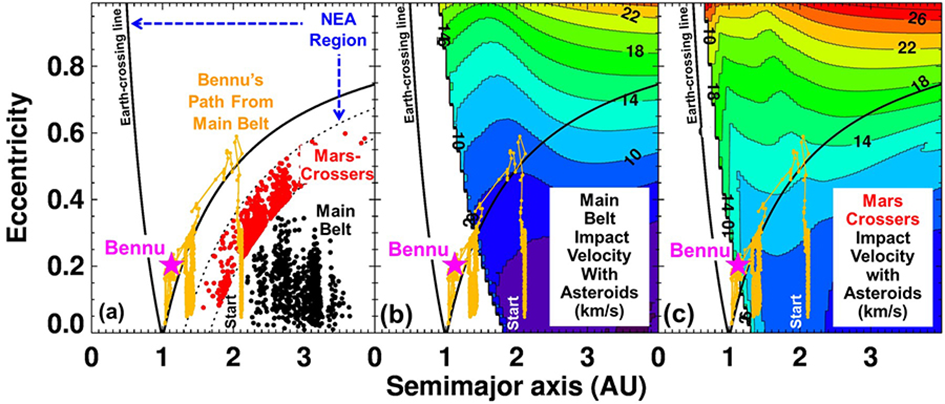
ETH Zurich Researchers Link Asteroid Bennu to Inner Solar System Transition Zone
Researchers analyzing titanium, chromium, and iron isotopes in samples returned by NASA's OSIRIS-REx mission have discovered that asteroid...