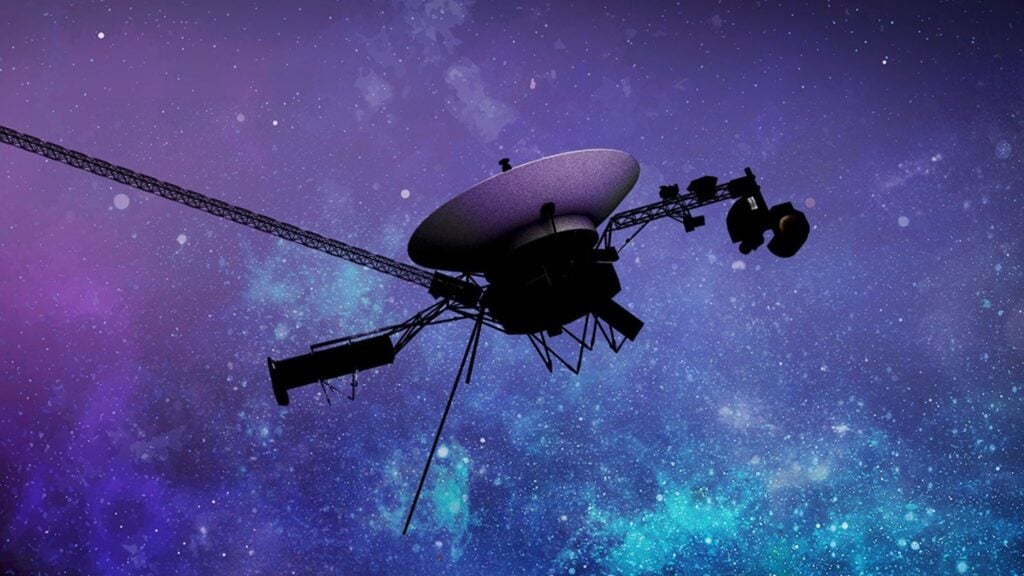
NASA engineers running the Voyager 2 spacecraft have successfully executed a power-switching strategy dubbed the “Big Bang,” extending the historic mission’s life into 2028 and delaying the shutdown of its Cosmic Ray System past the 2027 50th anniversary, according to a recent engineering update.
Operating a spacecraft in interstellar space for nearly half a century demands a mastery of subtraction. As nuclear power supplies steadily decline, mission managers at NASA must constantly decide which systems to turn off to keep critical instruments alive. For Voyager 2, that engineering challenge recently led to an aggressive, all-at-once power configuration that bought the aging probe precious extra operating time.
The Power-Thermal Dilemma of Sequential Shutdowns
The central limiting factor for both Voyager spacecraft is the predictable decay of their onboard nuclear power sources. This available output declines by roughly four watts each year as the plutonium produces less heat and the thermoelectric material loses efficiency with age.
When the mission began, three generators supplied about 470 watts, providing a generous margin for ten science instruments, computers, heaters, and radio equipment. Today, power management works strictly through subtraction. Originally, engineers planned to turn off spacecraft systems sequentially in a series to save power as supplies dwindled.
Shutting down instruments one by one in a series failed to provide enough residual heat to keep vital components warm. If the spacecraft grew too cold, propellant lines would freeze, making it impossible to point the high-gain antenna toward Earth.
Instead of turning systems off one by one, they proposed shifting power loads simultaneously within the spacecraft bus.
“The idea behind the Big Bang… If we were to switch systems and do a lot of power switching all at once within the bus of the spacecraft, we would gain a lot of power and it would still keep the electronics warm, as opposed to when we do it serially (in a series), it doesn’t provide enough of the heat input to keep the propellant lines warm.”
Suzanne Dodd, Project Manager for the Voyager project, via The Register
Executing the plan required meticulous modeling based on documentation nearly 50 years old. Every test was further complicated by deep-space signal delay: commands took up to 20 hours to reach Voyager 2, and another 20 hours for the response to return.
Following extensive testing on Earth, the team conducted initial orbital trials. In the first test, Voyager 2 entered the new configuration for just a few minutes, proving that power commands behaved precisely as expected. At the beginning of June, the team tested the thermal model by leaving the spacecraft in the configuration for six hours—long enough to observe thermal trends while maintaining a safety margin.
Executing the Permanent Shift and Expanding Margins
With thermal and power data matching expectations, the team moved forward with a permanent change. On July 9, the configuration was executed on the spacecraft, initiating a tense waiting period while engineers monitored thermal settling over the subsequent 36 to 48 hours.
“The nail-biter was that we had executed the commands twice before – we were pretty certain that those would work – but we had only done a limited thermal test. So we weren’t really sure after 24 or 48 hours where we would settle out thermally.”
Photo: The Register
Suzanne Dodd, Project Manager for the Voyager project, via The Register
The gamble paid off. The spacecraft settled into a stable thermal profile without experiencing the temperature drop predicted by conservative computer models. Furthermore, the team secured positive surprises in power gains, forcing engineers to update their predictive models.
By squeezing every fraction of a watt from the half-century-old system, the update successfully postponed the next scheduled instrument shutdown—targeting the Cosmic Ray System—to a timeline well into 2028. Meanwhile, Voyager 1 continues operating on even narrower power margins further away, with active measurements maintained by its magnetometer and Plasma Wave Subsystem beyond the heliopause.
NASA's Voyager 2: How Engineers Extended Its Mission by 1 Year | Space Exploration Breakthrough