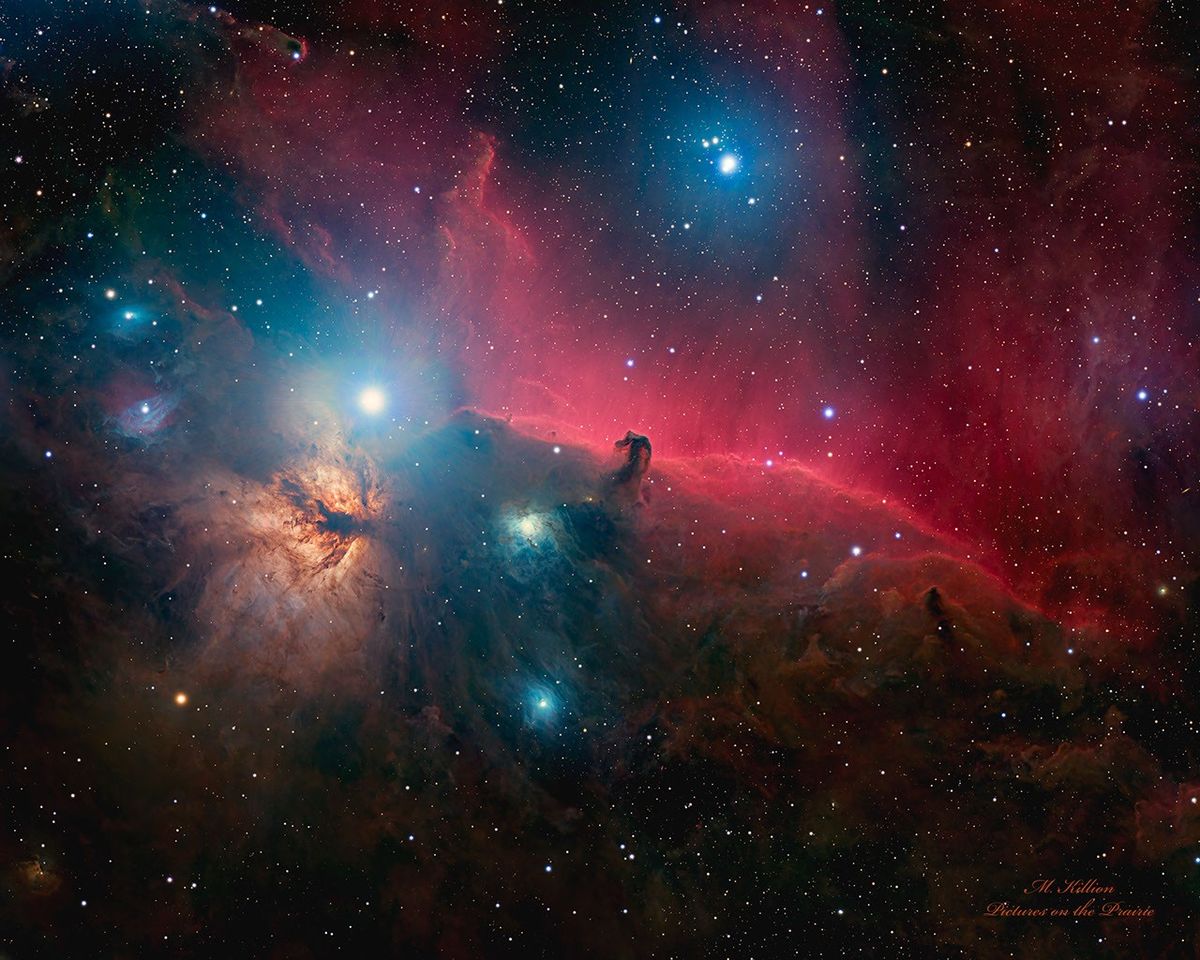
NASA’s Astronomy Picture of the Day featured the Horsehead and Flame nebulas on Thursday, captured from a remote Utah observatory controlled from Illinois.
The image, credited to astrophotographer Mark E. Killion, centers on the dark, dusty pillar of the Horsehead Nebula rising about five light-years against a background of ionized hydrogen gas.
That red glow is energized by Sigma Orionis, a bright star at the top of the frame. To the left, the Flame Nebula burns orange with dark filaments, while the blue reflection nebula NGC 2023 sits closer to the Horsehead, actively forming new stars. The brightest star in the field, left of center, is Alnitak — the easternmost star in Orion’s Belt and a triple star system.
Six hours, 2,000 kilometers apart
The data behind the image were collected over nearly six hours at the Utah Desert Remote Observatories. Killion operated the equipment from his home in Illinois, more than 2,000 kilometers away. The final composition was processed with explanations written by professional astronomers Cecilia Chirenti, Robert Nemiroff, Jerry Bonnell, and Keighley Rockcliffe, under the APOD service run by NASA’s Astrophysics Science Division at Goddard Space Flight Center and Michigan Technological University.
What the colors reveal
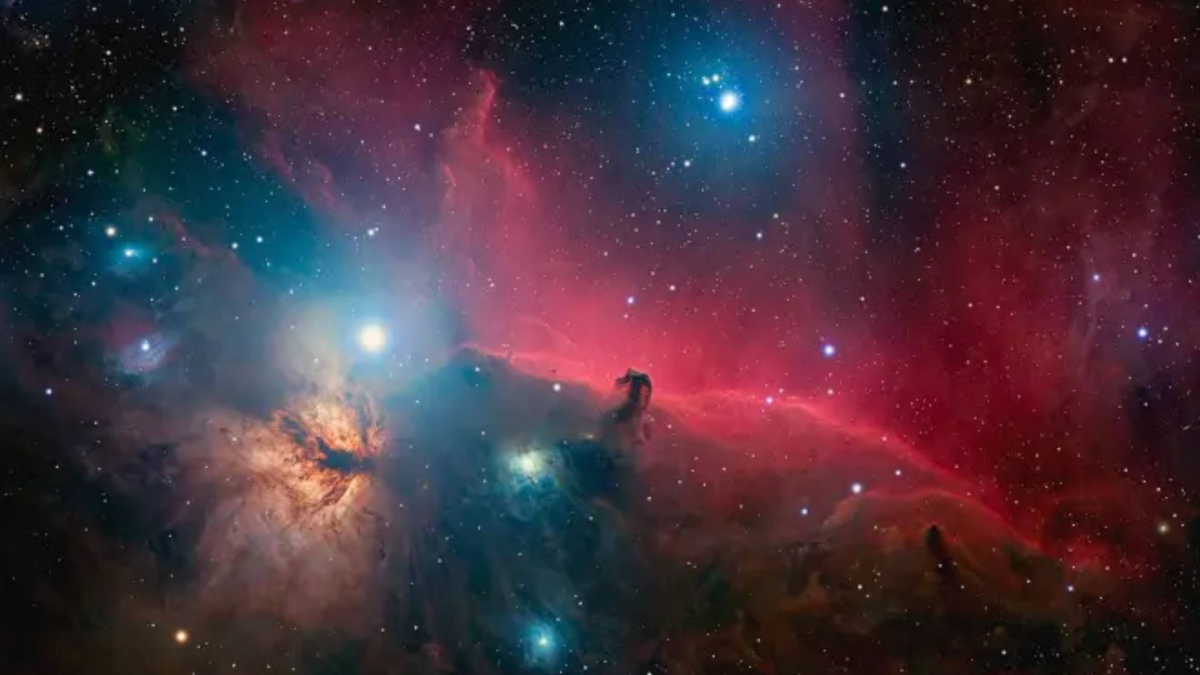
Each hue in the frame maps to a distinct physical process. The Horsehead’s silhouette is cold dust and gas blocking light from behind. The crimson background is hydrogen-alpha emission — hydrogen gas ionized by ultraviolet radiation from Sigma Orionis.
The Flame Nebula’s orange glow combines emission and reflection, threaded with dark lanes of denser dust. NGC 2023’s blue tint comes from starlight scattering off fine dust grains, marking a region where gravity is collapsing material into protostars.
Alnitak, shining blue-white at magnitude 1.7, anchors the scene. Though it appears embedded in the nebulosity, the triple system sits roughly 800 light-years from Earth — foreground to the Horsehead’s 1,500-light-year distance. Its intense radiation helps sculpt the surrounding clouds, but the primary ionizing source for the red backdrop is Sigma Orionis, just out of frame at the top.
Utah Desert Remote Observatories, where Killion’s data were gathered, sits along the southeastern edge of the Great Basin Desert, roughly 130 miles northeast of Las Vegas. The site occupies private property in a broad, flat valley that delivers Bortle 2 skies, reliable grid power and fiber-optic internet, and supports imaging on about 80 percent of nights — roughly 2,000 hours each year.
A daily window on the cosmos
APOD has published a new image with a professional explanation every day since 1995. Thursday’s selection follows Wednesday’s capture of a medium-sized solar flare, illustrating the project’s range from solar system dynamics to deep-sky structure.
The Horsehead and Flame region, nestled in Orion’s molecular cloud complex, remains one of the most photographed targets in the northern winter sky — yet remote observing and long-integration narrowband techniques continue to pull new detail from a familiar neighborhood.
Keep reading

Iran FM Araghchi Calls Emergency OIC Meeting on Gaza Blockade
Iranian Foreign Minister Seyed Abbas Araghchi called Thursday for an emergency meeting of the Organization of Islamic Cooperation's...

New UK Biobank Study Links Long-Term Summer Heat to 15% Higher Mortality Risk in Heart Patients
New research from the U.K. Biobank finds that every one-degree rise in long-term summer heat carries a 15...

US Sanctions Comanchero Leaders in NZ, Australia in First for Australian Crime Group
The United States Treasury placed five men linked to the Comanchero motorcycle gang under financial sanctions on Friday,...

JAMA Study: Childhood Head CT Radiation Linked to Higher Brain Tumor Risk
One head CT scan in childhood corresponds to roughly one extra brain tumor for every 1,266 scans performed,...