A new model shows that microscopic primordial black holes could have reheated the early universe after inflation, and that their varied masses suppress the gravitational-wave signal that earlier work predicted would rule them out.
The finding, published in Physical Review Letters on October 30, reopens a window for ultralight primordial black holes lighter than 109 grams — objects that would have evaporated completely within the universe’s first second.
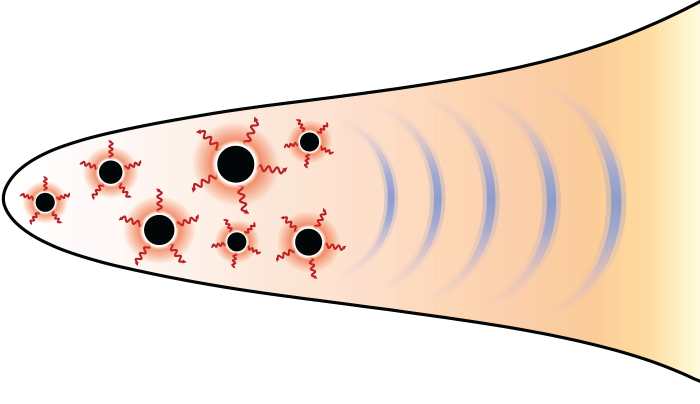
Earlier calculations assumed all such black holes formed with the same mass, causing them to vanish simultaneously in a burst that would have generated a loud “poltergeist” gravitational-wave signal inconsistent with observations. The new work uses the mass distribution predicted by general relativity, which spreads the evaporation over time and quiets the signal by orders of magnitude.
Mass tail smooths reheating
That gradual reheating could have produced the hot plasma from which all matter formed. “The smallest primordial black holes may have been smaller than an atom. But since they would have held almost all of the universe's energy, their explosions could have filled the entire cosmos with the hot plasma from which matter formed,” Leister said.
In this picture, the hot Big Bang we trace today is a second reheating episode, following the supercooling that ended inflation.
Signal suppression reopens the ultralight window
The poltergeist signal — a scalar-induced gravitational-wave burst from abrupt reheating — had been the primary observational constraint excluding a primordial-black-hole-dominated era. The new calculations show that the irreducible mass spread predicted by general relativity suppresses that signal by orders of magnitude.
“Future gravitational wave experiments probably won't be able to probe this theory,” Leister said. “But our findings do open the window to further cosmological research by showing that a primordial black hole-dominated early universe is possible.”
The study’s authors — Yann Gouttenoire of Sorbonne Université and CNRS, Nicholas Leister, and Pedro Schwaller of JGU and the Mainz Institute for Theoretical Physics — note that their perturbative treatment tracks disturbances while they remain small. Additional wave production after structures become nonlinear, and repeated mergers in some regimes, lie beyond the current calculation.
Stellar capture offers a detector
A parallel line of inquiry, reported by MIT on November 19, explores how asteroid-mass primordial black holes — those heavy enough to survive to the present — might be caught by stars today.
Simulations show that a passing primordial black hole cannot be captured by a single star’s gravity alone, but a three-body interaction with a companion star or planet can trap it. Over thousands to millions of years, the black hole spirals to the stellar center.

That signature — a distinctive multi-wavelength transient — offers a potential observational handle on primordial black holes that survived evaporation. The work was supported by the U.S. Department of Energy and the National Science Foundation.
Two eras, one hypothesis
The two studies address different mass ranges and cosmic epochs. The Mainz–Paris work concerns ultralight holes that evaporated in the first second, potentially seeding the hot Big Bang. The MIT work concerns heavier, asteroid-mass relics that could still exist and announce themselves by destroying stars from within. Both rely on Hawking’s prediction that black holes radiate and evaporate — a process still unconfirmed by direct observation.
Yann Gouttenoire, a researcher at the Institut d’Astrophysique de Paris, Sorbonne Université, and CNRS, also holds an affiliation with the PRISMA++ Cluster of Excellence and the Mainz Institute for Theoretical Physics at Johannes Gutenberg University. His recent work on the gravitational-wave signatures of evaporating primordial black holes led to the poltergeist-signal calculation at the center of the Mainz–Paris study.
Neither study claims a detection. The Mainz–Paris paper shows a cosmological scenario remains viable; the MIT paper proposes a search strategy. Together they illustrate how primordial black holes, if they exist, could leave traces from the universe’s first microsecond to the present day.
Chengdu University Study Finds Atmosphere Gained Oxygen in Three Pulses
Earth's atmosphere gained oxygen in three distinct pulses, each arriving hundreds of millions of years before the deep...

Bao, Huang and Wang Develop FFLE-Net for Real-Time Small Aerial Target Detection
Researchers built a compact neural network framework to detect small, densely packed targets in aerial imagery at real-time...

Study Finds Mutational Pressure Insufficient for Rhododendron Codon Bias
A study of eight Rhododendron species finds mutational pressure alone cannot explain their codon usage bias, pointing to...

Study Ties Mantle Convection To Billion-Year Rock Gap; Coauthor Disputes Pattern
Imagine a book where a huge section in the middle has been ripped out.