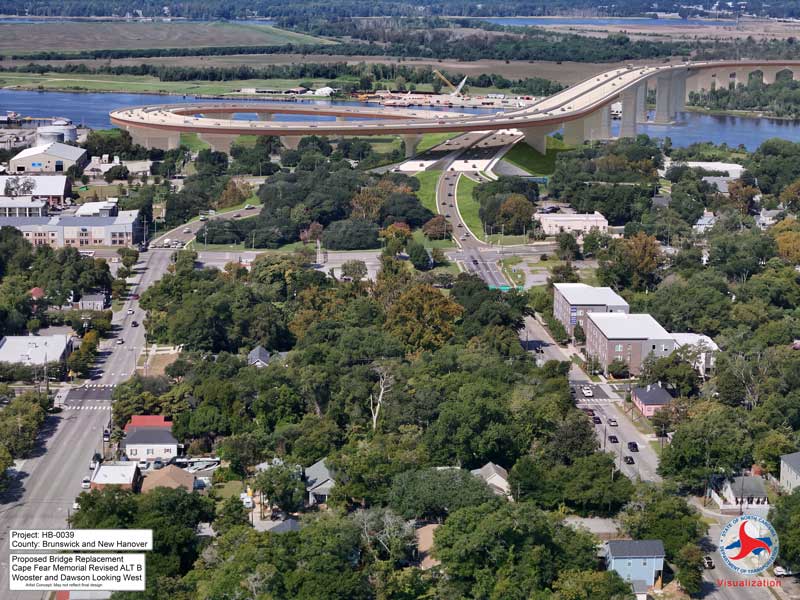
For months, downtown Wilmington residents had been bracing for a fight. The state’s original plan to replace the aging Cape Fear Memorial Bridge would have funneled new traffic onto Fifth Avenue and put two homes in the path of demolition. On Wednesday, the North Carolina Department of Transportation answered that pushback with a redesign that eliminates every residential relocation and shrinks the number of affected properties from 63 to 17, WilmingtonBiz reported.
The revised Alternative B keeps the same 135-foot fixed-span height but reroutes the interchange through a large loop ramp that lands at South Third Street instead of Fifth Avenue. The change came directly after downtown residents and local officials raised concerns about the original design’s impact on properties and neighborhoods, according to Trevor Carroll, NCDOT’s Division 3 engineer. A new public comment period opened Wednesday and runs through Dec. 4.
A Loop Ramp at Third Street, Zero Homes Taken
The numbers tell the story of what changed. Under the original Alternative B, the project expected to relocate two households and touch 63 parcels of land. The revised design lands on just over 30 acres south of the existing bridge — a bigger footprint than the original 25.6 acres, but one that avoids homes entirely. The cost also moved in taxpayers’ favor: just over $1.02 billion, about $9.3 million less than the nearly $1.03 billion price tag on the first version.
WECT reported that NCDOT unveiled the updated proposal alongside new project maps, visual renderings, and an addendum to the project’s environmental assessment, all available on the department’s project webpage. State officials first presented the initial concepts at public hearings on Sept. 14 and 15, and an earlier comment period on the two main options drew more than 1,800 comments, Carroll said.
“Our goal is to deliver a safe, resilient and reliable crossing that addresses the needs of this region for years to come,” Carroll said, according to WECT.
Two Designs Still on the Table
NCDOT is now weighing two primary options against each other. Alternative A is a movable-span bridge with a vertical clearance that adjusts between 65 and 135 feet over the Cape Fear River, at an expected cost of $1.11 billion. Revised Alternative B is the 135-foot fixed-span with the new Third Street loop, at just over $1.02 billion. The fixed-span option’s key advantage is that ships never wait for a drawbridge — but the tradeoff is the sprawling loop ramp that now dominates the land south of the river.
| Option | Design | Cost |
|---|---|---|
| Alternative A | Movable span, 65–135 ft clearance | $1.11 billion |
| Revised Alternative B | 135-ft fixed span, Third Street loop | Just over $1.02 billion |
Not everyone got the design they wanted. The city of Wilmington submitted its own proposed alternatives in its public comment, but Carroll said the project’s timeline leaves no room to study them. “Some of the options that the city of Wilmington presented are, I would say, welcomed alternatives,” he said, according to WilmingtonBiz. “Our constraints for delivering this project on schedule, we do not have the opportunity to explore the options through this current timeframe.”
Tolls Still Loom Over the $700 Million Gap
The money question remains unresolved. The project has locked in $242 million through a federal Large Bridge Project grant and $85 million in state funding, leaving roughly $700 million to cover — and that gap is expected to come from tolls. The Wilmington Urban Area Metropolitan Planning Organization board has affirmed support for keeping the tolled option on the table twice and does not need to vote again for the bridge to proceed as a tolled facility, though it can vote to remove tolling from consideration any time up until February.
Timing is the pressure point. NCDOT is working toward a federal grant obligation milestone of Sept. 30, and Carroll expects the state legislature to take up tolling legislation for an existing roadway in February. With the new comment period now open, the project’s merger team is expected to select a final design alternative in early 2027, around the same time NCDOT anticipates receiving a Finding of No Significant Impact for the project.
The bridge being replaced was built in 1969 and has been classified as functionally obsolete — a status that means it no longer meets modern design standards even if it still carries traffic. Whatever design wins, the replacement will carry the region’s river traffic for decades.
Keep reading

Mikie Sherrill urges port operators to turn away Russian diesel
Diesel at the pump is averaging $6.29 per gallon nationwide as of Tuesday morning, down from $6.50 just...

2 Nevada Ballot Questions Pass on Abortion Rights and Voter ID
Nevada voters have rewritten their state’s foundational legal document, approving two ballot measures on Election Day that simultaneously...

Lincoln Stars Acquire Defenseman Colin Feeley from Muskegon Lumberjacks
LINCOLN, Neb. — The Lincoln Stars' blue line just got a lot more interesting. General Manager Nick Fabrizio...

United Way of Yellowstone County Launches Read in Color in Billings, MT
United Way of Yellowstone County has brought Read in Color to Billings, Montana, joining the 2026 cohort of...