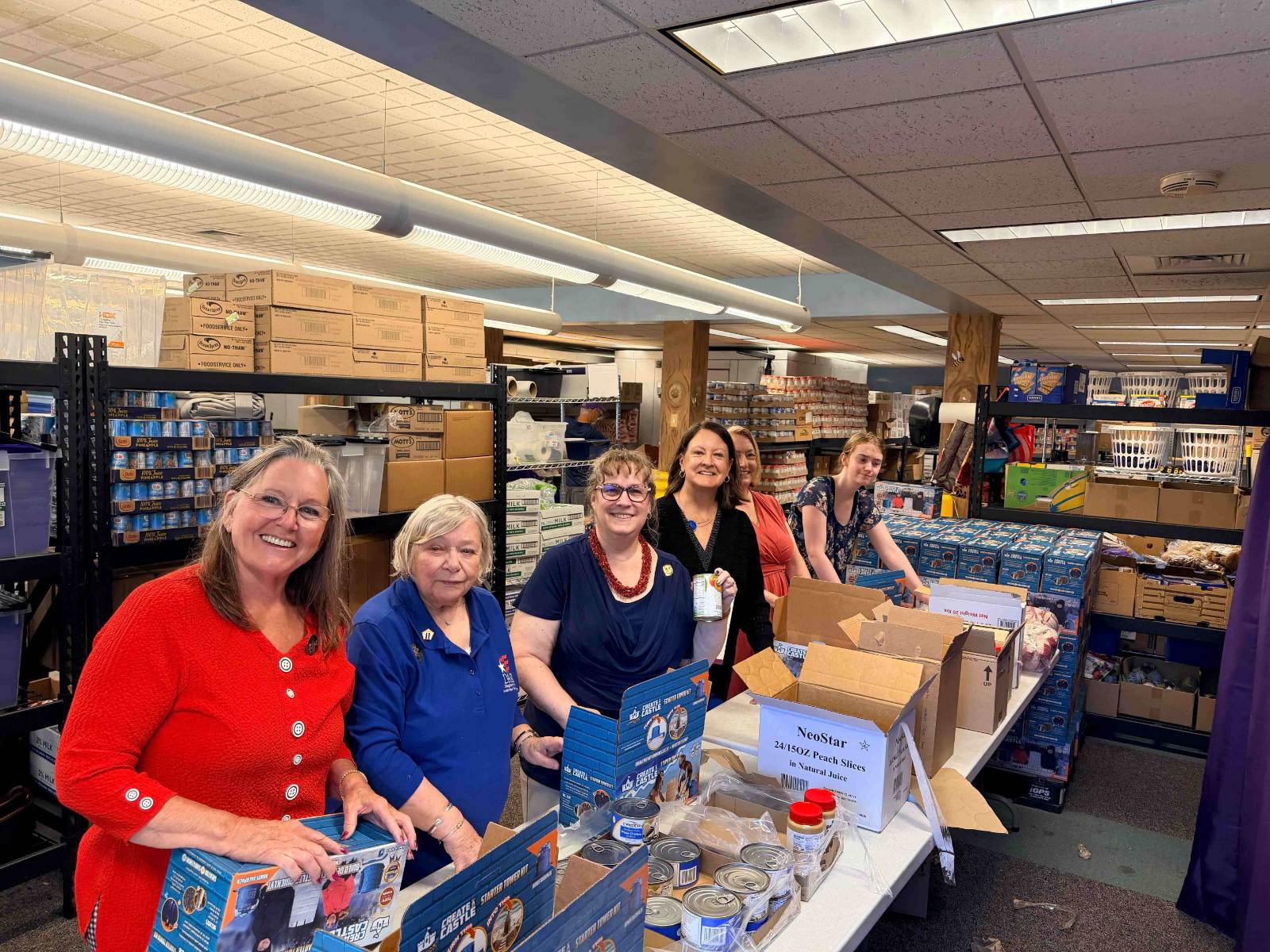
New Milford was supposed to be the place where working families got by — not the place where need grew fastest in the entire state.
The United Way’s latest ALICE report shows the share of households below the survival threshold jumped 17 percentage points here since 2019, the steepest climb of any Connecticut town.
“Since COVID, the district has had universal free lunch. At the end of April they no longer had funds to cover it, so they rolled that back,” Angela Chastain, founder and executive director of Camella’s Cupboard, told CT Insider.
“So we are seeing an increase this school year and I believe that’s because parents have to pay for school lunches and I believe that put them over the edge.”
The pantry now serves 250 families and 540 children. Annual growth typically runs 10 to 12 percent, but the curve sharpened when the school year started. Chastain said the families coming through live on the edge — earning too much for SNAP or cash assistance, but not enough to cover rent, gas, and groceries simultaneously.
“When I first started this in 2018, I didn’t know one person who came through our line,” Chastain said. “I know several of our families today.”
Gas sits above $4 a gallon, adding $50 to $60 a month in commuting costs. “That’s grocery money,” she said. “Electricity is up, groceries are up, everything is more expensive and that really affects a family. People think it’s just two or three dollars here and there, but when you’re on a tight budget, that two or three dollars can make or break you.”
Statewide, 570,000 households were financially unstable as of 2024, a 14 percent rise from 2019, according to the United Way of Connecticut. The ALICE threshold — Asset Limited, Income Constrained, Employed — now requires a single adult to earn roughly $20 an hour, or $40,000 a year. An adult with a child needs about $30 an hour, $59,000 annually. Two adults with two children in childcare must clear $116,000.
Cities like Bridgeport, Hartford, New Haven, and Waterbury still hold the largest raw numbers, but the suburban surge is the story. New Milford’s 17-point spike outpaced every other municipality.
On Fridays, Camella’s Cupboard runs a drive-thru. Volunteers load produce, milk, meat, eggs, and bread into trunks. Children receive snack bags — fruit cups, cereal, Pop-Tarts, granola bars, chips, juice or water — meant to supplement the family box. Afterward, clients shop “free-choice” inside for extra produce, shelf-stable items, pet food, vitamins, and lately, winter coats.
The nonprofit also stocks four Blessing Boxes — freestanding pantries at New Milford Congregational Church, United Methodist Church, Walnut Hill Church, and Oddfellows Hall. “Those are consistently empty,” Chastain said. “We fill them every single day.” A woman recently thanked her for the many dinners the boxes provided. Chastain noted many Blessing Box users are people she would expect to afford food on their own.
Cottyln, a mother of two who asked that her full name not be used, has relied on the pantry for years. She started during the pandemic when her hours were cut. “I find it very helpful. Every little bit helps, especially fruit and veggies, they’re so expensive,” she told CT Insider.
“When you’re not making what you’re supposed to make and have a big cut, it affects you a lot.” She also shares diapers and unused items with her mother and sister.
Loaves & Fishes Hospitality, in town for 41 years, serves breakfast and dinner 365 days a year. Managing Director Charles Bogie said 75 to 80 percent of guests are experiencing homelessness; the rest face food insecurity.
Since moving to 25B Bridge St. on Thanksgiving 2024, attendance has climbed. Before the move, 10 to 12 guests was typical. “Recently we’ve been seeing numbers in the 30s,” Bogie said. The week he spoke to CT Insider, 25 to 28 people came for meals.
Breakfast opens at 7 a.m. — boiled eggs, oatmeal, cereal. Dinner starts at 4:30 p.m., prepared by 22 rotating groups, each with a certified food manager. On Oct. 22, 28 guests ate chicken, red lentils, cream of rice soup, beets, and bagged lunches. The next night, 25 had baked ziti, meatballs, mixed vegetables, and Halloween desserts.
Bogie attributes the rise to a new hospitality program offering showers and laundry. “When I see 34 people here at dinner, we’re opening a conference room that we use for family dining and overflow dining,” he said. “Our dining room is packed when we get to 20 to 25 people.”
He worries the facility cannot sustain the volume if word spreads further. Bogie helped purchase the property with Sarah B. Straub, the nonprofit’s late treasurer, and stayed on to run operations after her death and Executive Director Lisa Martin’s illness.
Our Daily Bread Food Pantry, operating out of United Methodist Church for about 20 years, now serves roughly 210 families a week — up from 180 to 190 a few months ago. Assistant Director Ralph Williams said distribution runs Thursdays 3 to 6 p.m. from a shed he designed and built with the late Gene Parsons.
Connecticut Foodshare supplies most inventory, typically 5,000 to 6,000 pounds per order. Clients choose 30 pounds each. “They usually come with a cardboard box and can barely lift it,” Williams said. The pantry runs on 10 weekly volunteers and needs dry and canned goods — pasta, tuna, peanut butter, spaghetti.
New Milford, the state’s largest town by land area at 63.7 square miles, sits 50 miles west of Hartford and 14 miles north of Danbury along the Housatonic River and Candlewood Lake. Its population reached 28,115 in 2020. Roger Sherman, signer of the Declaration of Independence and the Constitution, lived here before 1761; his former homesite is now Town Hall.
Three organizations. Three waiting lines. One town where the cost of staying afloat just kept rising.
Worth a look
- CBS: Sacramento Imaginarium to Open Friday After Storm Delays; Cal Expo Cited Nov. 18
- Ryan Klund Argues Pre-Deciding Giving Turns Generosity Into Cheerful Habit
- Inflation Since October 2024 Adds About $4,720 a Year to Household Costs (daybreakwire.com)
- US envoys float NATO membership for Ukraine in exchange for Donbas, WSJ reports (newsarchyuk.com)

CBS: Sacramento Imaginarium to Open Friday After Storm Delays; Cal Expo Cited Nov. 18
Sacramento’s Imaginarium will finally switch on its 15 million LED lights Friday at Cal Expo after two storm-driven...

Ryan Klund Argues Pre-Deciding Giving Turns Generosity Into Cheerful Habit
Ryan Klund argues in a post on LinkedIn that separating the decision to give from the moment of...

Albany Finance Committee Advances 12% and 13.5% Tax Levies, Below Mayor’s 15% Plan
"There is no way to cut this budget any further than it's already cut without eliminating substantial components...

DMU, UnityPoint Launch Rural Health Collaborative to Boost Cancer Screening in Webster County
Only one in five eligible Webster County residents gets a lung cancer screening, and nearly three-quarters of those...