New Zealand’s final election count on Friday stripped Prime Minister Christopher Luxon’s coalition of its provisional majority, leaving the centrist Opportunity Party as the only path to a government without a fresh vote.
The Electoral Commission’s official tally, released November 27 after counting roughly 485,000 special votes, gave the National-led bloc 65 seats in a 130-seat Parliament — one short of the 66 needed for a majority. The three-party coalition of National, ACT and New Zealand First had held a two-seat edge on election night, November 7.
The left-wing opposition bloc, led by Chris Hipkins, sits on 58 seats even with the Greens and Te Pāti Māori. Opportunity, entering Parliament for the first time with seven seats, now decides whether Luxon returns to power or the country goes back to the polls.
Count flips two-seat edge to one-seat deficit
Special votes — cast from overseas or outside a voter’s home electorate — have historically favored the left. This year they erased National’s election-night majority. The party dropped two seats to 40, while the Greens gained one to reach 17, their best result. Labour held at 36.
ACT finished with 13 seats, New Zealand First with 12, and Te Pāti Māori with five. Three electorates changed hands after the special votes: Labour took Wairarapa by 81 votes and Hamilton East by 173 votes, while the Greens won Wellington Bays from Labour by 1,610 votes.
The final seat distribution reflects a 10-seat overhang — six for National and four for Te Pāti Māori — expanding Parliament from its usual 120 members to 130. Under New Zealand’s mixed-member proportional system, an overhang occurs when a party wins more electorate seats than its party-vote share entitles it to, adding seats to the chamber without reducing other parties’ allocations.
Opportunity holds lopsided power
Opportunity’s seven seats give it a unique but lopsided position. If the party supports the right bloc, Luxon reaches a 72-seat majority. If it backs the left, the combined total reaches only 65 — a tie that would almost certainly trigger another election.
Leader Qiulae Wong, a 38-year-old former KPMG consultant who took over the party in November 2025, has said she will negotiate first with the largest party but insists on bottom lines that include action on supermarket competition, a cap on political donations, a 10-year cross-party health plan, ending bottom trawling, and stronger climate commitments.
I want to be upfront with New Zealanders. These negotiations may be challenging, and they could take some time.
Christopher Luxon, Prime Minister
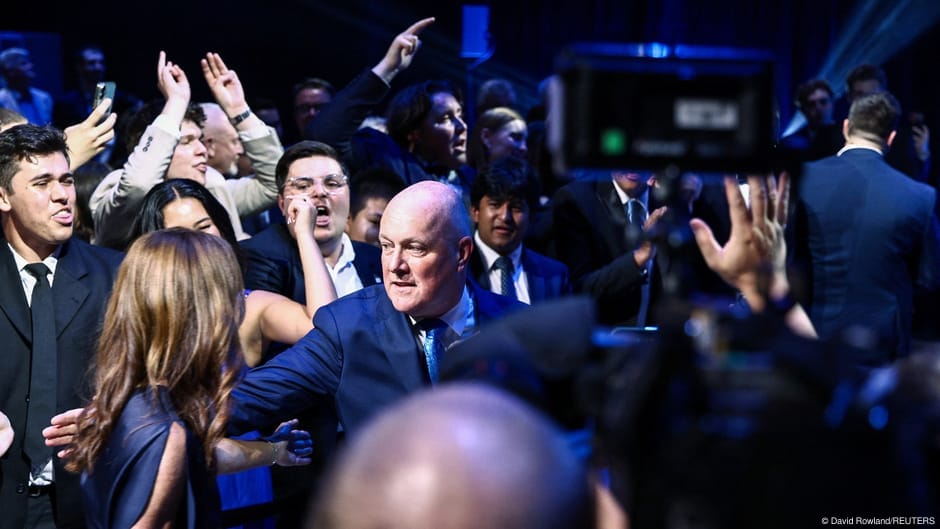
Luxon, who had ruled out working with Opportunity during the campaign, reversed course on Friday. He said he is confident of reaching a deal with Wong and his existing partners but acknowledged the talks will be difficult. “Getting it right matters far more than getting it done quickly. New Zealanders need a government that is stable, that works together and will last for the full term,” he told reporters.
really important to remember there are seven parties in parliament
Qiulae Wong, Opportunity Party leader
New Zealand First adds condition to right bloc
Any four-party deal on the right must also satisfy New Zealand First leader Winston Peters. Opportunity has said it will not join a government if Peters serves as Foreign Minister — a post he has held three times.
Peters’ party, which holds 12 seats, issued a statement Friday saying the results had “not provided the certainty our country needs” and that the next three months would be crucial. The caretaker government remains in office under a Cabinet Office circular issued November 9, with ministers restrained from significant policy decisions except in emergencies.
Special votes reshape electorate outcomes
The Conversation reported that 484,865 special votes — 16.5% of all ballots cast and well above the 400,000 initially estimated — overturned the provisional results. In Wairarapa, Labour’s Kieran McAnulty overturned National incumbent Mike Butterick’s 139-vote election-night lead to win by 81 votes on 81.9% turnout, while in Hamilton East, Labour’s Georgie Dansey erased a 456-vote deficit to unseat National’s Ryan Hamilton by 173 votes on 74.7% turnout.
National’s Rima Nakhle held Takanini by just 459 votes over Labour’s Kharag Singh, Lloyd Sam Budd kept Whangārei by 685 votes ahead of Labour’s Gary Payinda, and Blair Cameron retained Nelson by 1,083 votes over Labour’s Rachel Boyack, The Conversation added.
Party vote shares differ from seat totals
The Journal and finchannel both reported that at the final count National won 28.35% of the party vote while Labour received 29.88%, a different ordering from the seat totals.
Recount window opens, Parliament must meet by January 14
Parties may apply for recounts by December 3; any recount would take roughly five days. If no recounts are ordered, writs are returned on December 3 and Parliament must meet by January 14. Coalition talks in 2023 took 40 days; with four parties now needed for a majority, negotiators and the Governor-General, Dame Cindy Kiro, have signaled the process could run longer.
Kiro has said she would not accept a request for a fresh election until it is clear no government can be formed, and that the caretaker prime minister would need to consult other parties and seek majority support before any such request.
Voter turnout was 77.2%, down from 78.2% in 2023. The final count recorded 2.8 million votes cast. Until a new government is appointed, Luxon’s administration continues in caretaker mode — able to maintain day-to-day administration but constrained from major decisions.
Keep reading
- Trump Claims U.S. Victory Over Iran, Warns of Pickaxe Mountain Strike at Thanksgiving Briefing
- AP’s Global Teamwork and Scoops Define Trump Asia Trip Coverage
- Willie Mae’s Black Friday Classic Block Party Unites Southern and Grambling Fans in New Orleans (archyde.com)
- New Zealand's ruling coalition falls one seat short of majority in final election count (newsarchyuk.com)

Trump Claims U.S. Victory Over Iran, Warns of Pickaxe Mountain Strike at Thanksgiving Briefing
President Donald Trump told reporters at Mar-a-Lago on Thanksgiving Day that the United States has achieved victory in...

AP’s Global Teamwork and Scoops Define Trump Asia Trip Coverage
Jim Gomez, AP's Manila chief correspondent, secured a three-day advance on the story that China and ASEAN failed...

IISS Warns of Mass-Casualty Risk as Europe Sabotage Rises
There are increasing signs of lethal intent or the probability that one of these events will result in...

Defectors Find Refuge at Yeomyung School Amid Local Opposition
Roughly 35,000 North Korean defectors live in South Korea, where the law instantly welcomes them as citizens.