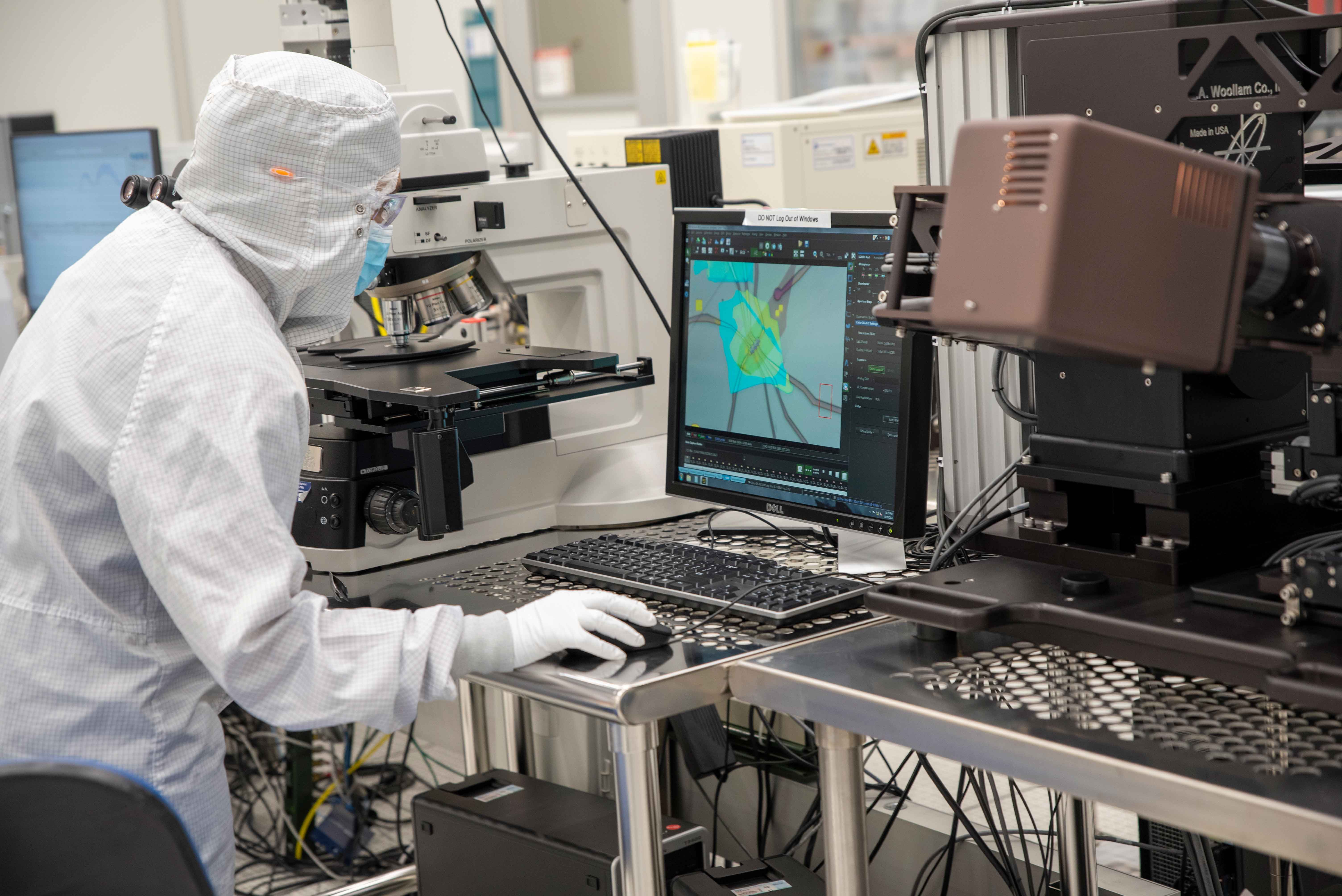
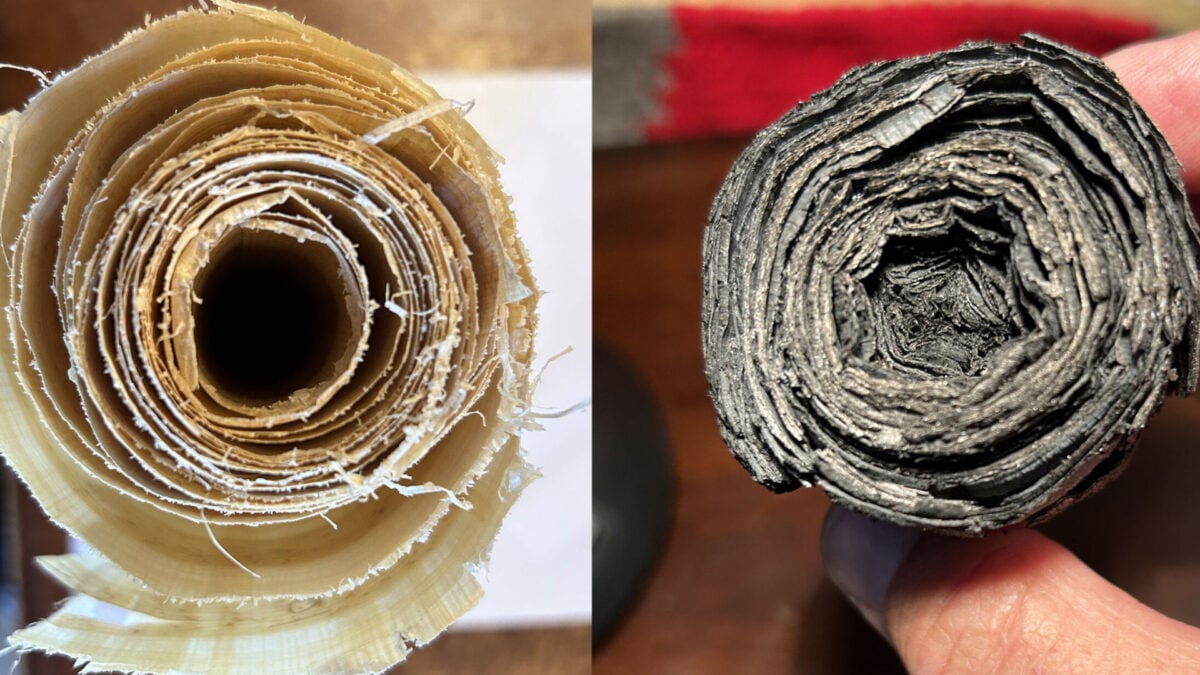
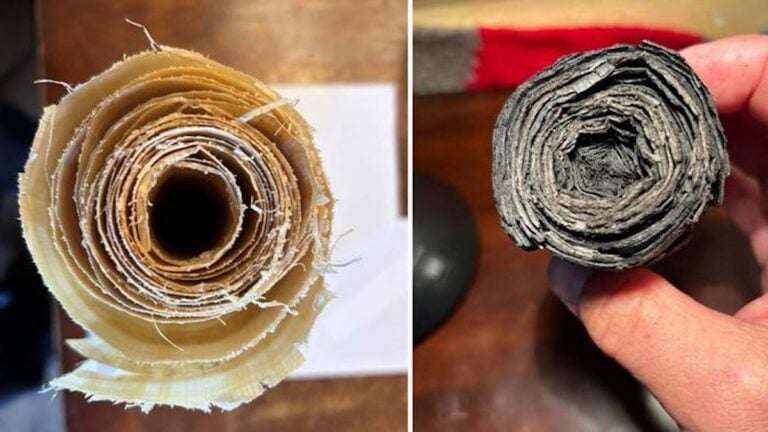
Researchers studying the 2,000-year-old Herculaneum papyri have tested a new method for reading carbonized scrolls by looking for lead-based ink. To verify the technique, a team including retired inventor Douglas Seiler and NIST researchers baked custom model scrolls written by high school students in a furnace, proving X-ray scans can detect leaded letters.
Mount Vesuvius and the Library of Antiquity
In the fall of 79 C.E., the eruption of Mount Vesuvius obliterated towns on the Bay of Naples, including Pompeii and Herculaneum. While the cataclysm brought destruction, it also preserved an extraordinary archive.
For nearly 1,700 years, those buried time capsules remained undisturbed until workers digging a well discovered a luxurious villa in 1750. Two years later, excavators uncovered hundreds of cylinder-shaped lumps of charcoal—the only complete library to have survived from antiquity. Initial attempts to physically unroll the fragile papyrus proved disastrous, as many scrolls crumbled to dust or were destroyed when cut open.
Testing the Lead Ink Theory on Paid High Schoolers
To test how to decipher these delicate artifacts without opening them, a team of researchers pursued a new approach: searching for lead in ancient ink. A study published in the journal PLOS ONE explains that small amounts of lead make letters highly detectable to X-ray CT imaging.
When scanned using 3D X-ray CT, the lead absorbed more X-rays than the surrounding charred papyrus, causing the inked letters to stand out sharply.
Adapting Battery Algorithms for Virtual Unrolling
Creating a 3D digital model of a burned scroll is only the first step, as the raw scan remains illegible until processed by specialized software. Researchers turned to computer algorithms to virtually unroll the cylindrical layers and display the hidden text. Cyrus Daugherty, a researcher at NIST, adapted code originally developed for mapping the inner layers of a lithium-ion battery to handle the uneven thicknesses and tight wraps of carbonized scrolls, NIST reported.
This computational work builds on recent milestones in artificial intelligence and imaging. In 2024, AI helped researchers recover columns from a Herculaneum scroll as part of the multimillion-dollar Vesuvius Challenge. In 2026, another team used AI to read part of a damaged scroll designated as PHerc. 1667, which discusses Stoic philosophy. However, those past successes relied on faint differences between carbon-based ink and carbonized papyrus—a low-contrast challenge that leaded ink circumvents entirely.
Screening Surviving Scrolls with Handheld Scanners
More than 1,800 scrolls and fragments from the ancient library still exist, containing works by authors such as the Epicurean philosopher Philodemus. Because ancient scribes used carbon-rich ink in some documents and lead-based ink in others, X-rays often struggle to find contrast on entirely carbonized material. NIST researcher Jacob LaManna described the difficulty, noting that You’re basically looking for carbon letters on a carbon scroll, and there’s no contrast between the two.
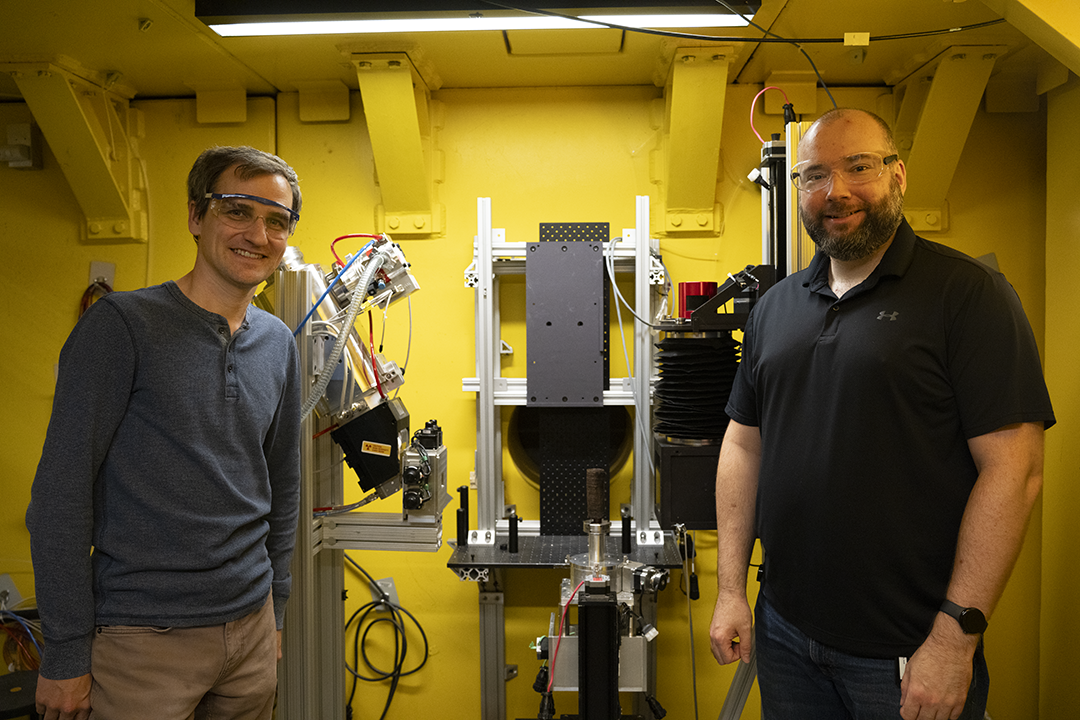
To screen surviving artifacts safely, researchers demonstrated that an inexpensive handheld X-ray fluorescence scanner can detect lead concentrations as low as 25 micrograms per square centimeter. This tool allows conservators to test fragile scrolls for lead before committing them to high-resolution CT imaging.
Preserving Fragile Artifacts Through Physical Models
Working with model scrolls provides a risk-free environment for testing and improving virtual unrolling software, since researchers know the exact text written inside each baked replica. Packard-Grams emphasized the safety advantage of this modeling approach, pointing out that If you hurt a model, it’s fine.
While the recent study does not establish how many of the remaining Herculaneum scrolls contain leaded ink, systematically screening the collection offers a path toward recovering lost classical texts.
Apple Launches Apple Watch Series 12 and Ultra 4 With New Retailer Deals
Apple launched the Apple Watch Series 12 and Apple Watch Ultra 4 on September 18, alongside new pricing,...

Battery Imaging Library Launches Open Access Database With 4.5TB of Data
Researchers have launched the world's first open-access Battery Imaging Library, housing over 4.5 terabytes of experimental data from...

UN Launches New Data Commons to Centralize Global Statistics
United Nations Secretary-General António Guterres unveiled the UN System Data Commons at UN Headquarters in New York, launching...
Researchers Use Lead-Mixed Ink to Help Read Herculaneum Papyri
Researchers have discovered that mixing microscopic amounts of lead into ink makes carbonized ancient scrolls readable under X-rays,...