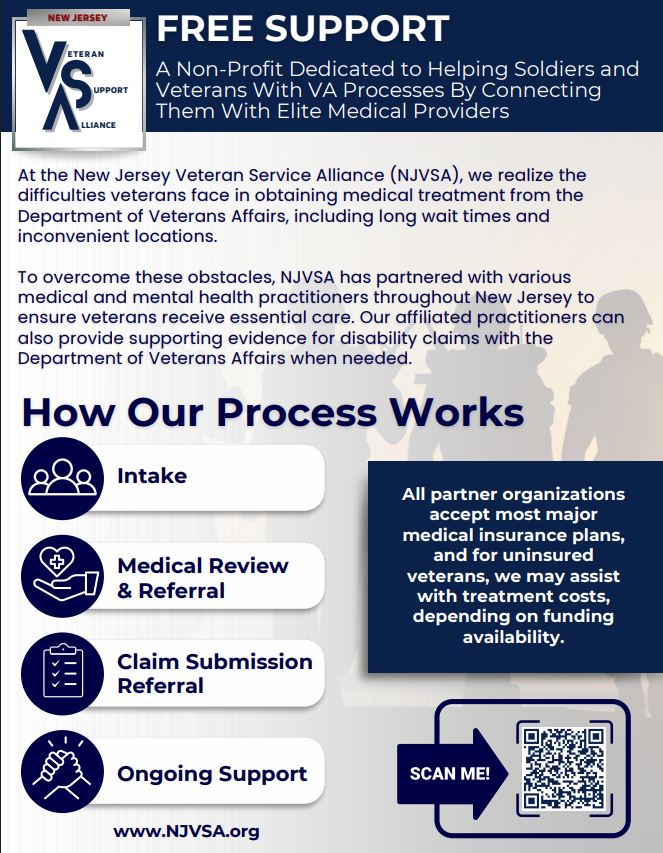
The New Jersey Veterans Assistance Association, a statewide 501(c)(3) nonprofit affiliated with The American Legion Department of New Jersey, is positioning itself as a central hub for service members, veterans, military families, and caregivers across the Garden State, according to reporting by MTEC. The organization’s stated purpose is direct: improving the quality of life, well-being, and economic security of the people who have worn the uniform and the families who have carried the weight alongside them.
What NJVAA actually does day to day is less abstract than its mission statement. The association delivers financial aid to veterans in crisis, runs homelessness prevention efforts, conducts mental health outreach, and provides family support for deployed service members. The program also assists veterans in understanding and accessing federal and state benefits, links them with peer support groups, and represents their interests in advocacy efforts. Its work spans suicide prevention and community-based health services, filling gaps that larger institutions sometimes miss. For a state with a large and diverse veteran population spread across urban centers, suburbs, and rural counties, that kind of ground-level presence matters.
A Bridge Between Government Programs and Real Lives
Benefits navigation is one of the quiet but critical pieces of NJVAA’s work. Veterans who have earned benefits through their service frequently struggle to claim them, and the association acts as a guide through that process. That role becomes especially important during moments of transition, when a service member leaves active duty, when a family faces a deployment, or when a veteran is at risk of losing housing. The organization describes its approach as coordinated service delivery, meaning it does not simply hand out a phone number but works with partner organizations to make sure a veteran’s needs are met across multiple fronts at once.
Funding for these programs comes from a mix of private donations, corporate support, and government sources, a diversified model the organization uses to sustain its veteran-focused programs over time. NJVAA employs a small staff, in the range of one to fifty people, which means much of its reach depends on community engagement and partnerships rather than a large payroll. That lean structure is common among veteran-serving nonprofits, and it makes collaboration with other organizations essential to its model.
Veterans Connect Through Shared Experiences
Mental health outreach and suicide prevention sit at the center of the association’s behavioral health work. Rather than operating as a clinical provider, NJVAA emphasizes peer support services and community-based health services, connecting veterans with people who share lived experience. For military families and caregivers, who often absorb stress quietly, the association’s family support programs offer a parallel safety net.
The affiliation with The American Legion Department of New Jersey gives NJVAA a direct line into one of the country’s most established veteran service organizations. That relationship helps the association amplify advocacy efforts and coordinate service delivery across the state, linking local posts and community partners to a shared mission of veteran welfare.
Why This Matters Across New Jersey Communities
The stakes for New Jersey’s veteran community are concrete. A veteran facing eviction, a family struggling while a loved one is deployed, or a service member transitioning to civilian life each represents a household where economic security and well-being are on the line. NJVAA’s combination of emergency financial aid, homelessness prevention, and mental health outreach is designed to catch people at those pressure points before they fall through the cracks. Because the organization raises funds from private, corporate, and government sources, its ability to keep those programs running depends on continued support from all three sectors.
Looking ahead, the association’s stated commitment is to keep improving veteran welfare through community engagement, advocacy, and coordinated services. For the service members, veterans, and families it serves, the measure of that work will be simple: whether help arrives when it is needed and whether it holds.
Related reading

William Lawrence Declares Victory Over Incumbent Tom Barrett in Michigan’s 7th District
"We built an unprecedented movement here in Mid-Michigan, powered by thousands of volunteers, and we showed that you...

Writer recounts baptism at Trinity Episcopal Church in Anoka
In a first-person column for Episcopal Minnesota, a writer recounts being baptized at Trinity Episcopal Church in Anoka...
Massachusetts Voters Uphold Strict 2024 Gun Safety Regulations
Massachusetts Voters Uphold Major Gun Safety Law, Rejecting Repeal Effort "This victory belongs to the people of Massachusetts,...

Baltimore County voters elect new council members and expand seats
After Tuesday's election, the County Council is on track to expand from seven members to nine, with at...