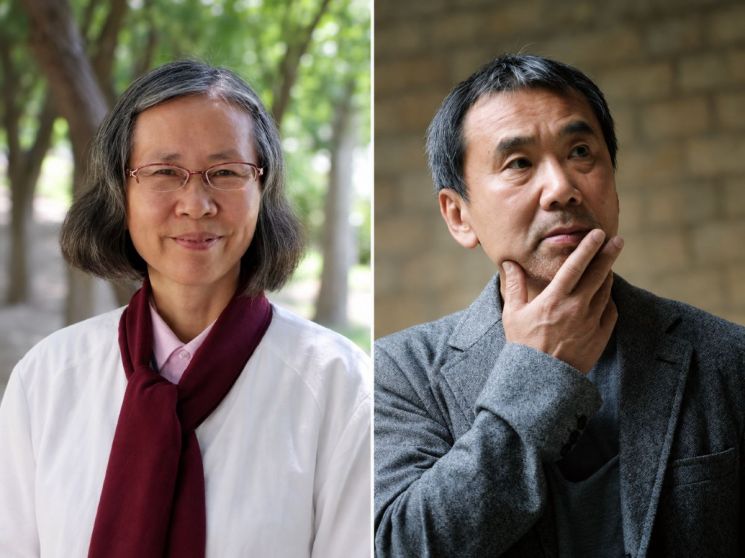
As global betting markets and publishers name top contenders for the 2026 Nobel Prize in Literature ahead of the October 8 announcement, literary experts analyze potential shifts in regional and demographic representation, weighing frontrunners such as Chinese avant-garde writer Chan Xue and Mexican author Cristina Rivera Garza.
Chan Xue, Haruki Murakami, and Cristina Rivera Garza on Nicer Odds
The global literary and publishing communities have entered the autumn season of predictions as the Swedish Academy prepares to announce the winner of the Nobel Prize in Literature. Overseas betting sites have also begun predicting the winner, fueling anticipation. Currently, the top three on the international betting site “Nicer Odds” are Chinese writer Chan Xue (殘雪, 73 years old), Japanese author Haruki Murakami (77), and Mexican writer Cristina Rivera Garza (62). However, considering that novelist Han Kang won in 2024, the publishing industry generally believes, It’s unlikely that an East Asian writer will receive the award this year.
Predictions are premature, as rankings can shift rapidly as the announcement date nears.
The winner of the Nobel Prize in Literature will be announced next week, on Thursday, October 8. Said winner will take home 12.0 million Swedish kronor (SEK), or a little over 1.2 million dollars, along with a lifetime of laurels. But who will it be? No one outside of the Swedish Academy can say for sure, but if you’d like to put some money on it, the bookies shall oblige—and the odds they’re offering might give us a hint. Or, just as often, not! Last year’s winner, László Krasznahorkai, had odds of 6 to 1 at this time last year; nobody is favored that heavily in this year’s list. But Can Xue is back on top after randomly falling out of the top 5 in 2025. Gerald Murnane continues to lurk; it could be his year too. Murakami, Pynchon, and Atwood are all too high and will never win. J.K. Rowling has the same odds as Louise Erdrich and Yoko Tawada, which is a travesty. I think Alexis Wright would be a good choice. Anyway, nobody knows anything, but here are the bookies’ odds for the winner as of this writing, according to British betting mainstay Ladbrokes.
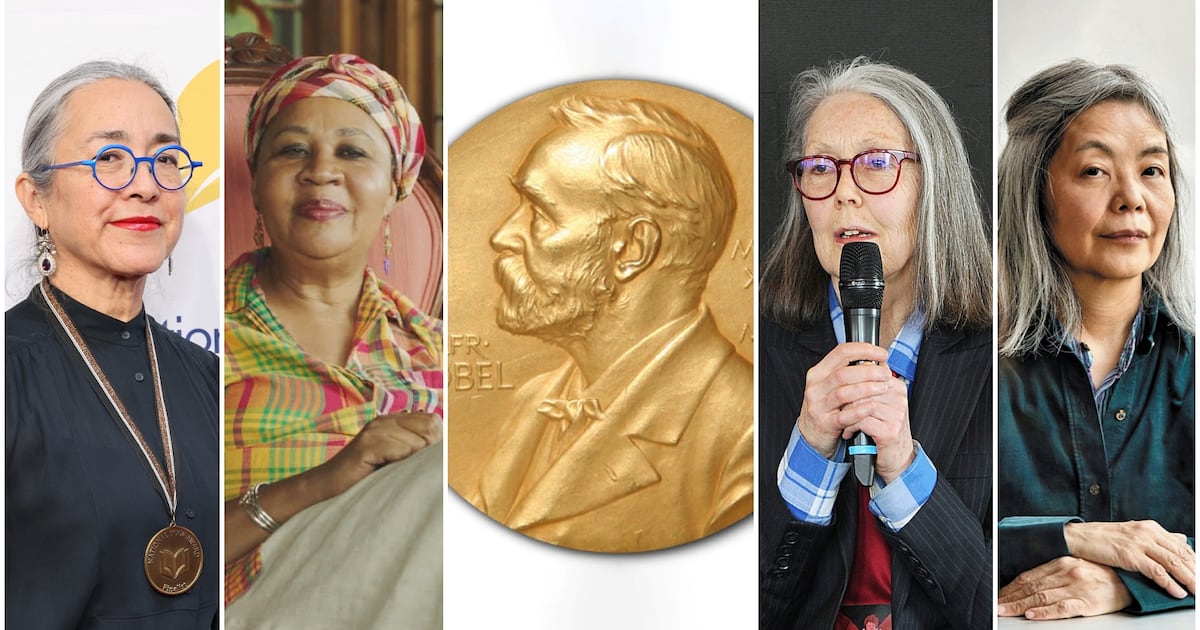
International Betting Markets and Publishing House Predictions
Chan Hsueh, Haruki Murakami, Margaret Atwood, and Gerald Murnane
With only ten days left until the announcement of this year’s Nobel Prize in Literature, the global literary and publishing communities have once again entered the season of predictions.
The list of expected candidates is growing longer, ranging from established figures like Chinese writer Chan Hsueh, Japanese writer Haruki Murakami, Canadian writer Margaret Atwood, and Australian writer Gerald Murnane—whose names have long circulated as potential recipients—to writers gaining recent prominence through international literary awards. Four authors appear across publisher and bookseller predictions, and Hyesoon Kim has also been recognized, alongside new releases and translations by candidate authors arriving.
Balancing Gender, Regional Representation, and Age Factors

Kazuo Ishiguro, Olga Tokarczuk, and Mario Vargas Llosa
The Swedish Academy, which awards the Nobel Prize in Literature, has maintained a balance in gender and regional representation over the past decade. Rivera Garza’s third-place ranking on betting sites reflects her meeting these criteria. Since British-Japanese author Kazuo Ishiguro (2017 laureate) and Polish writer Olga Tokarczuk, winners have alternated between male and female. No South American writer has won since Peruvian Mario Vargas Llosa.
Examining Literary Clues and Publisher Signals in Sweden
Lars Ring and Jamaica Kincaid at the Gothenburg Book Fair
Though little known, one behind-the-scenes episode surrounding last year’s Nobel Prize in Literature generated excitement among those closely following the prize. In September last year, a month before the Nobel announcement, The Melancholy of Resistance, a stage adaptation of a novel by Hungarian writer László Krasznahorkai, was performed at a theater in Stockholm. Lars Ring, a performance critic, spotted a member of the Swedish Academy in the audience. The news that a Nobel juror had watched a work by a leading candidate around the time of the announcement made headlines in an Oct. 8 article, and Ring interpreted it as a “sign.” His prediction proved correct. Two days later, Krasznahorkai was named the Nobel laureate. Predictions are growing that something similar could happen this year. On the 26th, Jamaica Kincaid visited Sweden to hold a solo event at the Gothenburg Book Fair, which happened to have the Swedish Academy as its key partner this year. Anders Olsson, chair of the Nobel Prize in Literature committee, along with the other committee members and life members, could hardly have failed to take notice of Kincaid at the event. Revised editions of her best-known works, Annie John and Lucy, were published in Sweden last July, followed by two more books in September. Swedish national radio is also featuring related programming.
The Elite Path of International Literary Awards
Since 1901, committees in Sweden and Norway have awarded Nobel Prizes annually to recognize achievements in physics, chemistry, physiology or medicine, literature, peace, and (from 1969) economics. Through the years, dozens of Harvard scholars and researchers have earned the title of Nobel laureate across all categories. Alfred Nobel’s 1895 will left 94 percent of his fortune to establish five prizes and instructed that the literature award go to work in an idealistic direction, a phrase that has been reinterpreted by every generation since 1901. This traces how that definition shifted from the conservative church-and-state idealism of Carl David af Wirsén, which excluded Tolstoy and Zola, to post-WWI humanism, 1930s accessibility, and modern human rights, walking through the annual gauntlet of roughly 220 nominations by February, a shortlist of five by May, a summer of reading, and oath-sworn secret translators.
Related reading

High-Sugar Foods Increase Gut Microbiome Damage During Antibiotic Treatment
Researchers studying hospitalized cancer patients at Memorial Sloan Kettering Cancer Center, City of Hope, and NYU Langone Health...

University of Hawaiʻi Researchers Find RNA Markers for Lung Cancer Risk
Researchers at the University of Hawaiʻi have identified 31 small non-coding RNA markers in stored blood samples that...

Early-Onset Colorectal Cancer Surges Among Adults Under 50
A sharp increase in colorectal cancer among adults under the age of 50 has drawn urgent attention from...
Researchers Defend In Vitro Study on C. difficile Spore Persistence
Researchers defending their in vitro study on sodium hypochlorite and Clostridioides difficile spores argue that basic laboratory science...