Ohio University’s Bobcats Dig Into Justice: CLJC-Funded Internships Send Students Across Ohio and Pennsylvania
Ohio University students spent their summers not in the classroom, but in courtrooms, legal aid offices, and prosecutor chambers, gaining firsthand experience in the pursuit of justice. These weren’t just casual summer jobs; they were high-stakes internships, supported by the Center for Law, Justice and Culture (CLJC), that sent a new generation of Bobcats into communities across Ohio and into Pennsylvania, as reported by Ohio University.
This is the real-world education the CLJC is built on. The program recognizes that financial constraints and a lack of prior experience can create significant barriers for students passionate about law and public service. By partnering with alumni, community leaders, and legal organizations, the CLJC provides competitive stipends that allow students to take on mission-driven internships that would otherwise be out of reach. The result is a growing commitment to experiential learning, where students develop the knowledge, skills, and sense of purpose needed to become the next generation of lawyers, advocates, and community leaders.
A Foot-Tall Stack of Cases in Athens County
In the quiet courtroom of Athens County Juvenile and Probate Court, Nick Silliman sat down with a stack of case files a foot tall and started sifting through each one. Judge Zachary Saunders had tasked him with getting familiar with the facts of the day’s hearings and the anatomy of a case file. As Silliman, a political science major, recalled, he opened the first folder not knowing what exactly to look for, combing through discovery requests, judgment entries, case plans, and an initial complaint filed two or three years ago.
One of the most striking lessons for Silliman was not about the law itself, but about how legal professionals think. He had never heard an attorney ask a question of a witness that they did not already know the answer to. “I was surprised that they ask questions of witnesses testifying to build a narrative of facts about what occurred, not to gain new information,” Silliman said. This contrast became especially clear when he listened to how self-represented litigants questioned witnesses. This experience taught him how to structure judicial opinions, take effective notes during hearings, and understand the practical demands of a judge’s work.
Advancing Access to Justice in Southeastern Ohio
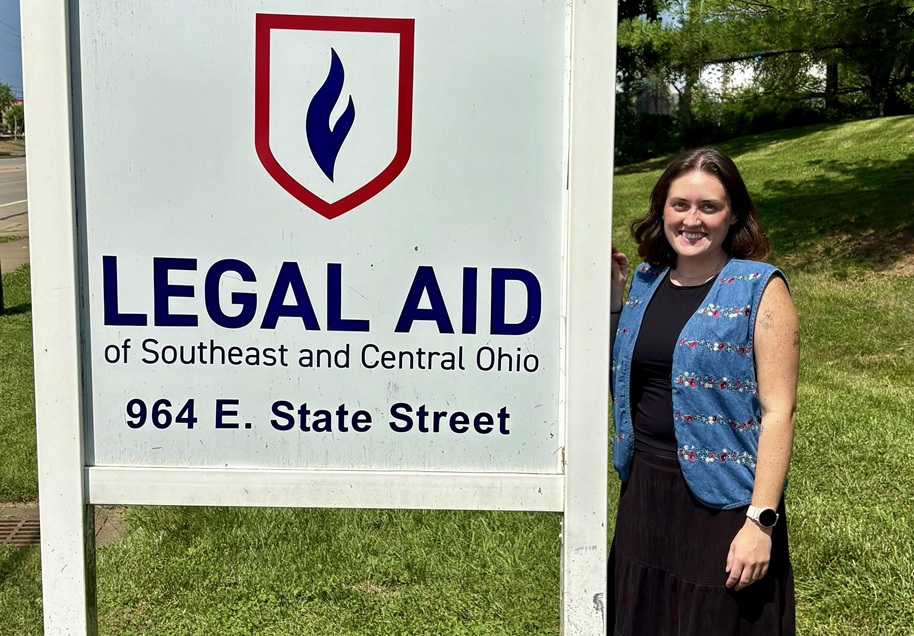
While Silliman learned the mechanics of the court, Ella Pelton and Lilly Garner were on the front lines of access to justice. The two political science students interned at Legal Aid of Southeast and Central Ohio (LASCO) in Athens, where they worked primarily in housing law through LASCO’s Tenant Advocacy Project. TAP helps low-income individuals facing eviction, and for Pelton, the work brought the law down to a human level.
“While in the courtroom, I had the opportunity to speak with clients one-on-one and work alongside attorneys to better understand the legal complexities behind each individual situation,” Pelton said. “These conversations with clients were some of the most meaningful parts of my internship. Hearing people’s stories and seeing how much a legal issue could impact their lives made the importance of access to justice feel much more real to me.”
Garner, who had just completed her bachelor’s degree, echoed this sentiment, noting that client interaction was the most meaningful part of her experience. “The law is incredibly complex, and the knowledge and resources necessary to navigate the legal system are often inaccessible to the people who need them most,” she said. “This is especially apparent in a community like Athens, where poverty can create additional barriers to accessing legal assistance.”
From Probate Court to the State’s Highest Legal Office
The CLJC internships span the entire spectrum of the legal system. In Jackson County, sophomore Marshall Smittle observed judges and magistrates in the Court of Common Pleas Juvenile and Probate Division. He accompanied bailiffs and probation officers to juvenile detention centers and read through various case files. It was in probate court, managing estates, adoptions, and guardianships, that Smittle found his fascination.
“The work done in probate court is some of the most interesting legal work I have gotten to witness so far,” Smittle said. “This court really surprised me in how incredibly important and fascinating it is in a way I had not thought of before.” Based on his experience, he developed a strong belief that every family deserves the support and resources needed to raise a child, often noting that children only find themselves in court due to inadequate access to necessary support systems.
At the other end of the state, junior Giana Ray spent her summer in Columbus at the Ohio Attorney General’s Office. As part of her internship in the Major Litigation Unit, she conducted research, prepared potential cases, and created presentations on professional development. She also explored her particular interest in elder justice, sitting down with the heads of the Elder Justice Unit and even attending the World Elder Abuse Convention.
“I was able to see career opportunities for my future after law school and made great connections,” Ray said. “Getting hands-on experience in the legal profession has given me valuable insight into the direct impact public service lawyers have.” Her experience solidified her plans to pursue a law degree and a career in social work, focusing on helping older adults and fighting elder abuse.
The Human Face of the Legal System in Cincinnati and Cambridge
Back in her hometown of Cincinnati, junior Sophia Maher interned at the Hamilton County Public Defender’s Office. Her work reviewing body camera footage, meeting with clients, and observing court proceedings completely changed her perception of public defenders. She saw firsthand the amount of work, advocacy, and compassion that goes into representing community members.
“One of the biggest takeaways from my experience was having my perception of public defenders and public defense work completely changed. Seeing firsthand the amount of work, advocacy and compassion that goes into representing members of the community was incredibly meaningful,” Maher said, “In particular, meeting juveniles navigating the court system stayed with me and reminded me of the importance of seeing the person behind every case.”
In a rural setting, sophomore Madison Peters interned at the Guernsey County Prosecutor’s Office in Cambridge. She spent her summer reviewing hundreds of case files to update information in compliance with Marsy’s Law and shadowed attorneys in court. The experience taught her about the importance of fair legal representation in a rural community.
“This internship taught me so much about the importance of fair legal representation in a rural community. "I learned that prosecution and victim advocacy not only affect the parties in a case but also bolster and protect the entire community we live in," Peters said. Her newfound interest lies in the intersection of law with education, copyright, and communications.”
These diverse experiences, from juvenile justice to civil liberties, were made possible by the generosity of Ohio University alumnae Leah Recht (’06) and Jennifer Stevens (’04), as well as a longtime friend of the University, Mary Stanley. Their support helps remove financial barriers, allowing students to pursue mission-driven internships that deepen their understanding of law and justice while making a tangible impact.
“These internships represent the very best of experiential learning,” said Larry Hayman, director of legal engagement and the Center for Law, Justice and Culture. “Our students spent the summer learning from judges, attorneys, legal aid advocates, public defenders, prosecutors and policymakers who generously invested their time and expertise in mentoring the next generation of legal professionals.”
As these students return to campus, they bring with them more than just a line on a resume. They carry a new perspective on the legal profession, a stronger sense of the kind of advocates they hope to become, and a firsthand understanding of how the law shapes the lives of real people every single day. That is the true measure of a summer well spent.
Worth a look

James Gates sues OpenAI alleging ChatGPT assisted wife’s plot
A North Carolina man has filed a lawsuit against OpenAI, alleging that its ChatGPT chatbot was used to...

Wyoming girls state swimming championships begin this Thursday
The Wyoming High School girls’ state swimming and diving championships kick off Thursday, Friday, and Saturday in Gillette....

Mitchell Robinson takes on new role as Celtics face early slump
Robinson's Rebound: A New Role for Boston's Center Seven games into the season, the Boston Celtics have their...

WVU Injury Update: Sieg, Weaver-Bomar Trending to Play at Texas Tech
West Virginia Mountaineers Get Key Injuy Boost: S Matt Sieg, WR Armoni Weaver-Bomar Trending to Play at Texas...