
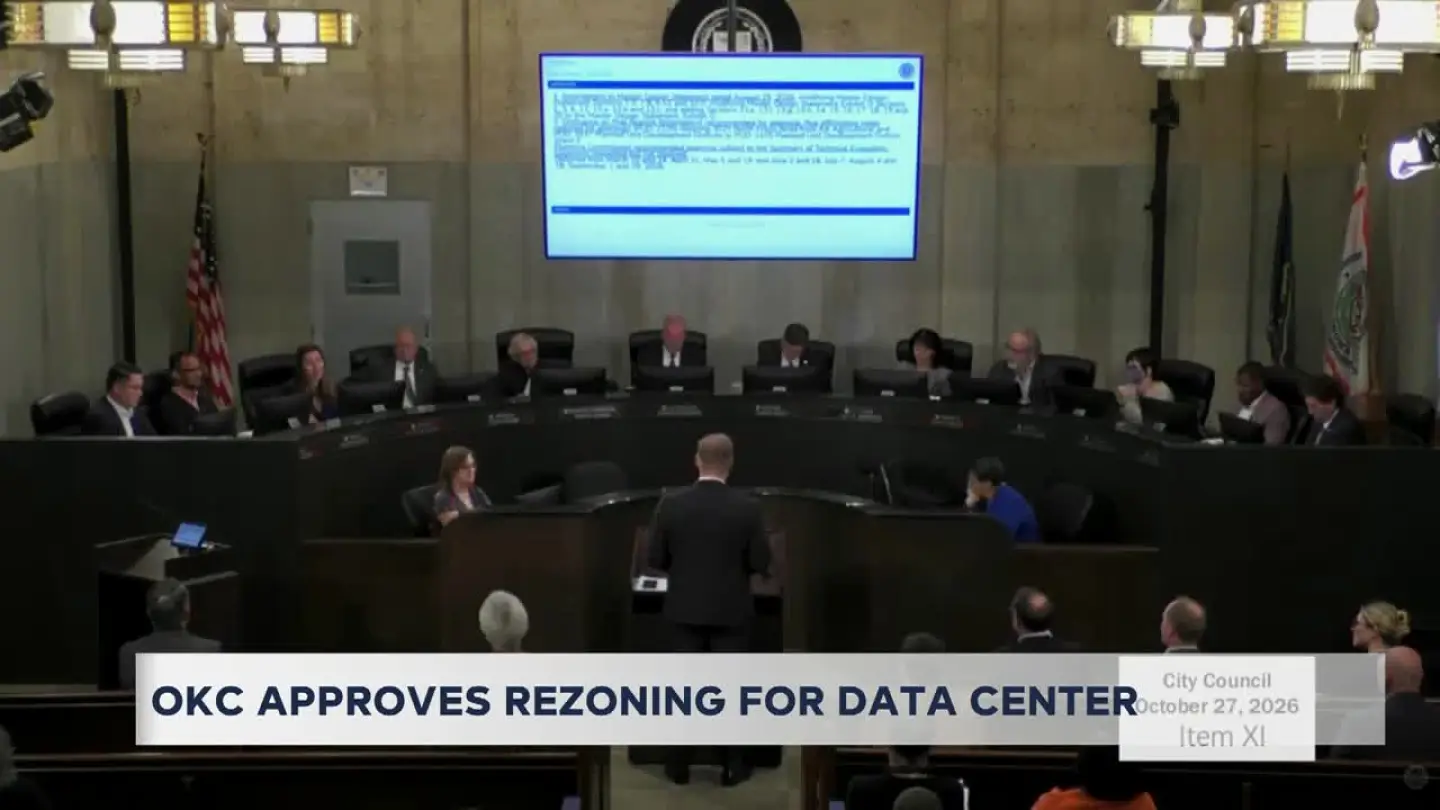
The Oklahoma City Council voted 6-3 on Tuesday to rezone land on the city’s west side to allow for a massive data center campus proposed by Beltline Energies. The project, described by one council member as a “once in a century development,” involves rezoning two parcels near Interstate 40 and Frisco Road from agricultural use to planned unit development districts.
This decision ends a cycle of deferrals that began in March, clearing the path for a project with an estimated $15 billion price tag. While the vote allows the developer to move forward with submitting plans and securing permits, the project is not yet a certainty. City officials stated that Beltline Energies must reach a community benefits agreement with the council before any building permits are issued, as reported by KOKH.
The $15 Billion Stakes for West Oklahoma City
The sheer scale of the investment created a deep divide among city leaders. Council member Katrina Avers, who lives near the proposed site, noted that the magnitude of the project demanded rigorous research. For Avers, the trade-off was a matter of land utility; she argued that the data center’s water requirements are no greater than what would be expected for 200 to 400 homes, whereas the same acreage could potentially house up to 4,000 residences.
Not everyone saw the investment as a win. Council member James Cooper expressed fierce opposition, stating, “There is no way I would support this. You couldn’t pay me money to support this.” This sentiment was echoed by local residents Paula Kelly and Stephanie Burdine, both of whom urged the council to reject the planned unit development (PUD) during the meeting.
The tension highlights a classic civic struggle: the promise of massive capital investment versus the preservation of agricultural land and neighborhood character.
City Secures Noise and Water Concessions for Data Center
To secure the 6-3 victory, the city had to negotiate specific concessions to appease neighbors concerned about the industrial nature of data centers. The most contentious issue was noise pollution. According to KOKH, the applicant originally held rights to a noise level of 75 decibels but agreed to reduce that limit to 55 decibels to align with the ambient noise levels of surrounding neighborhoods.
Beyond noise, the approval includes special conditions regarding electricity and water usage.
“This is such a big deal. It is a once in a century development,” council member Katrina Avers said during the proceedings.
The Moratorium and the ‘Open for Business’ Signal
The timing of this approval is a legal quirk that Mayor David Holt felt necessary to clarify. Oklahoma City currently has a moratorium on new data center projects in place until the end of this year. However, because Beltline Energies filed its application before the moratorium took effect, the project was grandfathered in.
Mayor Holt was explicit in his warning that this vote should not be interpreted as a policy shift or a green light for other tech giants to flood the region. He emphasized that the decision was a “stand-alone vote” reflecting a “very unique set of circumstances” and a year’s worth of specific negotiations.
What Happens Next for Beltline Energies
The road from rezoning to ribbon-cutting remains long. The project now enters the permitting phase, but the “community benefits agreement” remains the final major hurdle.
The project’s trajectory can be summarized by the following sequence of events:
- Rezoning Approval: Completed via two separate 6-3 votes on Tuesday.
- Plan Submission: Beltline Energies submits detailed architectural and engineering plans.
- Community Benefits Agreement: Negotiations between the developer and city council to finalize local offsets.
- Permitting: Issuance of building permits following the agreement.
While the $15 billion figure is staggering, the ultimate success of the campus depends on whether a massive industrial hub can truly coexist with the quiet, agricultural roots of West Oklahoma City.
Worth a look

Nelson Peltz Offers to Take Wendy’s Private as Shares Jump
Wendy’s shares jumped 15% at Wednesday's opening bell after activist investor Nelson Peltz launched a bid to take...

Indiana Parole Board recommends Governor Braun deny Jeffrey Weisheit clemency
The Indiana Parole Board has unanimously recommended that Mike Braun deny clemency to Jeffrey Weisheit, a death row...

Watershed Alliance Pivots to Neighborhood-Scale Stormwater Strategy
The Greater Chicago Watershed Alliance is pivoting toward a "neighborhood-scale" strategy to combat chronic urban flooding in Chicago's...

GJ Kinne: Texas State Facing Daunting Clash Against No. 20 Boise State
"I love this place," Texas State head coach G.J. Kinne told reporters Tuesday, shutting down speculation that he...