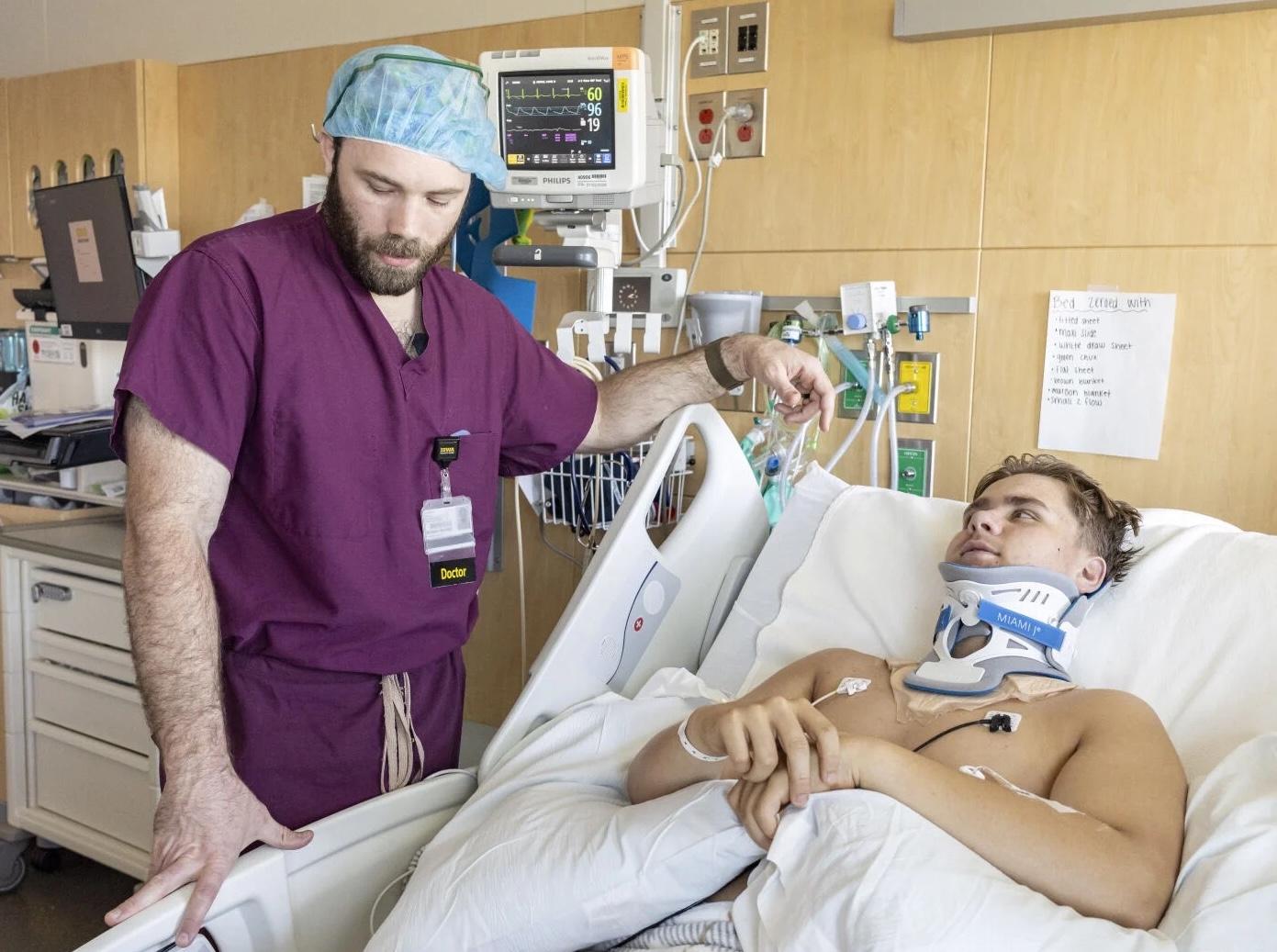
On May 3, 2026, a routine wrestling match in Cedar Rapids turned into a medical crisis when 15-year-old Layne Hearne was thrown headfirst to the mat.
The Ankeny high school athlete, just two weeks shy of his 16th birthday, suffered a fractured C6 vertebra and a dislocated C7 vertebra, leaving him motionless on the mat. According to University of Iowa Health Care, the injury was severe enough to cause an immediate loss of movement in his arms and legs, with only limited sensation remaining in his neck and torso.
The scene on the mat was harrowing for those watching. “He looked lifeless on the mat,” his mother, Jessica Simmons, recalled to University of Iowa Health Care. “In other times when he’s been dropped and injured, he’s still somewhat moving, but this time, he wasn’t moving at all.”
The situation changed trajectory due to the presence of Brandon Marshall, MD, an orthopedic resident physician with the University of Iowa Sports Medicine Outreach program. Marshall was providing medical coverage at the tournament, bringing a unique perspective to the emergency: he is a former competitive wrestler who participated in the 2024 Greco-Roman Olympic Trials.
“I was able to help put the pieces together not only on the clinical side, but on the wrestling side, too. Having seen similar injuries in the hospital before, I could quickly decide what to do. Everyone knew something was wrong, but they didn’t know how to proceed, and that was the part where I was really able to help, said Brandon Marshall, MD, an orthopedic resident physician at the University of Iowa.”
Marshall’s intervention was critical. He performed an initial exam and stabilized Hearne’s spine while guiding the athlete’s parents, Jessica Simmons and Laine Weston, and his coach, TJ Moen, through the immediate stabilization process.
This proximity of specialized care is a hallmark of the University of Iowa Sports Medicine Outreach initiative, which aims to place medical professionals at high-risk athletic events to mitigate the long-term impact of catastrophic injuries.
The stakes for such injuries in high school wrestling are high. While wrestling is a foundational sport in Iowa, the Centers for Disease Control and Prevention notes that cervical spine injuries, while rare, represent the most significant risk to long-term mobility for young athletes. The mechanical force of a takedown, when directed at the head or neck, can result in outcomes ranging from temporary stinger injuries to permanent neurological damage.
For Hearne, the realization that his injury was life-altering came quickly. “I tried to get up. I couldn’t get up,” Hearne said. “I knew something wasn’t right.”
The incident highlights the ongoing debate regarding the balance between athletic intensity and medical oversight in youth sports. While some critics argue that increased medical presence can lead to more frequent stoppages, proponents point to cases like Hearne’s as evidence that expert intervention is the difference between manageable recovery and lifelong disability.
By having a physician on the sidelines who understood the mechanics of the sport, the medical team was able to avoid the potentially dangerous movement of a patient with a spinal cord injury.
As the recovery process continues, the focus for Hearne and his family remains on the specialized care provided by the University of Iowa health system. The coordination between the event-side responders and the hospital’s orthopedic specialists remains a key factor in how such injuries are managed in the state.

Judge Sets March Date for Lindsay Clancy Retrial – Northeastern Global News
A Massachusetts judge scheduled March 29 as a possible retrial date for Lindsay Clancy on Monday, Northeastern Global...

State Housing Board Approves Low-Income Apartments That Cost Nearly $1 Million Each
The Oregon Housing Stability Council voted Oct. 2 to spend $30 million more on a subsidized apartment project,...

Planting Calendar & Schedule for Kansas City, MO – The Old Farmer’s Almanac
For gardeners in Kansas City, Missouri, success hinges on timing planting cycles around the region's specific frost dates...

Curt Cignetti Defends Indiana Resume Against CFP Criticism
Indiana head coach Curt Cignetti says the ongoing criticism regarding his team's schedule serves as a primary motivator...