
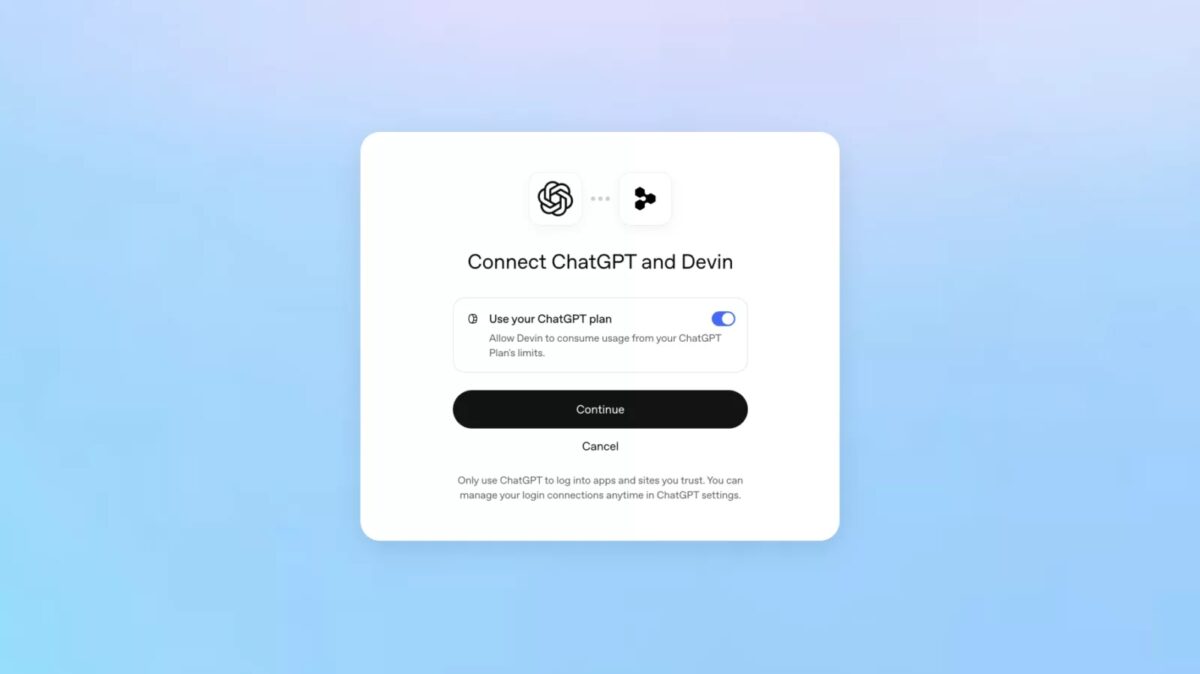
OpenAI has introduced a sign-in feature allowing ChatGPT Plus and Pro subscribers to use their accounts and subscription allowances across 16 third-party developer and productivity tools without generating API keys. The rollout places OpenAI identity inside external software ecosystems while the company expands its consumer AI offerings.
OpenAI rolled out Sign in with ChatGPT
for external software tools on Tuesday at the annual DevDay developer conference in San Francisco, giving users a way to log into participating services using their ChatGPT credentials. The system moves ChatGPT accounts far beyond OpenAI’s own website.
How Login Standards and Subscription Allowances Operate
The login feature relies on established standards like OAuth 2.0 and OpenID Connect. For a standard login, third-party apps receive a user’s name, email address, and profile picture. OpenAI logs account identifiers, app details, IP addresses, device IDs, and security signals to handle authentication and prevent fraud.

ChatGPT Plus and Pro subscribers can toggle a setting that bills AI requests directly to their existing plan. Users can assign separate limits for each app to avoid unexpectedly exhausting their allowance, after which usage halts rather than switching automatically to the app’s own billing.
- Cognition, known for its coding assistant Devin
- Notion, which integrates workplace software with AI tools
- Vercel, supporting developers building and deploying web applications
- Other launch partners including Lovable, OpenClaw, T3, Dactyl, Amp, Kilo Code, OpenCode, and Warp
Sam Altman’s Keynote and Protests at DevDay
OpenAI CEO Sam Altman spoke before roughly 2,500 developers gathered on the shores of the San Francisco Bay. We want to help people discover what you build and connect you with new customers,
Altman told attendees during his keynote address. Alongside the login feature, the company launched continuous AI agents called dots
and a less expensive model named GPT-6.1 Sol, which was described as nearly as powerful as GPT-6 Astra at one-fifth the price. Regulatory hurdles currently prevent individual users in Switzerland, the United Kingdom, and the European Union from accessing dots—which remain restricted to paid subscribers—though OpenAI is working to clear these roadblocks.
Outside the conference venue, approximately thirty protesters demonstrated with chants and demands that OpenAI drop its contracts with the U.S. military and Immigration and Customs Enforcement. Inside, Altman rejected comparisons between the artificial intelligence era and the Industrial Revolution, arguing that society should be more like the Renaissance
while handling agentic software capable of completing tasks like managing calendars and sorting email.
Anthropic Revenue Exceeds OpenAI as Leaders Pledge Safety
OpenAI president and cofounder Greg Brockman was present on Tuesday at a White House gathering where President Donald Trump announced that leading artificial intelligence figures had accepted a morally binding
pledge to develop AI responsibly with proper safety measures. While OpenAI has a massive weekly user base of 1.2 billion people, rival Anthropic overtook OpenAI in second-quarter revenue by generating $11.6 billion compared to OpenAI’s $6.7 billion, according to the Wall Street Journal.
“I want OpenAI to be a public company someday, but I don’t want to put additional pressure right now.”
Sam Altman, CEO of OpenAI
Altman told reporters that the company is investing more in safety, security, alignment, monitoring
after a series of security incidents forced OpenAI to temporarily halt the development of certain models. Meanwhile, OpenAI is seeking to raise at least $30 billion from private investors in a deal that could push its valuation to around $1.4 trillion.

Apple Schedules iPhone Duo for October as iFixit Rates AirPods 5 Low
Apple's foldable iPhone Duo is scheduled to arrive in October, while the AirPods 5 have scored 2 out...
Nvidia Launches 64GB DGX Spark AI Workstation Starting at $4,999
Nvidia has launched a 64GB configuration of its DGX Spark mini workstation starting at $4,999, arriving October 23...

IKEA and Xbox Launch YXSTABY Gaming Furniture Collection
IKEA and Xbox launched the nine-piece YXSTABY gaming furniture collection, combining original controller-inspired designs with everyday home goods.

Amazon Explores $8B Nvidia Chip Deal Via Special-Purpose Vehicle
Amazon is exploring a plan to offload approximately $8 billion in advanced Nvidia Corp. chips into a special-purpose...