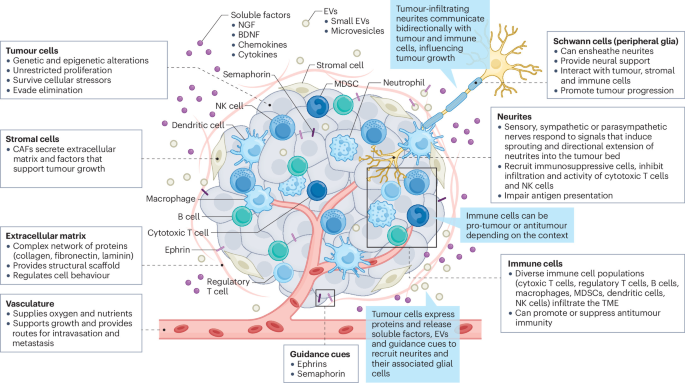
Peripheral nerves have moved from a footnote in cancer biology to a targetable driver of tumor growth, metastasis and treatment resistance, Nature reported.
- Nerves infiltrate tumors across multiple cancer types and actively regulate progression.
- Sensory and autonomic fibers form functional synapses with cancer cells in pancreatic, gastric and lung malignancies.
- Denervation or neurotransmitter blockade slows tumor growth in preclinical models.
- Nerve–cancer crosstalk suppresses anti-tumor immunity and drives resistance to checkpoint inhibitors.
From observation to mechanism
Pathologists noted nerves inside tumors as early as 1897, when H. H. Young used methylene blue vital staining to reveal their presence. Systematic immunohistochemical studies in the 1990s and 2000s confirmed innervation in prostate, liver and other malignancies, but the fibers were long regarded as passive bystanders.
That view shifted in 2013, when Magnon et al. showed sympathetic nerves drive early prostate tumor growth while parasympathetic signaling promotes invasion and metastasis. A year later, Zhao et al. demonstrated that vagal denervation suppresses gastric tumorigenesis in multiple mouse models, establishing autonomic innervation as a functional driver rather than a consequence of cancer.
Direct synaptic connections
Recent work has uncovered structural and functional synapses between neurons and cancer cells. Venkatesh et al. found that neuronal activity fuels glioma progression through activity-dependent secretion of neuroligin-3. In 2025, Chen et al. provided the first evidence that a peripheral malignancy — pancreatic ductal adenocarcinoma — establishes glutamatergic pseudo-synapses with sensory neurons, signaling through a GRIN2D receptor axis to accelerate tumor growth. Perez-Pacheco et al. classified neuron subtypes innervating oral cancer.
Neurotransmitters as growth signals
Specific neurotransmitter pathways now link innervation to tumor biology. Balood et al. demonstrated that nociceptor-derived CGRP induces CD8+ T cell exhaustion, directly suppressing anti-tumor immunity. Restaino et al. implicated substance P–NK1R signaling in tumor cell growth and migration.
Immunotherapy resistance
Nerve–cancer interactions also shape response to immunotherapy. Chen et al. further linked psychological stress to increased tumor innervation and pancreatic cancer progression via extracellular vesicle transfer of RNA, connecting behavioral states to the tumor microenvironment.
Clinical translation begins
Early clinical correlates reinforce the preclinical data. Perez-Pacheco et al. classified neuron subtypes innervating oral cancer, a step toward nerve-targeted interventions. Restaino et al. showed tumor-associated genetic amplifications alter extracellular vesicle miRNA cargo, changing how tumors recruit nerves in head and neck cancer.
Keep reading

Tidal to Begin Removing All Fully AI-Generated Music Dec. 9
Tidal announced Tuesday it will remove every track identified as fully AI-generated from its catalog on December 9,...

Human Rights Watch Says Modi Government Systematically Weakened Independent Institutions
Human Rights Watch said Prime Minister Narendra Modi’s government has systematically weakened independent institutions over the past decade,...

Prabowo Gets Rare Recognition From Trump in Manila, Putin and Xi in Shenzhen
Indonesian President Prabowo Subianto secured rare simultaneous recognition from the leaders of the United States, Russia and China...

UN Warns HIV Infections May Rise by 2027 After Historic Low as Funding Cuts Threaten Progress
New HIV infections fell to a historic low of 1.2 million last year, yet the UN warns that...