Higgins Welcome Center on the Kingston Campus.
The talk is part of the URI Retired Faculty Association’s speaker series and sponsored by the URI Provost’s Office, with refreshments provided by Belmont Market, according to the university’s events calendar. Przymus, an associate professor of TESOL and Bilingual Education in the Feinstein College of Education and a founding member of URI’s Translanguaging Lab, will share research analyzing the use of more than 100 languages spoken in Rhode Island.
“For a state that measures only 37 by 48 miles, Rhode Island has a rich history of linguistic and cultural diversity,” Przymus said.
After English, the most commonly spoken languages include Spanish, Portuguese, and French, though residents speak languages ranging from Arabic to Yoruba. The project also notes the predominant Narragansett place names across the state.
The Translanguaging Lab has expanded its partnerships since the project’s announcement earlier this year. Collaborators now include La Conexión Latina in Newport, the International Charter School in Pawtucket, Brown University, the MET School in Providence, and T-Time Productions. MET high school students are creating social media posts about the state’s linguistic diversity using the lab’s map.
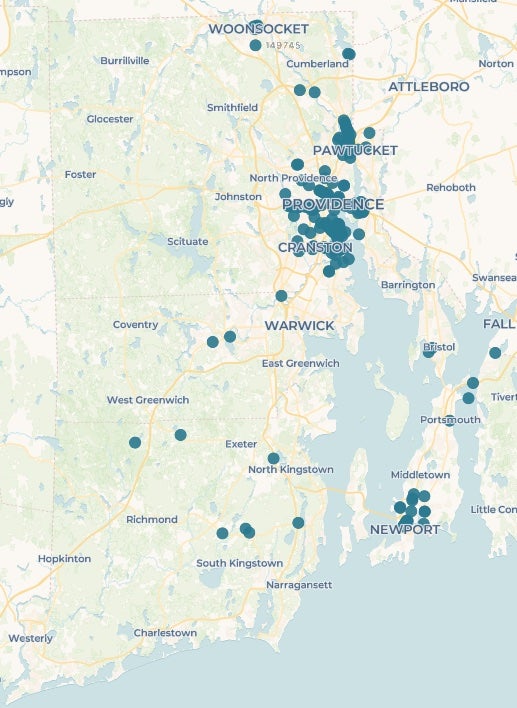
“The goal is to truly have a citizen scientist project,” Przymus said, “where anyone can be a sociolinguist by taking pictures of multilingual signs in their surroundings and uploading them to the map.”
Registration is appreciated but not required; contact [email protected]. For additional questions, contact [email protected]. Subscribe to Translanguaging Lab news by emailing [email protected].
URI’s Translanguaging Lab has developed novel methods to document and analyze the use of over 100 languages spoken in Rhode Island, according to the lab’s co-founder Steve Przymus. The lab’s geospatial mapping project aims to tell the rich cultural story of the state through its linguistic landscape.
Przymus said that the project has expanded since its announcement earlier this year with new partnerships across the state. Collaborators now include La Conexión Latina in Newport, the International Charter School in Pawtucket, Brown University, the MET School in Providence, and T-Time Productions.
Rhode Island’s linguistic density builds on its early role as a refuge: founded in 1636 by Roger Williams as a haven for religious liberty, the colony attracted dissenters and outcasts, establishing a pattern of diverse settlement within its 37-by-48-mile expanse.
The output includes TikToks designed to engage the public with the research findings.
Related reading

Trump Administration Proposes Rescinding Roadless Rule in Blue Mountains
In northeastern Blue Mountains, the Trump administration is pursuing policy changes that would expand roadbuilding and motorized access...

Kings Hosts Debate Keeping Sabonis, LaVine, Hunter Amid Murray’s Growth
Sacramento Kings radio hosts Allen Stiles and Kevin Gleason debated how the franchise should weigh rookie point guard...

Springfield Vintage to Close Storefront After Nov. 27, Shift to Pop-Up Model in 2027
"I've already bought my vintage camper so when I go to my Rock-A-Billy events where people wear their...

Fountain Hills Becomes Second Arizona City to Ban Automated License Plate Readers
Fountain Hills banned automated license plate readers on Nov. 17 in a 5-2 Town Council vote, becoming the...