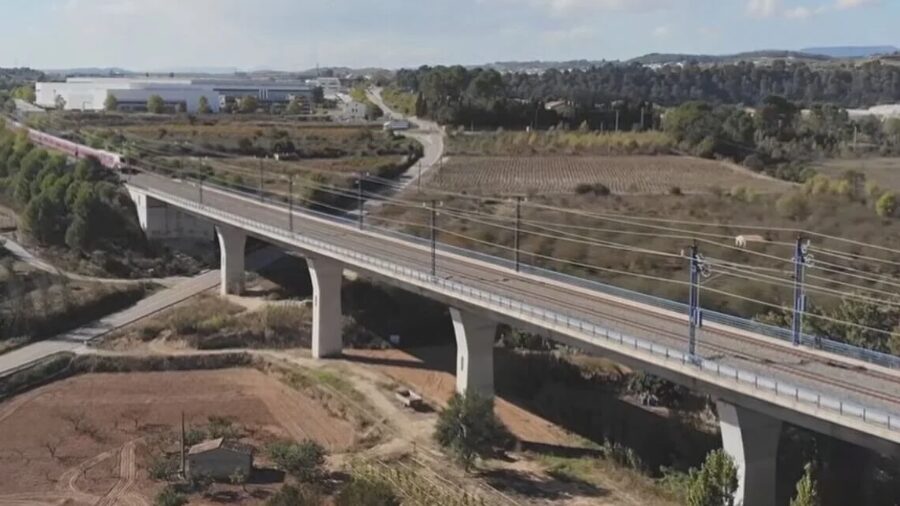
Seattle-Portland Bullet Train Plan Faces Scrutiny Over Cost and Feasibility
In a column for MyNorthwest.com, radio host Jake has delivered a scathing critique of the proposed high-speed rail line between Seattle and Portland, calling it a “hilariously horrible idea” that will burden taxpayers with an exorbitant price tag. Writing from his experience with high-speed rail in Europe, Jake argues that the $42 billion project, as proposed by the Washington State Department of Transportation, is financially unviable and ignores the sobering lessons of past public works failures.
The core of Jake’s argument hinges on a single, powerful point: cost. He posits that the best predictor of future behavior is past performance, and he points directly to California’s beleaguered high-speed rail project as a cautionary tale. “The best indicator of the future is past behavior, so look at California’s high-speed rail pipe dream,” he writes, MyNorthwest.com reported.
A Tale of Two Trains: California’s Cautionary Lesson
The California project, approved by voters in 2008 with a $9 billion budget, has since ballooned into a financial black hole. The original promise of 800 miles of track has been scaled back to a single 119-mile stretch, and the completion date has slipped from 2020 to the 2040s. Current cost estimates have surged to well over $200 billion. “When it was proposed in 2008, voters approved $9 billion to build it. That ballooned to $33 billion, and the 800 miles of promised track shrank to a more manageable focus of a single stretch of about 119 miles,” Jake explains. The project’s recent resignation of its CEO amidst questions about expenses and a track record of zero miles of completed rail only underscores the point.
Applying this pattern of cost escalation to the Washington state project, Jake is blunt. “Apply California’s track record to that number and the $42 billion estimate becomes $200 billion with ease, and likely closer to $300 billion, if it’s ever finished.”

This skepticism is not born in a vacuum for the region. Jake points directly to Sound Transit’s expansion, known as ST3. “We’ve already seen this movie in Washington,” he states. Voters approved ST3 with an estimated $53 billion, but current completion figures are projected to be near $200 billion. This local precedent, he argues, makes the idea of willingly signing up for another massive rail project seem almost incomprehensible to taxpayers.
Questions Train Ridership Projections
Beyond the staggering financial figures, Jake questions the fundamental premise that the train will be used enough to justify its existence. The project’s primary justification is a projection that 3 million more people will move to the region by 2050. While Jake considers this “optimistic” given the area’s high cost of living and low tax competitiveness, he challenges whether this population growth will translate into ridership.
He poses a series of practical questions: “How often will someone moving to a place along the I-5 corridor actually travel between Seattle and Portland? How many people would make that trip regularly enough to justify a taxpayer bill this size?” He contrasts this with the currently lackluster performance of the region’s light rail systems. “Look at light rail ridership, which isn’t great. Given train capacity and likely usage, the numbers just don’t add up.”
This leads to his most provocative conclusion: the project’s true purpose may not be transportation, but simply expenditure. “I’m left with one conclusion: for a lot of these projects, the point is simply for government to spend your money.”
He adds, “No, thank you.”
In the end, Jake offers a simple, personal alternative to the multi-billion-dollar public works gamble. “If I want to get to Portland, I’ll take my truck. It’s a lovely drive.”
Worth a look

Ealy Arrested on Assault, Peace Disturbance Charges
State Representative Anthony Ealy Jr. Arrested in Jefferson City After Threatening Disturbance A Kansas City-area lawmaker is currently...

Vikings Start Carson Wentz vs. Bills with Kyler Murray Out Due to Hamstring Injury
Carson Wentz will start at quarterback for the Minnesota Vikings against the Buffalo Bills on Monday night at...

Augusta Men’s Golf Wins Pearl at Kalauoa Invitational by 11 strokes
Augusta Men's Golf Secures 11-Stroke Victory at Pearl at Kalauoa Invitational The Augusta University men's golf team closed...
Family of Killed Boston Bicyclist Urges City Council for Safer Streets
We know all of you want to make sure no other family in Boston has to suffer the...