
Rain Halts Northeast South Dakota Harvest as Saturated Fields Threaten Soil Health
Recent autumn rainfall has brought field operations to a sudden standstill across northeast South Dakota, halting corn harvesting progress and creating mounting challenges for local producers. As combine wheels spin to a halt in wet acreage, farmers are grappling with soggy soils that heighten the risk of severe rutting and long-term compaction just weeks ahead of winter freeze-up.
Statewide harvest metrics show a regional slowdown. By contrast, local soybean harvesting has largely crossed the finish line, with 94 percent already completed across the state—sitting comfortably ahead of normal timelines.
Logistical Strain and Above-Average Yields Collide
In Roberts County, local farmer Jason Frerichs reported that roughly two inches of rain had fallen over the course of the week, with more precipitation lingering on the forecast. Operating heavy machinery in these saturated conditions has become an uphill battle.
“With the field conditions, it’s difficult to safely move around in terms of trucks and grain carts and everything else, but we’ll manage. We just have to remember to be patient,” Frerichs told Brownfield Ag News.
Despite the current logistical headaches, the underlying crop performance in the region has been remarkably strong. Frerichs noted that corn yields in his corner of the state have tracked above average, though regional weather variance played a definitive role. Summer heat waves dried down the crop efficiently—at times pushing conditions toward the dry side—before autumn rains reversed the trend and brought crucial moisture back into the profile.
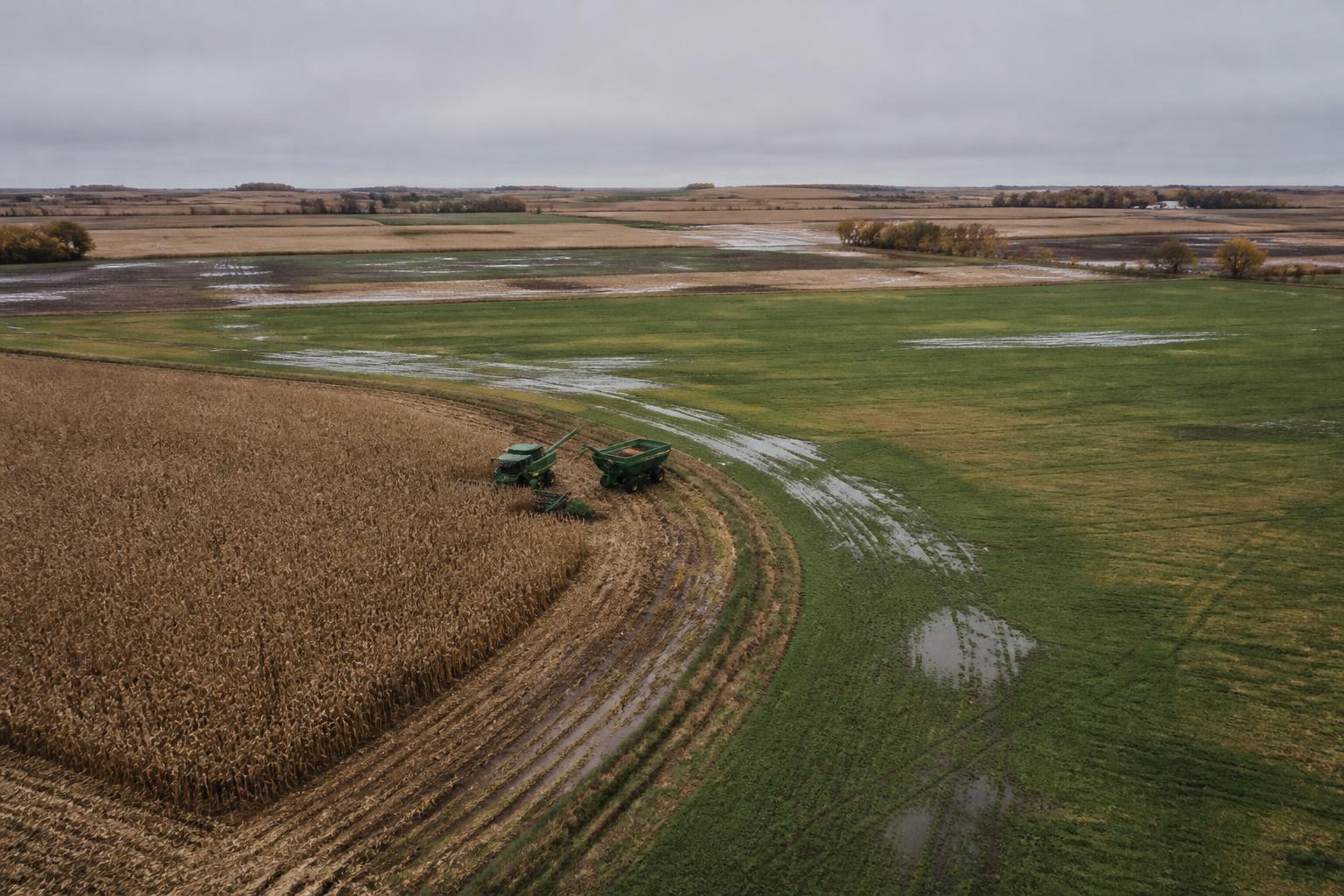
Once the skies clear and machinery can finally re-enter the acreage, producers face a secondary wave of labor. Fields will require targeted management to smooth out deep ruts and alleviate severe compaction before the soil freezes and preparation for spring planting begins.
Storage Bottlenecks and Regulatory Extensions
Beyond the immediate mud-bound delays, the regional harvest picture involves mounting pressure on local storage and logistics infrastructure. Reporting indicates that producers, particularly in southeastern pockets of the state, are confronting tight on-farm storage capacity. Because high-yielding volumes cannot always move directly to elevators—and because many growers prefer to hold inventory awaiting stronger market prices—operations are increasingly seeking creative temporary storage solutions.
To ease the administrative burden of these weather interruptions, state and federal authorities have spotlighted the availability of crop insurance harvest deadline extensions. Producers unable to finalize their field tasks due to saturated ground are being urged to consult directly with insurance providers regarding potential deadline adjustments, providing a critical buffer to protect coverage.
Meanwhile, broader market dynamics offer a measure of stability. Export demand for U.S. commodities, particularly ongoing soybean commitments, continues to track in line with expectations, offering financial support to growers holding inventory through late-season hurdles. Once fields dry out sufficiently to resume rolling combines, logistics managers anticipate a sudden surge in grain movement, making close coordination between producers and elevator facilities essential to preventing severe delivery bottlenecks.
Worth a look

Wilma Emmalee Austin of Huntsville, Arkansas Passes Away at 84
A Life of Connection in Northwest Arkansas Wilma Emmalee Austin, a longtime resident of Huntsville, Arkansas, passed away...
Election Day is Tuesday. Here’s where you can vote in Juneau. – KTOO
Alaska’s Juneau Votes in a Crucible of Change On Tuesday, November 2, 2026, voters in Juneau, Alaska, will...

Jury Convicts Little Rock Woman of Conspiracy to Commit Sex Trafficking of a Minor
Federal Jury Convicts Little Rock Woman in Sex Trafficking Conspiracy In a case that underscores the relentless efforts...

Women’s Basketball opens with Mississippi State in Starkville – University of North Alabama Athletics
North Alabama Women’s Basketball Faces SEC Powerhouse Mississippi State in Starkville The University of North Alabama women’s basketball...