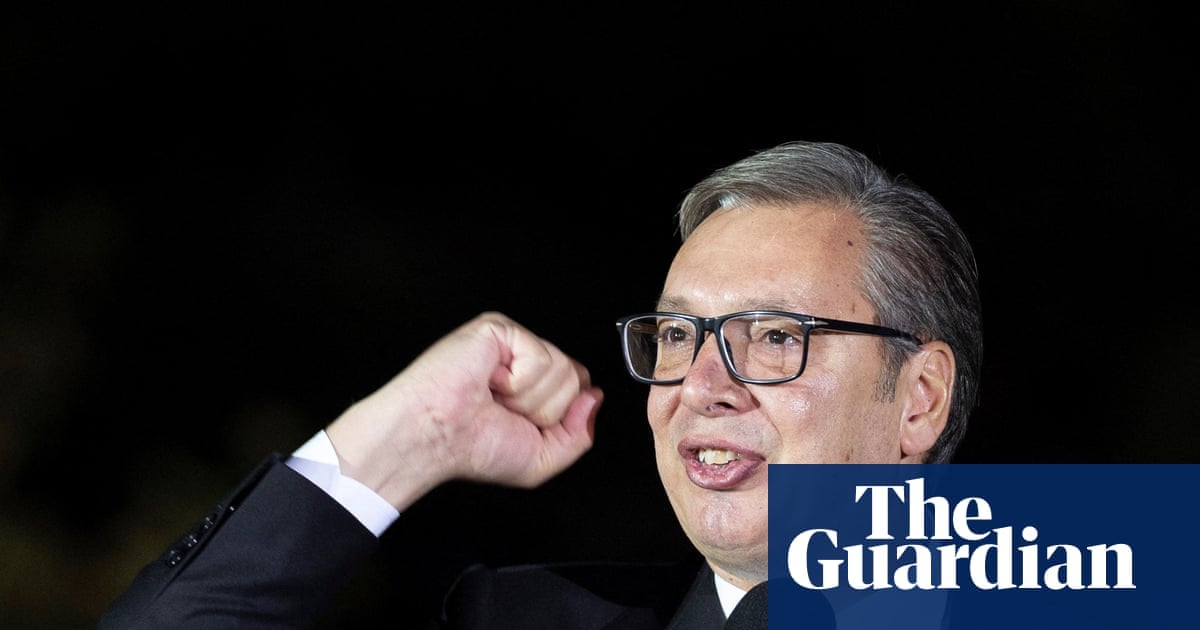
Serbia’s populist president, Aleksandar Vucic, resigned on Sunday to run for prime minister in an upcoming October parliamentary election. The snap ballot tests his 12-year political dominance following nearly two years of massive student-led anti-corruption protests triggered by a fatal railway station tragedy in Novi Sad.
Resignation and the Pivot to Parliament
Serbian President Aleksandar Vucic announced his resignation on Sunday, stepping down seven months before his second and final five-year presidential term was set to conclude in May 2027. Banned by the Serbian Constitution from seeking a third term, Vucic stepped down to lead his right-wing populist Serbian Progressive Party (SNS) into an early parliamentary election scheduled for October 25.
Hundreds of flag-waving supporters gathered outside the presidency building in central Belgrade on Sunday evening to watch his departure. Addressing the crowd moments before formally stepping down, Vucic marked the symbolic transition.
He added to the crowd, I have faithfully served you and my fatherland, Serbia … I am proud of what we have done together.
Vucic dissolved parliament earlier in the month on September 9, citing what he described as major political turbulence.
The Novi Sad Tragedy and Student-Led Upheaval
The political earthquake prompting Vucic’s resignation stems from nearly two years of sustained, youth-backed demonstrations across Serbia. The protests began in the wake of the November 1, 2024, train station canopy collapse in the northern city of Novi Sad, a structural failure that killed 16 people and was widely blamed on institutional corruption.
What started as demands for accountability from university students grew into a powerful anti-corruption movement aiming to unseat the SNS after 14 years in power. Vucic himself has served as either prime minister or president since 2014. The upcoming October ballot pits the ruling party against Students Win, a student-led anti-corruption movement, alongside European Serbia, an alliance of pro-Western opposition parties. The student-backed election list features professors, teachers, athletes, and experts from various fields who have toured the country on bicycles to promote the rule of law.
Ana Brnabic Steps In as Interim President
With Vucic’s departure, institutional control temporarily passes to a close ally. Outgoing Parliament Speaker Ana Brnabic assumes the role of acting president, as mandated by the Serbian Constitution. Brnabic, a former prime minister, holds all presidential powers—including commanding the military, signing legislation, and representing the state—with the explicit constitutional restriction that she cannot dissolve parliament or call new legislative elections.

Minutes before handing over power, Vucic exercised his constitutional authority to grant pardons to 49 individuals. Among them were 23 people connected directly to offenses stemming from the recent anti-government protests, including students and party loyalists.
Strict Constitutional Timelines for the Presidential Race
The formal submission of Vucic’s resignation triggers strict legal deadlines governing the next head of state. Under electoral law, a presidential vote must be held within 90 days of the resignation reaching the parliamentary registry office. Campaign periods must last between 30 and 60 days from the date the election is officially called.

Because the legal minimum for the campaign is 30 days and the absolute deadline for the vote falls on December 27, Brnabic must schedule the presidential election by November 27. Vucic stated that the first round of the presidential election is expected to take place by the end of December.
High Stakes and Mounting Political Tensions
Analysts note that the upcoming parliamentary vote functions essentially as a referendum on Vucic’s leadership, with polls showing a tight race between the incumbent populists and the student movement. While the prime minister’s office holds more formal power in Serbia’s political system, Vucic maintained vast personal authority throughout his presidential terms.
Independent watchdogs have raised concerns over the fairness of the transition. The Independent Bureau for Social Research (BIRODI) filed a complaint alleging that Vucic abused his presidential platform to campaign for his party during recent cross-country tours. Meanwhile, state authorities have cracked down on demonstrations with police detentions, while Vucic has publicly accused political opponents and critical media of conspiring to undermine the country under foreign influence.
Related reading

Xbox Project Helix Projected to Outperform PlayStation 6 in Raw Power
Hardware leaker KeplerL2 has revealed that next-generation graphics chips for the PlayStation 6 and Xbox Project Helix have...

AI Market Volatility Erases Trillions Before Rebound
Stock markets swung wildly over a recent two-week period, erasing and then recovering hundreds of billions of dollars...

Meta Unveils $1,299 VR Glasses With Lighter Design at Meta Connect
Meta unveiled its $1,299 Meta VR Glasses at the Connect conference on September 23, 2026, featuring a 100-gram...

TASK#STOMP Malware Uses Windows Tools to Steal Sensitive Enterprise Data
Security researchers have uncovered TASK#STOMP, a Windows backdoor using hidden PowerShell commands, VBScript installers, and scheduled tasks to...